

What if the reason you're working 70 hours a week isn't because you're busy, but because your business is actually designed to fail without you? It's a common frustration for many local founders. You might find yourself thinking, "my small business is not growing," while the weight of every decision feels heavier by the day. You're likely exhausted by static profit margins and a lack of clear systems.
We understand that feeling of being trapped. It's tough when you're the only one keeping the lights on. This article shows you the practical steps to break free from the owner’s trap and find hidden profits. We'll look at the tactical shifts needed to turn your operation into a well-oiled machine and reclaim your time for family life in Campbelltown or Liverpool.
Key Takeaways
- Learn why the "Owner’s Trap" makes you feel like my small business is not growing.
- Discover how to find hidden profits by looking closely at your current pricing and expenses.
- Focus on high-value clients and simple systems to improve your profit margins.
- See how a tactical 13-week sprint provides the on-site support needed to unstick your operations.
Why You’re Feeling Stuck: The "Owner’s Trap" in Small Business
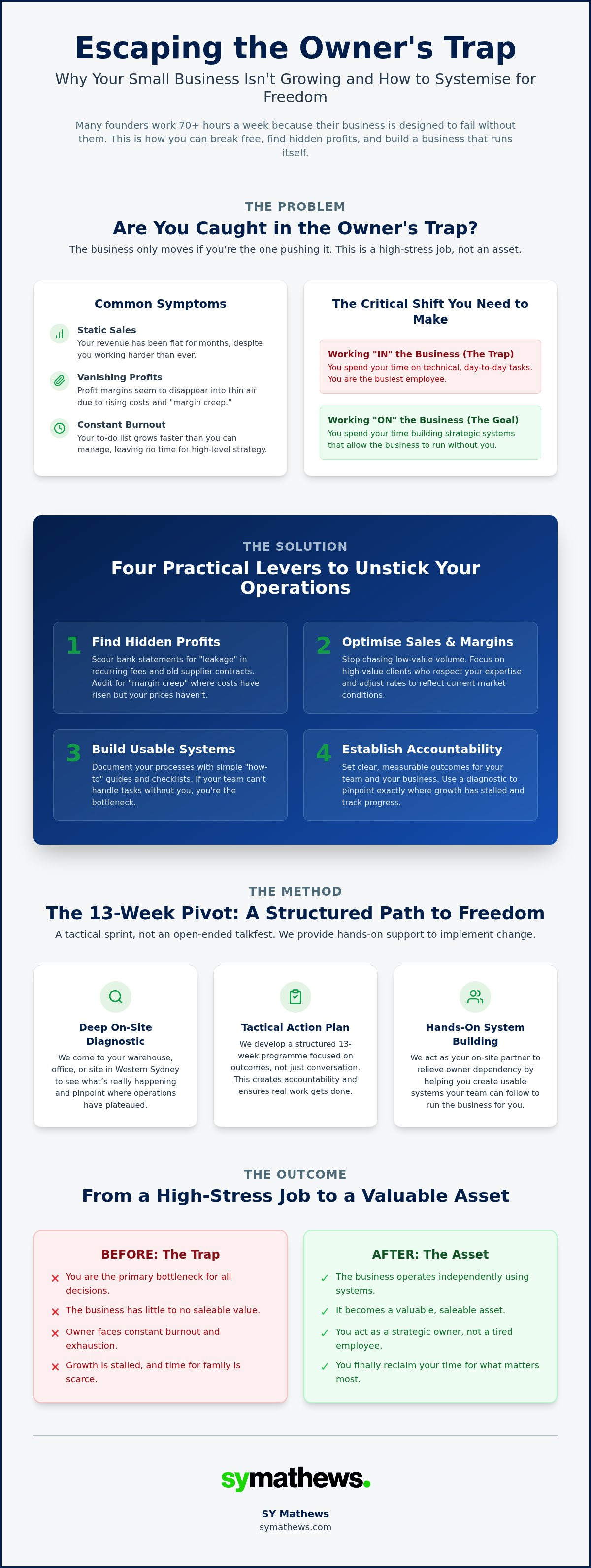
You feel like you're running on a treadmill. The business only moves if you're the one pushing it. This is the Owner's Trap. It happens when every operation depends on your daily presence. If you step away for a week, everything stops. You might be searching for why my small business is not growing, but the answer is often staring back in the mirror.
It's a frustrating spot to be in. You see common symptoms every day:
- Sales that haven't shifted in months.
- Profit margins that seem to vanish into thin air.
- A to-do list that grows faster than you can tick items off.
Most owners try to "work harder" to fix this. It's a mistake. Working more hours just leads to burnout. It doesn't build a better company. It just makes you a more tired employee of your own brand. Real growth requires a shift in how the gears turn behind the scenes.
The Difference Between a Job and a Business
A true business is an asset that operates independently of the owner. Most people don't actually have a business; they have a high-stress job they can't quit. You spend your time "working in" the business on technical tasks. You should be "working on" it by building strategic systems.
Without these systems, your company has very little saleable value in the Sydney market. Buyers want an engine that runs itself, not a role they have to fill. Getting started with creating a business plan is a vital step to map out this independence. It helps you stop being the bottleneck so you can finally move again.
Taking Action: Four Practical Levers to Unstick Your Operations
Pulling the right levers changes everything. If you are stuck thinking my small business is not growing, it's time to look under the hood. You don't need more hours. You need better mechanics. Start with these four tactical areas to get moving again.
- Lever 1: Hidden Profits. Scour your bank statements. Look for "leakage" in recurring fees and old supplier contracts. These small leaks sink big ships over time.
- Lever 2: Sales and Margins. Stop chasing volume for the sake of it. Focus on high-value clients who respect your expertise. Poor margin management is one of the common reasons for business failure.
- Lever 3: Usable Systems. Document your "how-to" guides. If your team can't handle the heavy lifting, you're the bottleneck. Simple checklists ensure the business runs well while you're away.
- Lever 4: Accountability. Set clear outcomes. Use a business diagnostic to see exactly where your growth has stalled.
How to Spot Hidden Profits Today
Audit your last three months of expenses for "margin creep." This happens when your costs rise, but your pricing stays flat. It's a silent profit killer. You can fix this by adjusting your rates to reflect current market conditions. Most loyal customers understand that quality requires fair pricing.
Try making a "stop-doing" list. Identify three tasks that don't directly lead to a sale or a finished job. Reclaim five hours this week by cutting these out. It's a fast way to find time for high-level strategy without adding to your burnout.
The 13-Week Pivot: A Structured Path for Sydney Owners
If you're stuck thinking my small business is not growing, you need a circuit breaker. Many coaching services offer open-ended, expensive talk. The SY Mathews 13-week programme is different. It is a tactical sprint designed specifically for Western Sydney business owners. We don't just send emails or talk over the phone. We provide dedicated on-site support in suburbs like Smithfield, Fairfield, and Parramatta.
Accountability is the missing piece for most solo operators. It's incredibly hard to stay disciplined when you're working 60 hours a week in the trenches. Professional guidance ensures you actually do the work that moves the needle when you feel like my small business is not growing. We act as your hands-on partner to relieve owner dependency and fix your systems.
What Happens When an Advisor Steps On-Site?
Our process starts with a deep diagnostic in your own workspace. We look at your warehouse, office, or site to see what's actually working and what's broken. By referencing the five stages of small business growth, we pinpoint exactly where your operations have plateaued. This helps us build a plan tailored to your current stage.
We take an outcome-based approach to every visit. This means we focus on clear, measurable objectives like improving sales margins or building usable systems your team can follow. A fresh set of eyes on your Minto or Ingleburn operations can find hidden profits you've simply walked past for years. You get a business that runs like a well-oiled machine while you finally reclaim time for your family.
Ready to Reclaim Your Business?
Escaping the owner's trap is about shifting from doing the work to building the machine. We've explored how identifying hidden profits and creating usable systems can change your daily reality. If you've spent months feeling like my small business is not growing, remember that the solution isn't just working harder. It's about changing the mechanics of your operations.
Our structured 13-week transformation programme provides dedicated on-site support across Western Sydney. We focus on tangible sales and margin growth to ensure your business finally works for you. Ready to unstick your business? Explore our 13-week advisory programme here.
You've built something great. Now it's time to make it run like a well-oiled machine so you can get back to what matters most. We're looking forward to seeing you move again.
Frequently Asked Questions
How do I know if I need a business advisor or just a new employee?
You need an advisor when the foundation of your operation is broken. If you feel like my small business is not growing despite hiring more hands, you likely need professional guidance to fix your strategy. An employee adds capacity to existing systems, but an advisor helps you build those systems. We ensure new staff actually solve your burnout instead of adding to your management load.
Can my small business really run without me in just 13 weeks?
Our 13-week programme is a tactical sprint designed to install the essential systems that reduce owner dependency. It's enough time to find hidden profits and document the core "how-to" guides for your team in Smithfield or Wetherill Park. While total independence takes time, this period is specifically structured to get the business functioning smoothly without your constant physical presence for every minor decision.
What is the difference between a business coach and a business advisor in Australia?
Business coaches in Australia often focus on mindset and personal motivation. SY Mathews acts as a business advisor, providing hands-on, tactical support directly at your site in Campbelltown or Liverpool. We focus on outcome-based solutions like improving sales margins and finding hidden profits. We don't just talk about goals; we help you build the actual systems to reach them.
How much time do I need to commit to a business improvement programme?
You'll need to commit enough time for our on-site visits and the implementation of new systems over the 13-week period. It's a focused investment of your energy to stop the cycle of working 70 hours a week. By dedicating a few hours each week to strategy and accountability, you'll eventually reclaim much more time for your family and personal life.

Article by
Sy Mathews
Sy Mathews is practical, down-to-earth and hands-on. He has owned and run businesses in Sydney and Melbourne at various times over the last fifty years, created, operated and sold them to larger companies in tourism, logistics, aviation, he understand the 'hands-on' of business ownership and the challenges it presents. He is motivated to assist owners to get out from under the burden of running and owning, into the freedom that independent business owners deserve to enjoy.
General information
Our articles are intended as general information. We provide mature, on-site advisors who can tailor solutions specifically for your business. We do not offer financial or legal advice, we recommend speaking to a specialist in those areas.


