
The cost of a business consultant in Sydney depends on the support you need. A one-off advisory session, an ongoing arrangement and a defined improvement program have different scopes and costs.
It’s reasonable to want a clear picture of the commitment before bringing in outside support. To compare the cost of a business consultant in Sydney, look beyond an hourly figure: consider the type of help, the work included and how progress will be measured.
This article explains common ways small business consulting is priced in Australia, including monthly retainers and individual advisory sessions. You’ll see what can affect the cost of a business consultant in Sydney, so you can compare the options with a clearer picture of what each is designed to do.
Key Takeaways
- Compare hourly, project-based and ongoing support by the work involved, not just the quoted format.
- Experience and specialisation can shape Sydney consulting rates, so match the adviser’s expertise to your business challenge.
- A monthly retainer suits ongoing guidance, while a single advisory session can help focus on a specific issue.
- Set a clear business goal before comparing options. It makes the scope and value of the support easier to assess.
How Much Does Small Business Consulting Cost in Australia?
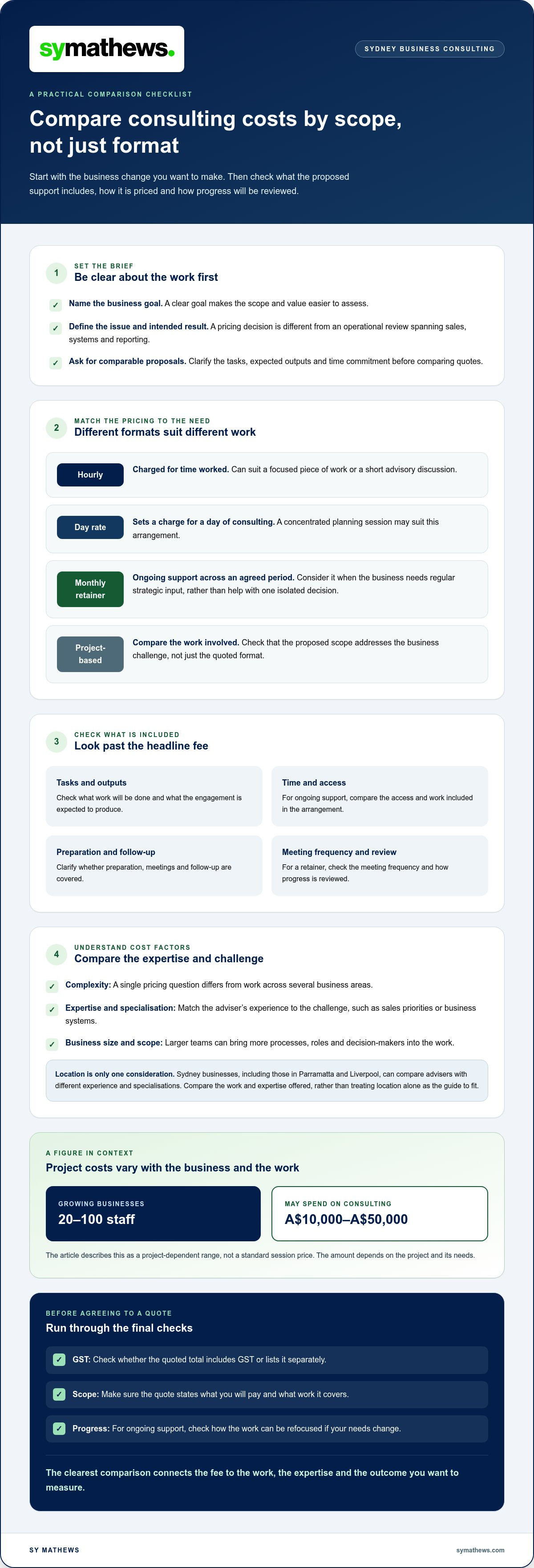
In Australia, consulting costs depend on the work, expertise and time involved. Hourly, day-rate and ongoing arrangements suit different needs.
Business consultant hourly rates
Hourly rates charge for an adviser’s time and can suit a focused piece of work. Rates vary with experience, specialisation and the challenge being addressed. Before comparing quotes, clarify the tasks, expected outputs and time commitment, then check that each proposal covers a similar scope.
Hourly rates across locations
Hourly rates reflect the consultant’s expertise and the local market. Sydney businesses, including those in Parramatta and Liverpool, may compare advisers with different specialisations and experience. For example, advice on a sales issue differs from specialist operations support. Compare the work and expertise offered, rather than treating location alone as a guide to the right fit.
Comparing hourly and day rates
Hourly pricing bills for time worked, while a day rate sets a charge for a day of consulting. A short advisory discussion may suit hourly billing; a concentrated planning session may suit a day rate. Clarify what each arrangement covers, including preparation, meetings and follow-up. This makes the scope and commitment easier to understand before agreeing to the work.
GST in quoted consulting fees
Consulting quotes may show a total that includes GST or list GST separately, so check how the amount is presented. The quote should make clear what you’ll pay and what work it covers. The exact figure depends on the scope, expertise and time involved, and is provided in a quote for your case. Compare GST treatment alongside the scope when reviewing proposals.
Monthly consulting retainers
A monthly retainer provides ongoing consulting support across an agreed period. It may suit a business that needs regular strategic input rather than help with one isolated decision. For example, an adviser might help an owner review sales priorities, identify margin pressures and keep agreed actions moving.
A retainer’s cost depends on the expertise, access and work included. Regular planning is different from hands-on support across several business challenges. Compare the scope, meeting frequency, preparation and follow-up, not just the monthly payment structure.
Regular one-to-one consulting gives an owner dedicated time to discuss decisions and progress. It can help turn business goals into practical actions, such as reviewing a sales plan, identifying barriers to profit and agreeing on the next priority.
Before agreeing to ongoing support, identify the business need. Note which decisions or tasks need regular attention, such as improving sales follow-through or addressing pressure on margins. Then compare those needs with the services and time set out in the proposal.
Published fee information can help set expectations, but a headline retainer figure doesn’t explain the full scope. Look for what the monthly arrangement covers and how progress is reviewed. If your needs change, discuss how the work can be refocused. That keeps the commitment connected to the business problem, rather than paying for support that no longer fits.
Consultation and advisory session costs
A focused session can address a defined question; a broader review can examine several parts of a business. The scope and expertise required depend on the challenge and the operation’s needs.
Factors affecting consulting costs
Consulting costs reflect the problem’s complexity, the adviser’s expertise and the work needed to address it. A discussion about one pricing decision differs from an operational review spanning sales, systems and reporting. A clear structure helps business owners compare what each engagement covers. Define the issue and the result you want, such as a measurable plan to improve sales follow-up. That gives the advisory work a practical focus.
Costs by business size
Business size affects consulting scope because larger teams can bring more processes, roles and decision-makers into the work. Growing Sydney businesses with 20 to 100 staff may spend A$10,000 to A$50,000 on consulting, depending on the project. That range reflects varied project needs, not a standard session price. For a smaller operation, a defined review may be more relevant than work across multiple teams. Match the structure to the issue owners need addressed.
Consultant experience and specialisation
Relevant expertise matters when a business faces a complex operational challenge. A review of business systems calls for different skills from advice on sales priorities. Compare the adviser’s experience with the problem and the work proposed.
Explore practical business insights
SY Mathews: Business advisory services
SY Mathews offers business advisory services for owners who need clearer direction and support putting plans into action. Its structured 13-week program focuses on four business objectives, including improving sales and margins while reducing reliance on the owner.
Consider advisory support when day-to-day demands leave little time to focus on growth, or when sales and marketing need a clearer strategy. Practical guidance, motivation and accountability can help keep agreed priorities moving.
For a business facing several connected challenges, a structured program offers a way to work through priorities over time. It is a practical next step when you want support that connects strategy with action.
Contact SY Mathews to discuss your business priorities.
Make your next business move count
The cost of a business consultant in Sydney is only one part of the decision. Start with the change you want to make, then check whether the proposed scope addresses it and how you’ll measure progress.
If your next move is about sharpening direction, improving sales or refining marketing, SY Mathews can help you focus on the work ahead. Bring the challenge you’re working through and the outcome you want to pursue. A grounded starting point can make the next steps feel clearer.
Small, considered steps can build momentum. You don’t need to have every answer before you begin.
Frequently Asked Questions
How do you know if it is worth it?
Consider engaging a consultant when a defined business problem has a measurable impact and outside expertise can help address it. Establish a baseline, such as missed enquiries, recurring delays or decisions that stall without the owner. Agree what progress would look like and how you’ll review it. If the expected benefit is unclear, sharpen the goal before committing.
Is it tax deductible?
Business advisory fees may be deductible expenses in Australia, depending on the purpose and circumstances. Keep the invoice and notes showing how the advice relates to business activity, then ask your tax adviser to assess your situation. This separates a general consideration from advice about your tax return.
What questions should Sydney businesses ask before paying?
Before agreeing to an engagement, clarify the deliverables, who will do the work and how progress will be measured. Check what meetings, preparation and follow-up are included, how changing priorities will be handled, what information your team needs to provide and which decisions remain yours. This helps you judge whether the proposal addresses the problem you want solved.
What are you actually paying for?
You’re paying for more than a conversation. An engagement may involve assessing a problem, analysing business information, recommending actions and supporting agreed work. The balance depends on the scope. For example, a review of customer enquiries may lead to a clearer follow-up process, while an operational review may identify workflow changes. Check that the written scope names the work and expected outputs.
What type of issues can a business consultant help with?
Consultants can help address unclear strategy, weak sales follow-up, pricing pressure and operational bottlenecks. They can also help shape business systems and accountability, so routine work doesn’t rely on the owner for every decision. This support is relevant to businesses in Campbelltown, Ingleburn, Minto, Liverpool, Parramatta, Milperra, Padstow, Revesby, Chullora, Smithfield, Wetherill Park, Fairfield, Regents Park, Lidcombe and Silverwater.

Article by
Sy Mathews
Sy Mathews is practical, down-to-earth and hands-on. He has owned and run businesses in Sydney and Melbourne at various times over the last fifty years, created, operated and sold them to larger companies in tourism, logistics, aviation, he understand the 'hands-on' of business ownership and the challenges it presents. He is motivated to assist owners to get out from under the burden of running and owning, into the freedom that independent business owners deserve to enjoy.
General information
Our articles are intended as general information. I personally work on-site with clients to provide tailored solutions specifically for the business.
I do not offer financial, investment or legal advice. If required, I can assist in recommending professionals in those areas. I take no fees or commissions from third parties, my recommendations are authentic and carry no hidden costs.


