

A business sale typically takes about 10 to 12 months. Australian owners are advised to start preparing 12 to 24 months before going to market. Knowing how to prepare business operations for sale means getting the business ready before buyers arrive, not just keeping it running until handover.
You’re right to focus on day-to-day operations. Selling a business can take months, and customers, staff and suppliers still need reliable service while you prepare records and respond to buyers.
This guide explains the sale timeline, the financial information buyers may review and how an audit can help build confidence. It also covers practical ways to document processes, share responsibility and maintain operations, so buyers can see how the business runs beyond its owner.
Key Takeaways
- Allow about 10 to 12 months for a sale, and start preparing 12 to 24 months before going to market.
- Organise at least three years of financial information. An audit can help build buyer confidence, but the key is clear, accurate records.
- Bring legal, tax, accounting and corporate finance advice together so financial, tax and transaction details are considered.
- Document key processes and share responsibilities across the team to help keep the business running smoothly during the sale.
How long does the business sale process typically take?
- Plan the timeline early. A business sale typically takes about 10 to 12 months, from choosing a buyer through to closing. Start preparing 12 to 24 months before going to market. Use that time to improve the valuation story and fix operational gaps before negotiations begin.
- Map potential successors. List internal options, such as family members or your management team, alongside external buyers. Trade buyers and private equity-backed buyers may have different goals and transition needs. Compare each option against your priorities for timing, legacy, continued involvement and risk.
- Organise due diligence records. Prepare current customer and supplier contracts, employee documents, intellectual property records, lease agreements and financial information. Have non-disclosure agreements ready. An organised file makes it easier for buyers to review the business and can reduce avoidable due diligence delays.
- Build accurate buyer information. Create an Information Memorandum covering investment highlights, the business model, management team, growth strategy and historical and forecast financial performance. Keep it truthful, accurate and complete. Leave customer names and full pricing structures out of this early document.
- Market the business and qualify interest. Define your buyer profile before approaching potential buyers. Assess their strategic fit, experience and ability to proceed, then share sensitive information in stages under confidentiality arrangements. A focused process helps you compare offers and manage negotiations without distracting the team.
- Plan employee communication and handover. The Fair Work Act 2009 requires an employer selling a business to give employees written notice that their employment is ending or payment instead of notice, according to the Federal Register of Legislation. Plan communications alongside contracts and handover tasks so operations continue smoothly.
Do financial statements need to be audited before a business is sold?
An audit can strengthen buyer confidence, and buyers generally request at least three years of financial information. Prepare clear records and address financial, legal and operational risks before the sale process begins.
-
Appoint professional advisers
Bring legal, tax, accounting and corporate finance advisers together early. Ask them to review the proposed sale structure, financial records, tax issues and operational risks. Broker, accountant and legal fees depend on the transaction, adviser scope and work required; fees are set through the relevant quote or engagement. Prepare three years of financial information, separate personal and business transactions, and list unusual or one-off expenses. Review employee records, supplier and customer contracts, leases, and any clauses restricting transfer or a change of control. Addressing gaps early helps avoid due diligence surprises.
-
Assess earnings quality and predictability
Review three to five years of EBITDA and explain changes in revenue, costs and cash flow. Identify non-recurring expenses and related-party transactions, then show how earnings may look under new ownership. Build credible forecasts for the next one to three years using reasonable assumptions. Avoid unexplained projections or last-minute operational changes that buyers may challenge. Document standard operating procedures, delegate key decisions, train employees, and record customer and supplier relationships. These steps reduce reliance on you and help the business keep working during the sale. A pre-sale review should also flag employee liabilities, lease issues and legal risks before buyers examine them.
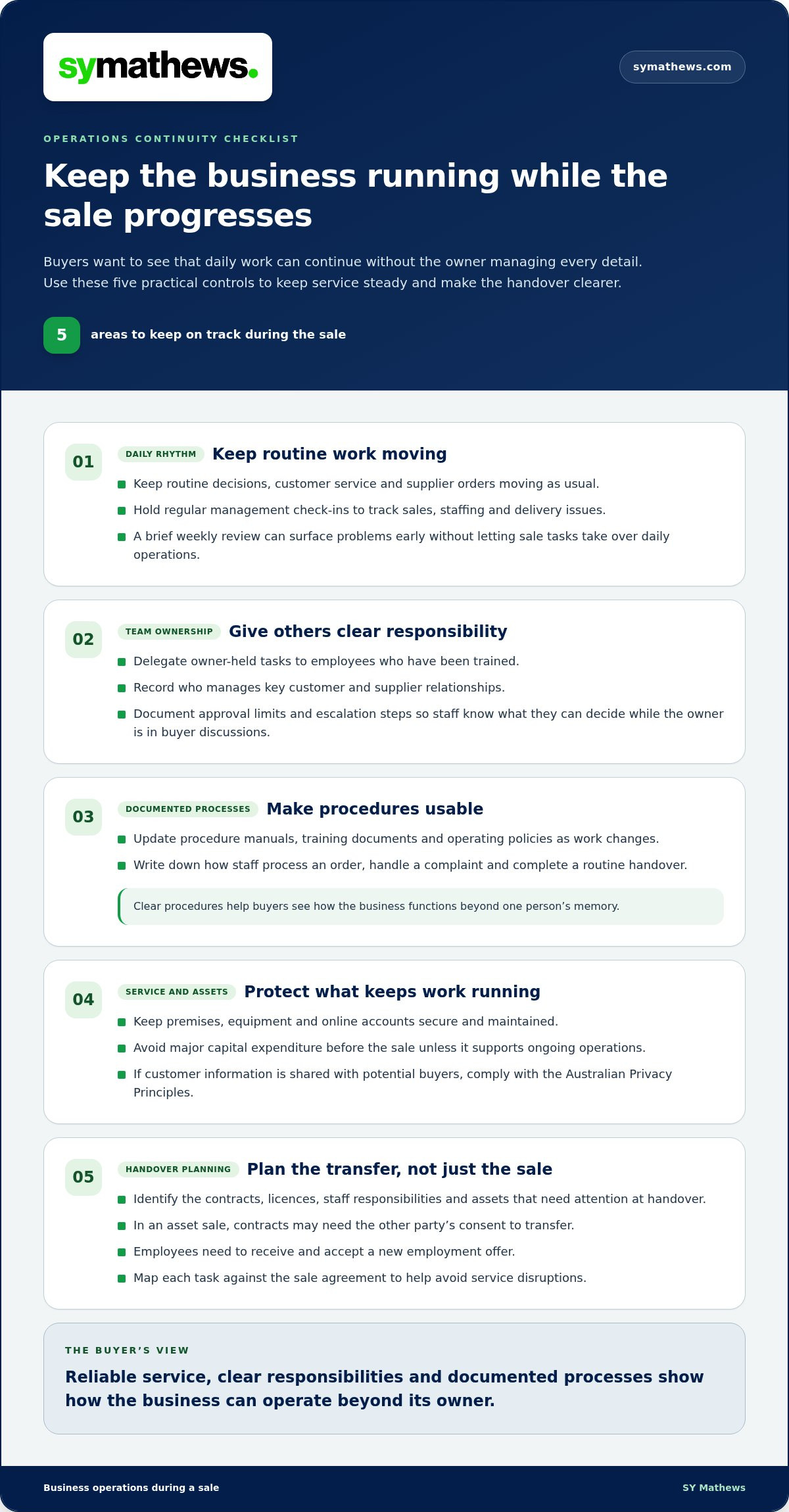
Keeping business operations running during a sale
Keep serving customers as the sale progresses. Buyers want to see that daily work can continue without the owner managing every detail.
- Set a steady operating rhythm. Keep routine decisions, customer service and supplier orders moving as usual. Hold regular management team check-ins to track sales, staffing and delivery issues. A brief weekly review can surface problems early without letting sale tasks take over daily operations.
- Give others clear responsibility. Delegate owner-held tasks to trained employees and record who manages key customer and supplier relationships. Document approval limits and escalation steps, so staff know what they can decide while owners are involved in buyer discussions.
- Keep processes usable. Update procedure manuals, training documents and operating policies as work changes. For example, document how staff process an order, handle a complaint and complete a routine handover. Buyers can then see how the business functions beyond one person’s memory.
- Protect service and assets. Keep premises, equipment and online accounts secure and maintained. Avoid major capital expenditure before the sale unless it supports ongoing operations. If customer information is shared with potential buyers, comply with the Australian Privacy Principles, as required by the Office of the Australian Information Commissioner.
- Plan the transfer, not just the sale. Identify which contracts, licences, staff responsibilities and assets need attention at handover. In an asset sale, contracts may require the other party’s consent to transfer, and employees need to receive and accept a new employment offer. Map each task against the sale agreement to help avoid service disruptions.
business systems and operational planning
SY Mathews: Business advisory services
SY Mathews provides business advisory services for owners preparing for a sale and working to strengthen day-to-day performance. Strategy can clarify priorities and focus improvement efforts. Sales and marketing services can support a more consistent approach to attracting and serving customers. Motivation can help owners and teams stay engaged while sale preparation runs alongside normal operations.
Consider this support when the business needs clearer direction, stronger sales activity or more consistent follow-through before going to market. SY Mathews’ practical business improvement work can complement your legal, tax and accounting advisers while keeping attention on operations and performance.
Contact SY Mathews or visit symathews.com to explore the next step.
Make your next move with a clear plan
Treat sale preparation as a way to build a business that can thrive beyond your ownership. A practical plan for how to prepare business operations for sale turns broad intentions into focused decisions about priorities, responsibilities and customer experience. Connect each improvement to the business you want a buyer to take over.
SY Mathews offers business advisory services, strategy, and sales and marketing services to help owners shape this work. These services can support clearer direction and stronger follow-through as you prepare the business for its next chapter.
Take the next step at a pace that works for you. A more sale-ready business starts with a clear decision and steady action.
Frequently Asked Questions
Does sale-readiness differ between an asset sale and a share sale?
Yes. An asset sale transfers selected assets and operations, while a share sale transfers the company, including its historical liabilities. For an asset sale, map which equipment, stock and contracts are included. For a share sale, organise records that explain the company’s history and existing obligations. The structure affects what buyers review and what must transfer.
Planning for Your Future Exit: What Type of Buyer Is Right for Your Business?
The right buyer depends on your priorities for the business after the sale. A family member or management team may support continuity; a trade buyer may value strategic fit. Private equity-backed buyers and employee ownership trusts are other possible paths. Consider your preferred legacy, ongoing involvement and risk tolerance before deciding which buyer profile fits.
What documents will a buyer examine during due diligence?
Buyers may examine financial and tax records, employee files, customer and supplier agreements, leases, intellectual property records and compliance documents. They may also review the customer base, disputes and day-to-day operations. Add explanations to records that need context, such as a change in a major customer relationship or a one-off cost.
What happens if due diligence identifies a problem?
A buyer may seek a lower price, extra warranties, a specific indemnity, a purchase-price retention or an earn-out. They could also request a condition before completion or a longer owner handover. Your response depends on the issue and its effect on the deal. Clear records and a practical explanation can help both parties assess the risk.
What steps should Australian business owners take to prepare operations for sale?
A practical way to prepare business operations for sale is to identify decisions only the owner makes, then delegate and document them. Update procedures, train staff and record key customer and supplier processes. Owners in Campbelltown, Ingleburn, Minto, Liverpool, Parramatta, Milperra, Padstow, Revesby, Chullora, Smithfield, Wetherill Park, Fairfield, Regents Park, Lidcombe and Silverwater can use the same approach.

Article by
Sy Mathews
Sy Mathews is practical, down-to-earth and hands-on. He has owned and run businesses in Sydney and Melbourne at various times over the last fifty years, created, operated and sold them to larger companies in tourism, logistics, aviation, he understand the 'hands-on' of business ownership and the challenges it presents. He is motivated to assist owners to get out from under the burden of running and owning, into the freedom that independent business owners deserve to enjoy.
General information
Our articles are intended as general information. I personally work on-site with clients to provide tailored solutions specifically for the business.
I do not offer financial, investment or legal advice. If required, I can assist in recommending professionals in those areas. I take no fees or commissions from third parties, my recommendations are authentic and carry no hidden costs.


