

An advisor for industrial businesses in Smithfield can bring an outside view to your operations, assess strengths and risks, and help clarify which decisions deserve attention first. They can help you weigh options, set business goals and spot practical opportunities to improve efficiency or support growth. The focus is on making the next steps clearer.
You may already know where the pressure points are. The tricky part is finding time to assess them properly while keeping the business moving. This article explains what an advisor can review, how they can help identify efficiencies, and what to consider when shaping the work and meeting schedule. You’ll also see how to prepare for an initial discussion, so the advice can stay grounded in your business’s priorities.
Key Takeaways
- Use an outside perspective to assess your business’s strengths, risks and growth opportunities.
- Map key workflows to spot bottlenecks and find practical ways to improve efficiency.
- Shape an advisory engagement around clear priorities, useful actions and a meeting rhythm that suits the work.
- Consider structured business advice when you need clearer strategy, stronger sales and marketing focus, or steady accountability.
Looking for a Business Advisor?
For an industrial business in Smithfield, an adviser can assess operations and help clarify important decisions. A search for an advisor for industrial businesses Smithfield can start with the work you need covered, such as production processes, logistics, sales or expansion planning.
Industrial Industry Experience
Manufacturers, exporters and logistics businesses each face distinct day-to-day challenges. A manufacturer may need to review production handovers, while an exporter may focus on sales processes or entering new markets. Logistics businesses can examine how work moves between teams and where delays occur. An advisor for industrial businesses Smithfield firms consider should understand these practical differences and connect advice to clear priorities.
Tailored Advice and Ongoing Support
Useful business advisory services start with your goals and the issues affecting your operation. An adviser can map a challenge, such as inconsistent sales or unclear responsibilities, then help set priorities and practical next steps. Ongoing support can keep those actions visible as conditions change. Look at how the engagement will be structured, what progress it reviews and how advice can adapt when priorities shift.
Adviser Specialisations and Support Options
Compare advisers by matching their focus to your main need. Strategy can clarify direction; operations advice can examine processes; growth support can shape expansion plans. Available services may include business diagnostics, planning and sales or marketing support. For local options, assess the adviser’s stated specialisations against the work your business needs.
For NSW grants or support programs, identify the activity you want supported, then compare it with each program’s purpose and eligibility criteria. The suitable option depends on the proposed activity and program requirements. Include application and reporting steps in your planning.
A business advisor can help business owners evaluate options and weigh risks and rewards when facing complex challenges or critical decisions. An external, impartial perspective can assess a company's strengths, weaknesses, opportunities and threats. Strategic planning can clarify goals, analyse market trends and identify growth opportunities.
Operational reviews and efficiencies
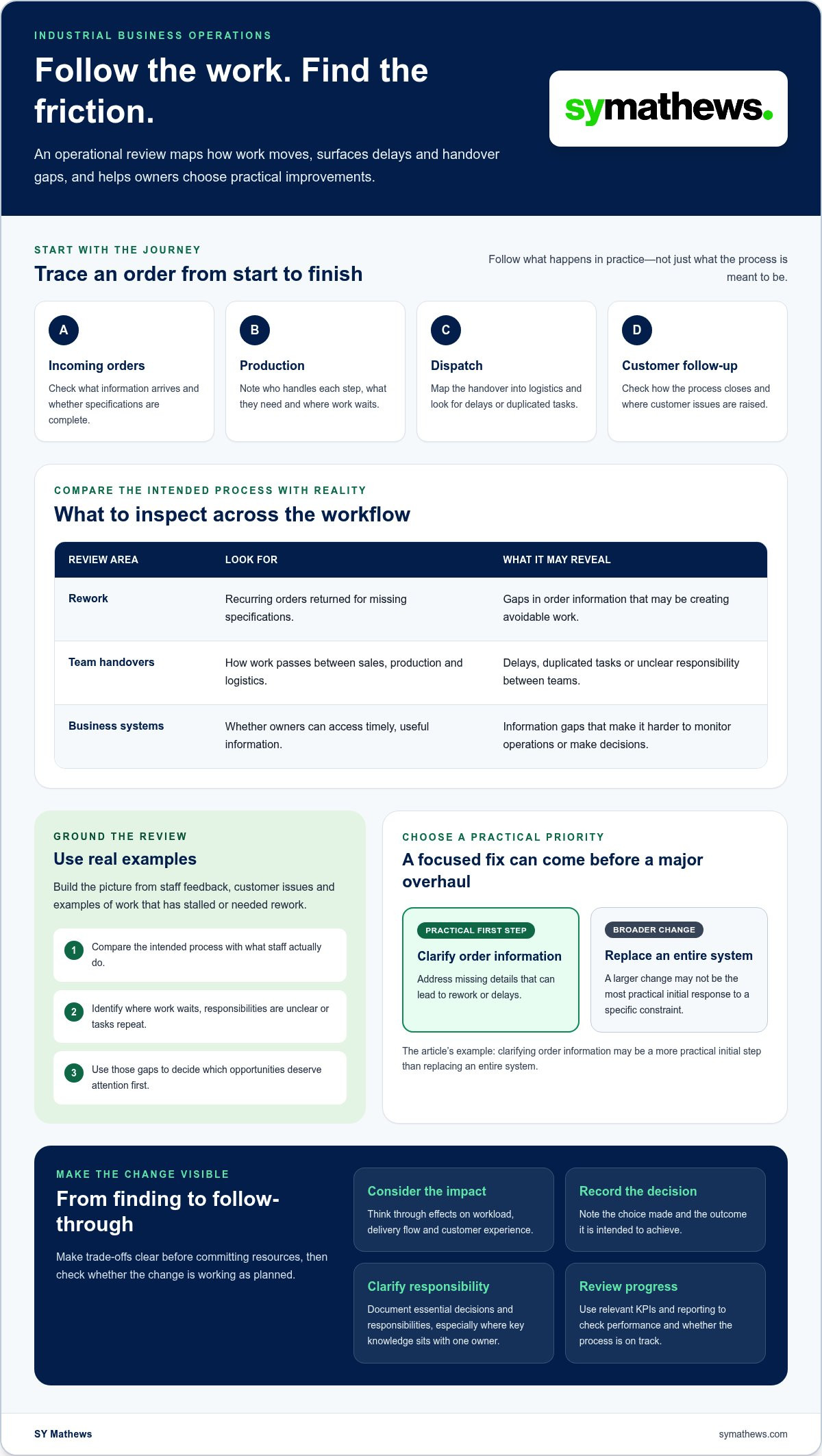
An operational review follows how work moves through your business, from incoming orders to production, dispatch and customer follow-up. This gives owners a clearer view of delays, duplicated tasks and unclear handovers.
Start with a process causing friction. For example, trace a manufacturing order from approval to delivery. Note who handles each step, what information they need and where work waits. Compare the intended process with what staff actually do. The gaps can reveal practical ways to simplify work or clarify responsibility, which can then become priorities for improvement.
- Review recurring rework, such as orders returned for missing specifications.
- Map handovers between sales, production and logistics teams.
- Check whether business systems give owners timely, useful information.
Use those observations to prioritise changes. A business diagnostic can help identify constraints and decide which opportunities deserve attention first. For instance, clarifying order information may be a more practical initial step than replacing an entire system. Ground the review in real examples, including staff feedback and customer issues, then track progress against clear KPIs.
Good decisions also depend on making trade-offs visible. Before committing resources, consider how a change could affect workload, delivery flow and customer experience. Keep records of the decision and its intended outcome, then review performance through relevant KPIs and reporting to see whether the new process is working as planned.
Review the business structure as well as daily tasks. If key knowledge sits with one owner, document essential decisions and responsibilities. That can support continuity and succession planning, while helping the team handle routine work with less reliance on informal instructions.
Business advisory engagement and meeting frequency
Set the engagement around a clear business need, such as improving cash flow or reviewing profitability. Begin with a short diagnostic discussion. Agree on the decisions to address, the information needed and how progress will be reviewed. For example, a manufacturer might focus on stock movement and production delays before considering broader changes.
Meeting frequency should match the pace of the work. A business facing a major expansion decision may need closer discussions while assessing options. A more stable project may suit meetings around agreed milestones. Set the rhythm with the adviser, then adjust it when priorities or operating conditions change.
Use each working session to turn discussion into action. Bring current business information, open decisions and updates on previous tasks. If cash flow is a concern, review payment timing, stock commitments and upcoming costs. Accounting records can inform that discussion, while an advisor helps connect the figures to practical business decisions.
Agree how actions will be recorded and who owns each next step. A simple action list can show the decision, responsible person, due point and progress. This helps business owners stay informed between meetings and makes it easier to see where the plan needs attention.
Before starting, clarify the adviser’s position, the scope of support and how the engagement may change. Ask how they assist with strategy, operations or growth decisions, and how they’ll keep advice relevant to your priorities. A clear structure helps you use meeting time well without adding unnecessary reporting tasks.
Explore business advisory support
SY Mathews: Business advisory services
SY Mathews provides business advisory services for owners who want clearer priorities and practical support to move forward. Its structured 13-week program is designed around four business objectives, with a focus on improving sales and margins while reducing reliance on the owner.
That support can suit an industrial business working through growth, sales challenges or day-to-day decision pressure. Strategy can help set direction, while sales and marketing services focus attention on reaching customers. Motivation and accountability can help keep agreed actions moving between discussions.
If you’re ready to explore a more focused plan for your business, contact SY Mathews.
Give your next business decision a clear starting point
Choosing an advisor for industrial businesses in Smithfield starts with the decision you need to make next. Bring one current priority, such as clarifying your direction or reaching the right customers. A focused conversation can help you decide whether further support fits the work ahead.
SY Mathews offers business advisory services, strategy, and sales and marketing services. These can help owners put attention on business direction and customer growth. Keep your next step simple: outline the decision, what’s making it difficult, and what a useful outcome would look like.
A clearer starting point can make the path forward feel more manageable.
Frequently Asked Questions
How can an adviser help with manufacturing efficiency, supply chains and workforce challenges?
An adviser can help trace where production, supplier handovers or team responsibilities are slowing work. For example, a Smithfield manufacturer could map how a delayed component affects scheduling, customer updates and staff workloads. Reviewing those links helps business owners choose a practical priority, clarify who owns each action, and develop systems that make disruptions easier to manage.

Article by
Sy Mathews
Sy Mathews is practical, down-to-earth and hands-on. He has owned and run businesses in Sydney and Melbourne at various times over the last fifty years, created, operated and sold them to larger companies in tourism, logistics, aviation, he understand the 'hands-on' of business ownership and the challenges it presents. He is motivated to assist owners to get out from under the burden of running and owning, into the freedom that independent business owners deserve to enjoy.
General information
Our articles are intended as general information. I personally work on-site with clients to provide tailored solutions specifically for the business.
I do not offer financial, investment or legal advice. If required, I can assist in recommending professionals in those areas. I take no fees or commissions from third parties, my recommendations are authentic and carry no hidden costs.


