
What if the first move when your business is losing money isn’t to cut costs or raise prices? If you’re asking, “my business is not profitable what to do”, start by checking what the numbers are really telling you. A loss can come from lower sales, shrinking margins, rising costs or cash arriving too late. Each cause calls for a different response.
It’s understandable to want a quick fix, but rushed changes can add pressure without solving the cause. First, verify the figures, pinpoint what’s driving the loss and choose practical actions. Then track whether those actions are working. If you need help turning the findings into a plan, structured, hands-on support can help you decide what to do next.
Key Takeaways
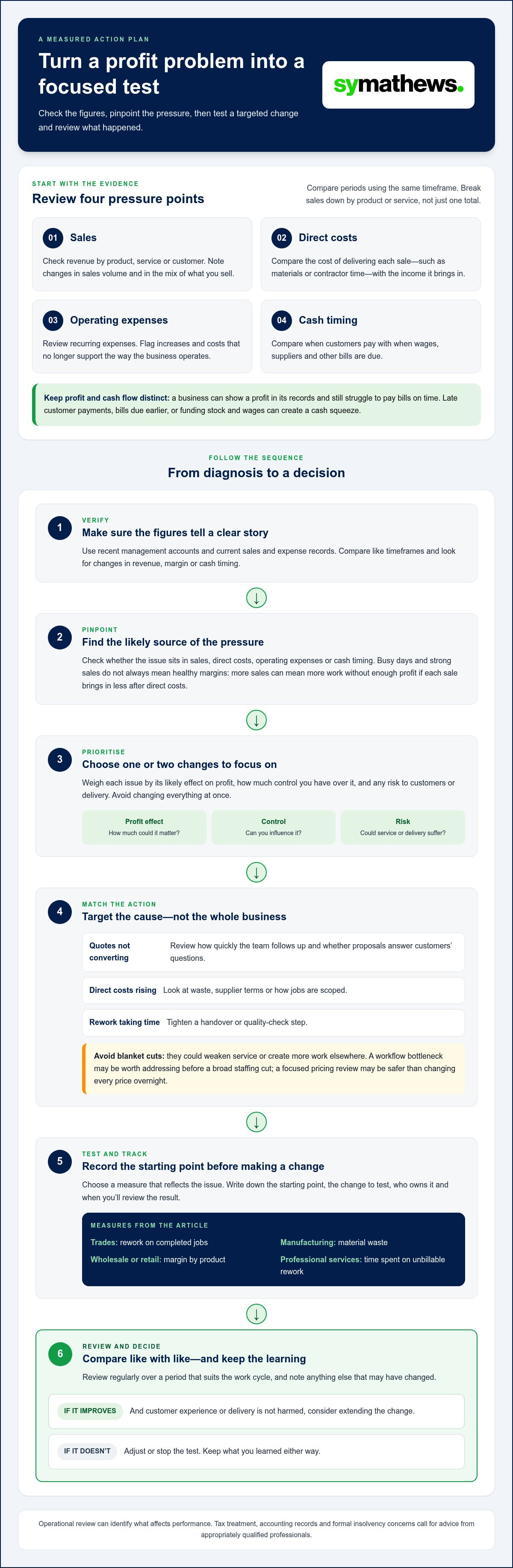
- If you’re asking “my business is not profitable what to do”, compare sales, direct costs, operating expenses and cash timing to find the pressure point.
- Choose one or two changes based on their likely effect on profit, how much control you have and any risk to customers or delivery.
- Test targeted adjustments to sales, pricing, costs or workflow instead of making broad cuts, then track the results.
- For eligible Western Sydney businesses, SY Mathews’ hands-on, on-site 13-week program provides structured support across diagnosis, sales and margins, operations and implementation.
Business Not Profitable: How to Spot What's Going Wrong
A loss can feel like a verdict on the whole business, but it’s a signal to investigate. First, work out whether profit is consistently weak or cash is temporarily tight because customers are paying late, bills fall due earlier, or stock and wages need funding. These issues are connected, but they’re not the same. A business can show a profit in its records and still struggle to pay bills on time.
Busy days and strong sales don’t always mean healthy margins. If each job, product or service brings in less after its direct costs, more sales can mean more work without enough profit to show for it. Compare sales with the profit margin to see whether revenue is turning into a return.
Which business figures should you review first?
Start with recent management accounts and current sales and expense records. Compare periods using the same timeframe, then look for changes in revenue, margin or cash timing. Break sales down by product or service rather than relying on one total. This can reveal whether the pressure is concentrated in a particular offering, comes from rising direct costs or sits across the wider cost base.
- Sales: Check revenue by product, service or customer. Note changes in sales volume and in the mix of what you sell.
- Direct costs: Compare the costs of delivering each sale, such as materials or contractor time, with the income it brings in.
- Operating expenses: Review recurring expenses. Flag increases and costs that no longer support the way the business operates.
- Cash timing: Compare when customers pay with when wages, suppliers and other bills are due. This can help separate a cash-flow squeeze from a profit problem.
Keep the questions in the right lane. An operational review can help identify what’s affecting performance, but tax treatment, accounting records and formal insolvency concerns call for advice from appropriately qualified professionals.
Business Not Profitable: A Measured Action Plan
Once you’ve found a likely cause, resist the urge to change everything at once. Prioritise one or two issues by asking how much they could affect profit, how much control you have over them and whether a change could harm customers or delivery. A workflow bottleneck may be worth addressing before considering a broad staffing cut. A focused pricing review may be safer than changing every price overnight.
Match the action to the problem. If quotes aren’t converting, review how quickly the team follows up and whether proposals answer customers’ questions. If direct costs are squeezing margins, look at waste, supplier terms or how jobs are scoped. If rework is taking too much time, tighten a handover or quality-check step. Avoid blanket cuts that could weaken service or create more work elsewhere.
How can you test a profit improvement without guessing?
Choose a measure that reflects the issue, such as quote conversion, gross margin on a product line or rework hours. Record the starting point, the change you’ll test, who owns it and when you’ll review the result. In trades, track rework on completed jobs. In manufacturing, monitor material waste. In wholesale or retail, compare margin by product. In professional services, measure time spent on unbillable rework.
Review the measure regularly over a period that suits the work cycle. Compare like with like and note anything else that may have changed. If the result improves without hurting customer experience or delivery, consider extending the change. If it doesn’t, adjust or stop the test. Keep the learning either way.
If you’re still asking “my business is not profitable what to do”, use the figures to set a clear next step rather than guessing. A structured improvement process can help turn priorities into tracked actions. Explore practical business improvement support when you’re ready to put a plan into action.
When should a Western Sydney business get hands-on help?
Outside perspective can help when the same performance problems keep returning, agreed actions stall, or you’re too caught up in daily work to follow through. If you’ve identified a likely issue but can’t turn it into a practical plan, structured support can bring clearer priorities and regular accountability.
Before seeking help, identify what’s getting in the way. Are the priorities unclear? Is there no time to test changes? Are sales, margins or operations still under pressure despite your efforts? If you’re asking, “my business is not profitable what to do”, hands-on support can connect the diagnosis to measurable actions. It can help you track progress without promising a particular result.
What does SY Mathews’ 13-week improvement program involve?
The program is designed for privately owned Western Sydney businesses with 5-50 employees and/or contractors in trades and construction, industrial and manufacturing, wholesale and distribution, retail, or professional services. It’s hands-on, on-site and commercially focused, with four phases that move from diagnosis to implementation:
- Weeks 1-2: Review business performance, identify constraints, establish KPIs and prioritise opportunities.
- Weeks 3-6: Improve the sales process, lead conversion, pricing structure and revenue consistency.
- Weeks 7-10: Identify operational bottlenecks, improve workflow and establish clearer accountability.
- Weeks 11-13: Consolidate improvements, optimise performance and prepare for the next growth stage.
Weekly working sessions, KPI tracking and reporting, accountability and implementation support keep the work focused on measurable performance improvement. The fixed fee for the 13-week program is $14,300.00, invoiced weekly or monthly in advance according to your cash-flow preference.
The free entry point is a 50-minute on-site diagnostic session. It assesses the business and quantifies additional profit potential, giving you information to consider when deciding on your next steps.
Give your next move a clear direction
If you’re still asking, “my business is not profitable what to do”, don’t let uncertainty lead to another round of changes without a way to judge them. Choose a practical next step, give it focused attention and measure what happens. A clearer view of the opportunity can help you decide where to put your time and energy.
SY Mathews brings more than 40 years of commercial experience. The founder has built and sold multiple businesses. On-site support focuses on putting actions into practice, with KPI tracking, reporting and accountability to keep the work connected to business performance.
For small businesses in Campbelltown, Ingleburn, Minto, Liverpool, Parramatta, Milperra, Padstow, Revesby, Chullora, Smithfield, Wetherill Park, Fairfield, Regents Park, Lidcombe and Silverwater, the 50-minute on-site diagnostic is a practical first step towards understanding what may be holding profit back.
Frequently Asked Questions
Can a business be busy but still not profitable?
Yes. Turnover measures sales, not the amount left after direct costs and operating expenses. A business can stay busy yet earn little from each job if materials, subcontracting or time costs rise faster than its selling price. Compare returns by job type, not just total invoices. This helps show whether extra work adds worthwhile profit or simply adds pressure.
Should I cut staff if my business is losing money?
Not as an automatic first response. First map labour costs against workload, delays, missed sales and customer service. If the team is waiting on materials or redoing work, fewer staff may not fix the underlying issue. Use current figures to understand each role, then weigh potential savings against delivery capacity, customer impact and employment obligations before making changes.
What is a break-even point in a small business?
A break-even point is the sales level where income covers the costs included in the calculation, with no profit or loss for that period. For a retailer, the result changes if you include rent and wages as fixed costs and stock as a variable cost. State the timeframe and assumptions clearly, then revisit them if prices or costs change.
How long does it take to improve an unprofitable business?
For small businesses in Campbelltown, Ingleburn, Minto, Liverpool, Parramatta, Milperra, Padstow, Revesby, Chullora, Smithfield, Wetherill Park, Fairfield, Regents Park, Lidcombe or Silverwater, SY Mathews’ structured program runs exactly 13 weeks, with KPI tracking and reporting to measure progress. If you’re asking “my business is not profitable what to do”, the time it takes to improve performance still depends on the cause and how quickly changes can be implemented.

Article by
Sy Mathews
Sy Mathews is practical, down-to-earth and hands-on. He has owned and run businesses in Sydney and Melbourne at various times over the last fifty years, created, operated and sold them to larger companies in tourism, logistics, aviation, he understand the 'hands-on' of business ownership and the challenges it presents. He is motivated to assist owners to get out from under the burden of running and owning, into the freedom that independent business owners deserve to enjoy.
General information
Our articles are intended as general information. I personally work on-site with clients to provide tailored solutions specifically for the business.
I do not offer financial, investment or legal advice. If required, I can assist in recommending professionals in those areas. I take no fees or commissions from third parties, my recommendations are authentic and carry no hidden costs.


