
What if your business actually made more money while you were down at the beach? Most Aussie owners think systemisation is just a dry small business operations manual template gathering dust on a digital shelf. It isn't. It is the difference between a job that owns you and a business that creates real freedom. You likely feel the weight of every decision. It is exhausting when things only go right when you are watching.
We know the feeling of watching profit leak through messy workflows and inconsistent results. This guide changes that. You will learn how to build usable systems that find hidden profits and let you finally take a weekend off without the business imploding. We are going to walk through how to create a business that runs itself. You deserve more time for family and the strategic growth you have been planning.
Key Takeaways
- Escape the owner trap by shifting from constant firefighting to repeatable, reliable results. It is about making your business run smoothly even when you aren't watching.
- Turn your messy workflows into a usable small business operations manual template. Simple checklists ensure your team delivers top-tier results every single time without you hovering.
- Plug the profit leaks by auditing where your time and money are currently disappearing. Finding these hidden margins is the fastest way to boost your bottom line.
- Embed new habits through a structured 13-week transformation. This focused approach ensures your systems actually stick so you can finally enjoy a well-earned weekend off.
Stop the Operational Drag: Why Systemising Matters Now
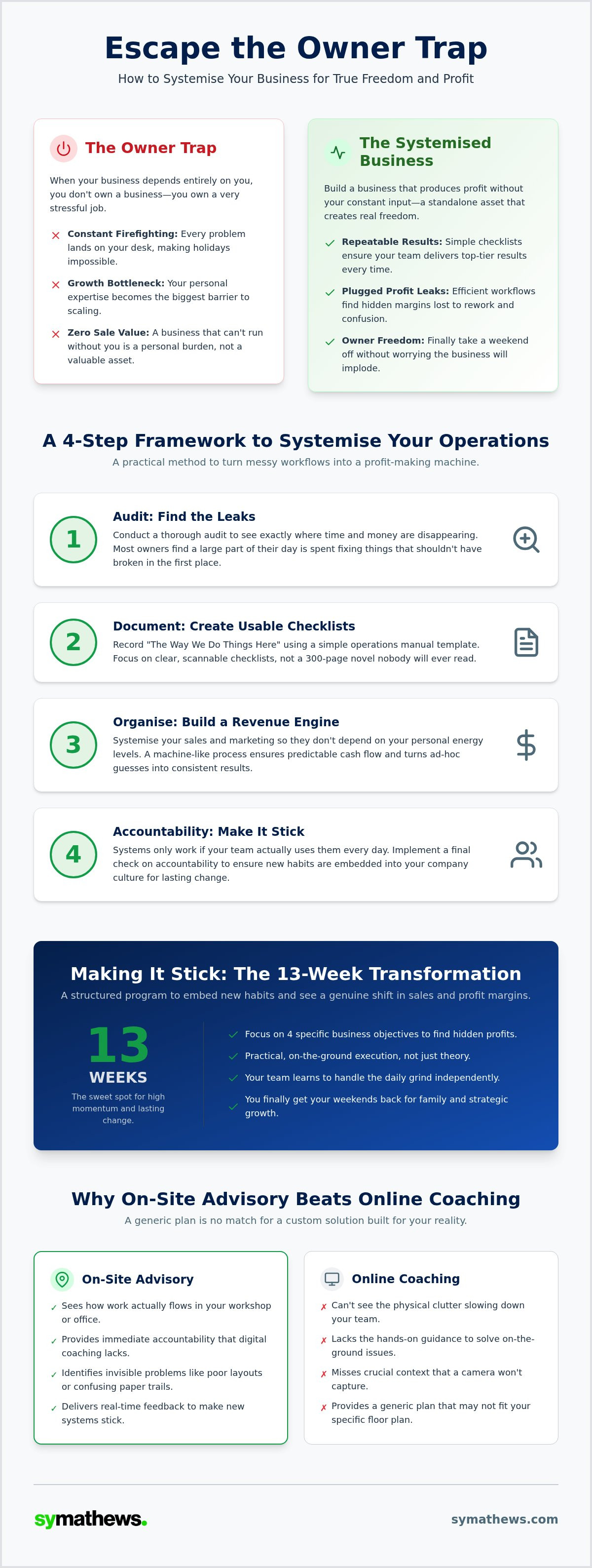
Systemising is often misunderstood. It isn't about creating a dusty 300-page binder that nobody reads. It is about building a repeatable way to get top-tier results every single time. When you use a smart small business operations manual template, you aren't just filing paperwork. You are building a machine. Most owners fall into the "Owner Trap". Your personal expertise becomes the biggest bottleneck to your growth. If you are the only one who can close a sale or fix a production glitch, you don't own a business. You own a very stressful job.
By formalising a Standard Operating Procedure (SOP), you turn your daily grind into a valuable asset. A systemised business is something you can eventually sell. It becomes a standalone entity that produces profit without your constant input. This shift moves you from being a weary operator to a confident owner.
The Real Cost of Owner Dependency
Think about the burnout factor. If you are the only person solving problems in Minto or Liverpool, your holiday is always one phone call away from ending. Owner dependency is the primary ceiling that stops local businesses from scaling their margins. Being indispensable feels good for the ego, but it is a massive liability for your long-term health. If the business implodes the moment you look away, it has no value without you. True freedom comes from workflows that work while you sleep. Check out our blog for more stories on how local owners use a small business operations manual template to break this cycle. You need a business that breathes on its own.
A 4-Step Framework to Systemise Your Operations
Forget the flashy SaaS subscriptions for a second. You don't need another monthly bill to fix your workflows. You need a practical method. Step one is a thorough audit. You have to see where time and money are leaking out. Most owners find that a chunk of their day is spent fixing things that shouldn't have broken in the first place. Step two is about documentation. Use a simple small business operations manual template to record "The Way We Do Things" here. Don't write a novel. Use checklists that your team will actually follow without you breathing down their necks.
Step three focuses on your revenue engine. Organise your sales and marketing systems so they don't rely on your personal energy levels. A machine-like sales process ensures consistent cash flow. Step four is the final check on accountability. Systems only work if your team actually uses them every day. If you want to see how this looks in practice, our SY Mathews blog has plenty of real-world examples from local workshops and offices.
Finding Hidden Profits Through Process
Efficiency is just another word for margin. Eliminate redundant steps in your service delivery to keep more of every dollar. Messy workflows are quiet profit killers. By using a small business operations manual template to trim the fat, you find margin previously lost to rework or confusion. It turns sales from ad-hoc guesses into a predictable result. A quick business diagnostic can show you exactly where to start.
Making It Stick: The 13-Week Transformation
Real operational change requires a structured approach. You can't just hand over a small business operations manual template and hope for the best. It takes a 13-week program to embed new habits into your culture. This timeframe is the sweet spot. It's long enough to see a genuine shift in your sales and profit margins, yet short enough to keep the momentum high. During this period, we focus on four specific business objectives to find hidden profits that are usually buried under messy paperwork. By the end, your team handles the daily grind, and you finally get your weekends back. This isn't about theory. It's about practical, on-the-ground execution that creates lasting owner freedom. You start to see the business as a valuable asset rather than a personal burden.
Why On-Site Advisory Beats Online Coaching
An advisor on a Zoom call can't see the clutter slowing down your team in Wetherill Park or Smithfield. On-site support provides immediate accountability that digital coaching simply lacks. We visit your workshop or office in suburbs like Parramatta and Campbelltown to see how work actually flows. This hands-on guidance identifies invisible problems, like a poorly placed workstation or a confusing paper trail, that a camera would miss. It's about having a partner who understands the local Western Sydney landscape. You get real-time feedback that makes the systems stick. Seeing the operation in person allows us to tweak your small business operations manual template so it fits the reality of your specific floor plan and staff. It's the difference between a generic plan and a custom solution that actually works when you aren't looking.
Build a Business That Runs Without You
Scaling your business doesn't have to mean working more hours. You have seen how a simple small business operations manual template can stop the operational drag and find hidden profits. It is about moving from a stressful job to a valuable asset. Real change happens when you commit to a structured path. Our on-site support in Greater Western Sydney helps you audit workflows and fix profit leaks where they happen. Over 13 weeks, we help you organise your sales and margins so the business breathes on its own. You deserve a weekend at the beach without your phone blowing up. We are here to help you get there with a clear, proven roadmap. Ready to reclaim your time? Check out our 13-week program. It's time to build something that lasts.
Frequently Asked Questions
How long does it take to systemise a small business?
It takes about 13 weeks to see real, lasting change in your operations. This timeframe allows us to audit your workflows and embed new habits through dedicated on-site support in suburbs like Minto or Revesby. While you might see quick wins in the first month, a full transformation ensures your team follows the system consistently even when you are away.
Do I need expensive software to start systemising my operations?
No, you don't need fancy tech to get started. A simple, usable small business operations manual template is often more effective than complex software that nobody uses. We focus on creating practical checklists and workflows that your team in Chullora or Fairfield can actually follow. The goal is clarity and repeatability, not a high monthly subscription fee.
Can my business really run without me being there every day?
Yes, it absolutely can. The "Owner Trap" happens when you are the only person who can solve problems. By systemising your operations, you create a business that functions as a standalone asset. Whether you are in Parramatta or taking a holiday, your team uses documented processes to deliver consistent results. This shift lets you take a weekend off without the business imploding.
What is the first thing I should systemise in my business?
Start with the tasks that consume most of your time or cause the most friction. For many local workshops in Smithfield or Wetherill Park, this means documenting the sales process or core service delivery. Creating a small business operations manual template for these high-impact areas provides immediate relief. It plugs profit leaks and ensures your team knows exactly how to get top-tier results.

Article by
Sy Mathews
Sy Mathews is practical, down-to-earth and hands-on. He has owned and run businesses in Sydney and Melbourne at various times over the last fifty years, created, operated and sold them to larger companies in tourism, logistics, aviation, he understand the 'hands-on' of business ownership and the challenges it presents. He is motivated to assist owners to get out from under the burden of running and owning, into the freedom that independent business owners deserve to enjoy.
General information
Our articles are intended as general information. We provide mature, on-site advisors who can tailor solutions specifically for your business. We do not offer financial or legal advice, we recommend speaking to a specialist in those areas.


