

Small business consulting in Liverpool should help identify the main constraint in your business and turn that diagnosis into practical action. For owner-led and family-run businesses, look for hands-on support with strategy, sales, systems and accountability, not advice that stays on paper.
Choosing a consultant is a significant decision, especially when your business is closely tied to your family, team and day-to-day work. It makes sense to look for a clear process, useful recommendations and support to put changes into practice. Start by defining the outcomes that matter and what your team can realistically implement. This guide explains how to assess consulting support in Liverpool, what diagnosis and implementation involve, and how advisory services can help owners build a more manageable path forward.
Key Takeaways
- Compare consulting firms by the business problems they focus on and how clearly they explain their approach.
- Use discovery to pinpoint priorities, then agree on practical steps for putting changes into action.
- For owner-led and family-run businesses, look for advice that fits the team’s time, responsibilities and working relationships.
- SY Mathews offers business advisory services, strategy, sales and marketing services, and motivation for businesses ready to work on their next steps.
How many business management consulting firms are there based in Liverpool, NSW?
There is no reliable single count of business management consulting firms based in Liverpool, NSW. Directories use different categories, and some consultants serve local businesses without having a Liverpool office. Compare firms by the work they do, such as business planning, sales improvement or systems development, and how that work connects to your priorities.
Rather than relying on an unsupported claim about which Liverpool consultants have the best reviews, assess feedback for specific examples relevant to your needs. Look for detail about clearer sales processes, improved follow-through or other practical outcomes, rather than star ratings alone.
Different advisers handle different needs. Business consultants work with owners on strategy and operations. Accountants focus on financial records and tax matters, while coaches commonly work on personal goals and accountability. Government advisers can provide information about business support and programs.
Match the consultant’s work to your priority, whether that is improving customer follow-up or clarifying team responsibilities. Discuss the steps, scope and implementation support, then consider whether the proposed work is tied to a concrete business outcome.
Small businesses in Liverpool and Western Sydney can explore government-backed workshops, mentoring and business programs. Their purpose and eligibility vary, so distinguish general guidance from tailored advisory support and check that a program addresses your actual business need.
Liverpool City Council may share business information, events or support programs. Before building plans around a grant or program, review its eligibility rules, application dates and eligible activities.
For marketing, websites and local customers, map your offer, intended audience and how customers currently find you. This can help pinpoint whether the main gap is marketing direction, website content or follow-up after an enquiry.
Common business risks include unclear priorities, weak follow-through and over-reliance on the owner. Assign an owner to each action, document repeatable tasks and set review points to assess whether the changes are helping.
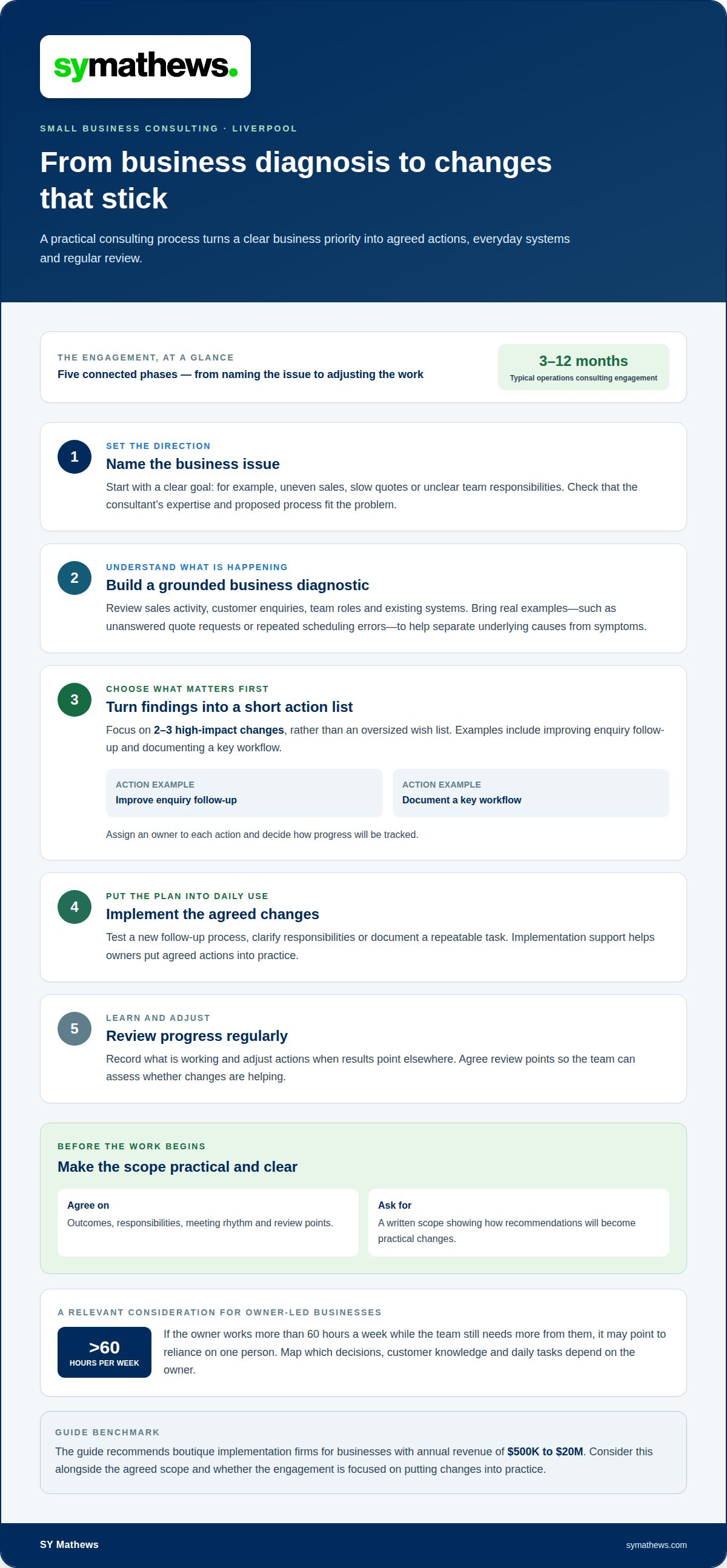
Business consulting discovery and implementation phases
Start your search for small business consulting in Liverpool with a clear goal. Name the issue, such as uneven sales, slow quotes or unclear team responsibilities. Then assess whether the consultant’s expertise and proposed process fit the problem, and agree on the scope and how implementation will work. This gives the engagement a practical starting point.
A business diagnostic should build a grounded picture of how the business operates. Review sales activity, customer enquiries, team roles and existing systems. Bring concrete examples, such as unanswered quote requests or repeated scheduling errors, to help distinguish underlying causes from symptoms.
Next, prioritise the changes. A useful diagnostic turns findings into a short action list, rather than an oversized wish list. It may focus on 2-3 high-impact changes, such as improving enquiry follow-up and documenting a key workflow. Assign an owner to each action and decide how progress will be tracked.
Implementation puts agreed changes into daily use. For example, test a new follow-up process, clarify responsibilities or document a repeatable task. Review progress regularly, record what’s working and adjust actions when results point elsewhere. Operations consulting engagements typically run for 3 to 12 months.
Before work begins, agree on the outcomes, responsibilities, meeting rhythm and review points. Ask for a written scope that explains how recommendations will become practical changes. A diagnostic can clarify the starting point, while implementation support helps owners put agreed actions into practice. Small business consulting in Liverpool should connect each step to a real business priority.
For more prompts on improving business decisions, explore these business advisory articles.
The guide also recommends boutique implementation firms for businesses with annual revenue of $500K to $20M. Consider both benchmarks alongside the agreed scope and whether the engagement is focused on putting changes into practice.
Consulting for owner-led and family-run businesses
In a family business, decisions at work can affect life at home. Clarifying roles, decision-making responsibilities and business priorities can help keep the two in balance. For example, agree who approves spending and who manages customer follow-up.
Consider outside support when the owner works more than 60 hours per week while the team still needs more from them. This points to a possible reliance on one person, not simply a busy season. A consultant can map where decisions, customer knowledge or daily tasks depend on the owner.
Handle family relationships thoughtfully when changing responsibilities. List each person’s current tasks and the skills those tasks require, then discuss proposed changes with everyone affected. This makes gaps easier to spot and keeps decisions grounded in business needs rather than assumptions about family roles.
Practical systems reduce repeated questions. A written process for handling enquiries, preparing quotes or opening the shop gives staff a shared reference. The owner can then focus on exceptions instead of repeatedly explaining routine tasks.
Choose a consultant who understands both the business priorities and the family dynamics involved. In an initial discussion, describe a recurring issue, such as delayed decisions between relatives. Ask how the diagnostic would clarify its cause and how the team would take part in implementation.
The aim is to build capability, not dependence on an adviser. Set clear responsibilities, document repeatable work and review whether the owner can step back from routine decisions. These steps give the family and team a practical way to see whether new habits are taking hold.
Explore practical business advisory insights
A study found that owners’ available time, financial resources and attitudes towards consulting affected their desire and ability to learn from new knowledge and put it into practice.
SY Mathews: Business advisory services
SY Mathews helps small businesses turn challenges around sales, margins and owner dependency into practical priorities. Its business advisory services combine strategy, sales and marketing support, and motivation to help owners move from ideas to action.
The structured 13-week Business Advisory Program is designed to achieve four specific business objectives. Its focus includes improving sales and margins while reducing reliance on the owner. It may suit an owner who has identified a need for change and wants a clear improvement program.
If your next step is to get focused support for your business, visit symathews.com.
Choose a practical next step
Start by choosing one business issue and describing what you want to change. Keep the first discussion anchored in a real decision, such as where to focus effort or how to make the next step manageable for your team.
For small business consulting in Liverpool, a useful fit starts with your priorities and how you want to put advice into practice. SY Mathews offers business advisory services, strategy, and sales and marketing services. That support can help frame a practical direction for your business.
You don’t need every answer before taking the first step. Bring the question occupying most of your attention and explore a sensible way forward. A focused discussion can help turn uncertainty into a clear business priority.
A thoughtful first step is still a step forward.
Frequently Asked Questions
Small Business Help?
Yes. Small businesses in Liverpool can seek support by identifying whether they need planning, sales improvement, stronger team follow-through or better business systems. For example, a retailer with quiet weekdays could examine which customers return and where enquiries stall. SY Mathews’ on-site business advisory program helps Western Sydney businesses set commercial priorities, track performance and put improvements into practice.
How can a small business in Liverpool get help with business plans, cash flow and bookkeeping?
Business advisory support can help a Liverpool business shape a plan and clarify commercial priorities, while bookkeeping remains a separate record-keeping task. Gather current sales, invoices due, regular expenses and upcoming commitments to inform planning and decisions. SY Mathews helps small businesses across Liverpool and nearby Western Sydney locations improve commercial performance through practical, on-site advisory support.

Article by
Sy Mathews
Sy Mathews is practical, down-to-earth and hands-on. He has owned and run businesses in Sydney and Melbourne at various times over the last fifty years, created, operated and sold them to larger companies in tourism, logistics, aviation, he understand the 'hands-on' of business ownership and the challenges it presents. He is motivated to assist owners to get out from under the burden of running and owning, into the freedom that independent business owners deserve to enjoy.
General information
Our articles are intended as general information. I personally work on-site with clients to provide tailored solutions specifically for the business.
I do not offer financial, investment or legal advice. If required, I can assist in recommending professionals in those areas. I take no fees or commissions from third parties, my recommendations are authentic and carry no hidden costs.


