

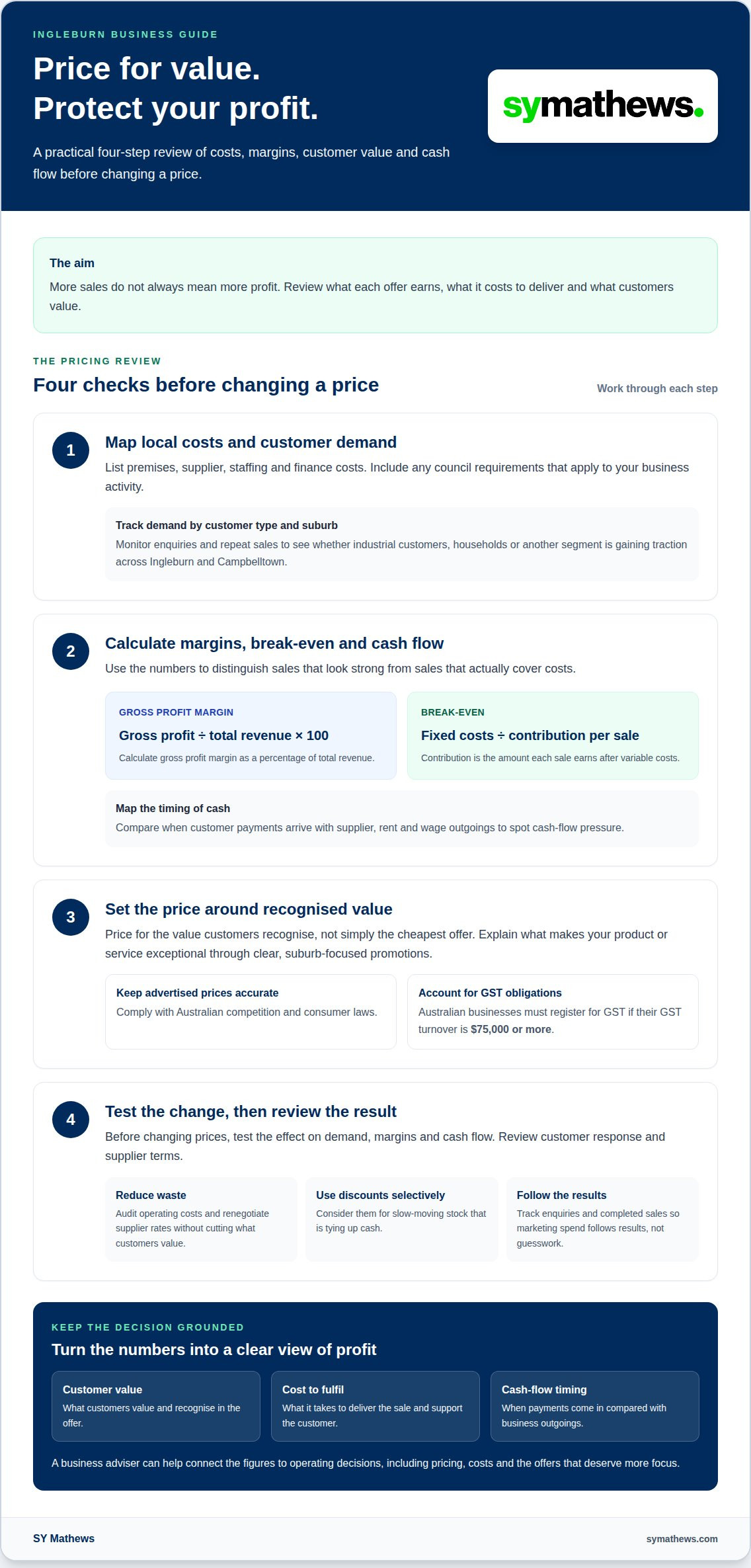
More sales don’t always mean more profit. To find more profit in your business in Ingleburn, review what each product or service earns, set prices around the value customers receive, and trim costs that don’t support good returns. You can calculate gross profit margin by dividing gross profit by total revenue, then multiplying by 100.
It’s easy to focus on turnover, especially when costs keep creeping up. But what you sell, what it costs to deliver and what customers value can matter just as much to profit.
This guide shows you how to review your prices, spot your strongest profit drivers and use professional advice to make clearer decisions. You’ll get practical steps to see where profit is being made, where it may be slipping away and what to focus on next.
Key Takeaways
- Set prices around the value customers receive, not just what competitors charge.
- Compare the profit each product or service contributes to find what deserves more focus.
- Use sales and financial records to spot cost pressures, weak performers and opportunities to improve.
- Business advice can help turn profit insights into a clear strategy and practical next steps.
Setting prices based on the value proposition
For an Ingleburn business, profit-led pricing starts with customer value and the cost of fulfilling each sale. Work through these steps before changing a price.
-
Review local costs and customer demand
Map premises, supplier, staffing and finance costs, then include any council requirements that apply to your business activity. Track enquiries and repeat sales by customer type and suburb to see whether industrial customers, households or another segment is gaining traction across Ingleburn and Campbelltown.
-
Calculate margins, break-even and cash flow
Calculate gross profit margin by dividing gross profit by total revenue, then multiplying by 100. Find break-even by dividing fixed costs by the amount each sale contributes after variable costs. Map when customer payments arrive against supplier, rent and wage outgoings to see cash-flow pressure. An advisor can help owners distinguish a fantastic turnover from sales that actually cover costs.
- Price for the value customers recognise, not simply the cheapest offer. Explain what makes your product or service exceptional through local marketing, such as clear benefits in suburb-focused promotions. Keep advertised prices accurate and comply with Australian competition and consumer laws. According to the Australian Taxation Office, businesses in Australia must register for GST if their GST turnover is $75,000 or more. Include GST obligations in pricing decisions.
- Before changing prices, test the effect on demand, margins and cash flow; review customer response and supplier terms. Reduce waste, audit operating costs and renegotiate supplier rates without cutting what customers value. Use discounts selectively for slow-moving stock tying up cash. Promote relevant offers to nearby suburbs and track enquiries and completed sales, so marketing spend follows results rather than guesswork.
Identifying the products and services that generate the most profit
- To find more profit in your Ingleburn business, organise sales records by product, service and customer type. Record sales, refunds, delivery effort and direct costs for each. Look for offers that sell regularly but require extra work or frequent follow-up. A sales audit can reveal which items tie up stock or staff time without generating enough return.
- Compare what each offer contributes with the resources it uses. Include preparation, fulfilment, customer support and time spent resolving problems. Strong sales may still strain capacity if an offer causes delays elsewhere. Check results across trading periods and investigate unusual changes before deciding whether to promote, adjust or pause an offer.
- Review customer behaviour alongside product results. Track repeat purchases, cancellations, returns and complaints. Customer satisfaction can influence sales and, in turn, profit. If customers regularly request a feature or service, assess whether it fits your operations and can make a worthwhile contribution. Avoid adding options just because one customer requested them.
- Choose a clear action for each result. Promote offers that combine steady demand with manageable delivery, and investigate the causes behind weak performers before removing them. Retaining customers can also support profit: experts estimate that recruiting new customers costs five to 10 times more than retaining existing ones. Track repeat sales and customer responses after changes, then use those results to guide your next decision.
Small businesses can audit sales data to identify top performers and products or services that are not selling and tying up cash. Focus on offers with stronger gross profit margins and consider removing those that are unprofitable. Margins can reflect delivery costs: drinks, for example, may have lower margins than beauty products partly because they are heavier and cost more to ship.
Nicole Banning described 80 per cent of a business coming from 20 per cent of its products or clients as a principle she used to focus on bestsellers. Regularly measure profit drivers to assess strategy impact, and compare profit margins and ratios with averages for your own industry, since margins vary widely between industries.
Using accountants, business advisers and brokers
- Give each professional a clear role. An accountant can interpret trading accounts and profit and loss statements. A business adviser can help connect those results to operating decisions. A broker is most useful when buying or selling a business, when valuation and the business’s position matter. Keep the work focused on the decisions you need to make.
- Bring consistent records to the conversation. Australian businesses preparing for a valuation should gather financial statements for the last five years, if possible. Trading accounts and profit and loss statements can show which products, services or customer groups contribute most. Ask the adviser to explain how changes in sales, costs and margins affect the result, not just report headline figures.
- Use the right professional for tax and support questions. An accountant can review your business records for deductions that apply to your circumstances. They can also assess relevant grants or business support programs against eligibility requirements and your plans. Funding is not profit by itself, so include its timing and any associated costs in cash-flow decisions.
- Ask for a practical recommendation. A business adviser can help compare options such as improving retail margins, changing a low-performing offer or strengthening business systems. A broker can provide context when a sale or purchase is under consideration. Past financial results and trends among similar businesses can help inform estimates of future profit and finance or sale-price negotiations. Agree on an action, a measure of progress and a review point so you can assess whether the change supports your goal.
Explore business advisory insights
SY Mathews
SY Mathews helps business owners turn profit insights into practical priorities. If pricing, sales or margins are difficult to improve, business advisory and strategy can connect the numbers to clear decisions. Sales and marketing services can support customer acquisition and help focus on the offers that contribute most.
The structured 13-week program is designed around four specific business objectives, including improving sales and margins while reducing owner dependency. It can suit owners who have identified profit opportunities but need support, motivation and direction to put changes into action. The focus is on building a workable path forward for your business, rather than chasing activity without a clear purpose.
Contact SY Mathews to discuss the profit challenges you want to address.
Turn profit insight into your next move
Finding more profit in your business in Ingleburn is an ongoing habit, not a one-off exercise. Choose a practical change that fits your priorities and decide what result would show it is working. A clear focus helps you avoid spreading time and effort across too many ideas.
SY Mathews provides business advisory, strategy and sales and marketing services to help turn business opportunities into a considered direction. The key question is which decision deserves attention first. Set a review point and use what you learn to shape the next step.
Start with a focused conversation about the business challenge you want to tackle.
Your next improvement can begin with a clear, manageable step.
Frequently Asked Questions
What are the most effective ways to increase small-business profit in Ingleburn?
Start with the part of your business where a small operational change could protect more profit. For example, a trades business in Ingleburn could review job scheduling and repeat visits, while a retailer could examine which product lines need frequent markdowns. A business adviser can help turn those findings into focused actions for businesses across Campbelltown, Minto, Liverpool, Parramatta, Milperra, Padstow, Revesby, Chullora, Smithfield, Wetherill Park, Fairfield, Regents Park, Lidcombe and Silverwater.
What NSW and Australian tax deductions, grants or business support programs can improve profitability?
An accountant can review deductions that apply to your circumstances and assess relevant grants or business support programs against their eligibility requirements and your plans. Include funding timing and associated costs in cash-flow decisions, as funding is not profit by itself.

Article by
Sy Mathews
Sy Mathews is practical, down-to-earth and hands-on. He has owned and run businesses in Sydney and Melbourne at various times over the last fifty years, created, operated and sold them to larger companies in tourism, logistics, aviation, he understand the 'hands-on' of business ownership and the challenges it presents. He is motivated to assist owners to get out from under the burden of running and owning, into the freedom that independent business owners deserve to enjoy.
General information
Our articles are intended as general information. I personally work on-site with clients to provide tailored solutions specifically for the business.
I do not offer financial, investment or legal advice. If required, I can assist in recommending professionals in those areas. I take no fees or commissions from third parties, my recommendations are authentic and carry no hidden costs.


