

What if working harder is keeping your business stuck? If you’re searching for “feeling stuck in my business what to do”, you may be carrying every decision, fixing every problem and still seeing the same profit margins. That treadmill can leave you worn out and wondering how the business would manage without you.
You’re not alone in feeling caught in the owner’s trap. The way forward isn’t simply doing more. It’s finding where profit is slipping away and building systems your team can use. Start by checking which decisions still rely on you, which jobs are earning a worthwhile margin and where work gets delayed. This article shares practical steps to reduce owner dependency, sharpen your view of margins and make day-to-day work run more smoothly. You’ll also see how a focused 13-week program can help small business owners around Campbelltown, Liverpool and nearby Western Sydney suburbs make progress.
Key Takeaways
- If you’re searching “feeling stuck in my business what to do”, start by spotting where the business still depends on you to keep moving.
- Review expenses and pricing to find potential profit improvements in your current setup.
- Look beyond sales volume and identify which clients and jobs bring the most value to your business.
- A structured 13-week advisory program can help build usable systems and ease owner dependency.
Why You’re Feeling Stuck: The "Owner’s Trap" in Small Business
If you’re asking, “feeling stuck in my business what to do?”, start by looking at how much depends on you. The Owner’s Trap is when the business relies on your daily presence to function. If every job, customer issue or approval waits for you, the business can’t move faster than your own capacity.
The signs often show up in everyday numbers and routines:
- Sales stay flat, even though you’re putting in longer hours.
- Margins shrink as costs rise or jobs are priced too tightly.
- Your to-do list keeps growing because routine tasks and decisions come back to you.
Working harder can feel like the obvious fix. But taking on more work may leave less time to review pricing, improve processes or help your team take ownership. You get busier, not necessarily more profitable. That pace can wear you down without addressing what’s holding the business back. The useful question is not just, “What else can I do?” It’s, “What could the business handle without me?”
The Difference Between a Job and a Business
A business that can operate effectively without the owner’s constant presence is less dependent on one person. Working in it means completing technical tasks, such as serving customers, preparing quotes or fixing a problem on site. Working on it means creating clear processes, setting responsibilities and reviewing how work flows. For example, a tradie with a small crew might document how enquiries are handled, what information a quote needs and who follows up, so each quote doesn’t depend on the owner.
That distinction matters if you want the business to have value beyond your own labour. When customer relationships, know-how and daily decisions sit only with you, it can be harder for someone else to take over. Usable systems and a capable team help the business keep delivering when you step back.
Taking Action: Four Practical Levers to Unstick Your Operations
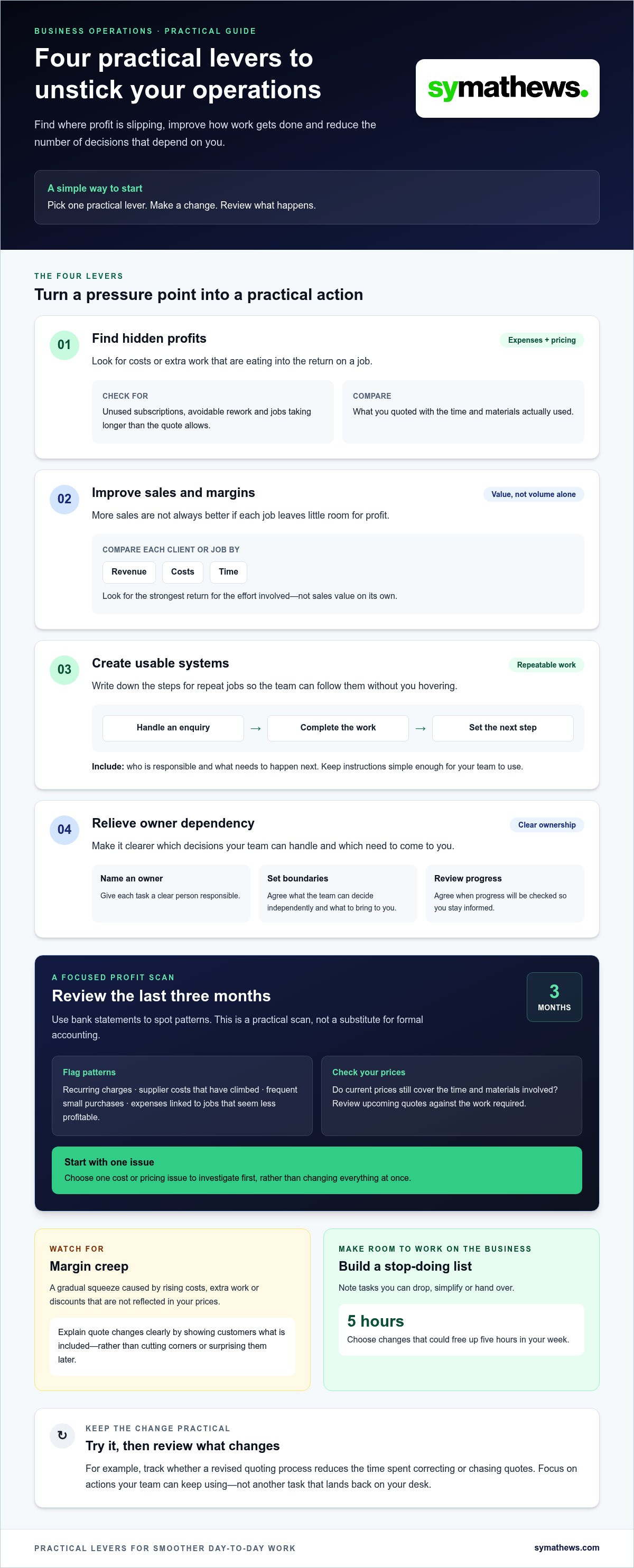
If you’re wondering “feeling stuck in my business what to do”, don’t try to overhaul everything at once. Pick one practical lever, make a change and review what happens. For example, track whether a revised quoting process reduces the time spent correcting or chasing quotes.
- Find hidden profits. Scan expenses and pricing for subscriptions you no longer use, avoidable rework or jobs that take longer than your quote allows. Compare what you quoted with the time and materials actually used to see where profit is leaking.
- Improve sales and margins. Look at which clients and jobs generate the strongest return for the effort involved. More sales aren’t always better if each one leaves little room for profit. Compare jobs by revenue, costs and time, rather than judging them by sales value alone.
- Create usable systems. Write down the steps for repeat jobs, from handling an enquiry to finishing the work. Include who is responsible and what needs to happen next. Keep instructions simple enough for your team to follow without you hovering.
- Relieve owner dependency. Give each task a clear owner and agree on when progress will be reviewed. Set boundaries for decisions your team can make independently and the situations that should be brought to you. Accountability helps your team take action while keeping you informed.
How to Spot Hidden Profits Today
Set aside time to review the last three months of bank statements. This is a practical scan for patterns, not a substitute for formal accounting. Flag recurring charges, supplier costs that have climbed, frequent small purchases and expenses linked to jobs that seem less profitable than expected. Then compare those costs with your quotes and the work completed.
- Compare repeat expenses across the three months and flag costs that have changed.
- Check whether current prices still cover the time and materials involved.
- Choose one cost or pricing issue to investigate first, rather than changing everything at once.
Margin creep is the gradual squeeze caused by rising costs, extra work or discounts that aren’t reflected in your prices. Review upcoming quotes and make sure they reflect the work involved. Explain changes clearly by showing customers what’s included, rather than cutting corners or surprising them later.
Make a stop-doing list, too. Note tasks you can drop, simplify or hand over, then choose changes that could free up five hours in your week. For practical business improvement ideas, focus on actions your team can keep using, not another task that lands back on your desk.
The 13-Week Pivot: A Structured Path for Sydney Owners
Knowing the business needs to change is one thing. Making that change while handling customers, staff and daily jobs is another. SY Mathews provides small businesses with a structured 13-week on-site advisory program focused on finding hidden profits, improving sales and margins, and creating practical systems that reduce owner dependency. The defined program gives you a clear improvement period to work on priorities, rather than an open-ended consulting arrangement.
On-site support brings the work into your real operating environment. Whether your business is in Smithfield, Fairfield or Parramatta, an advisor can see how work moves through the business, where decisions get held up and what your team already does well. Regular guidance and accountability help turn priorities into actions you can keep progressing, even when the week gets busy.
What Happens When an Advisor Steps On-Site?
The starting point is a business diagnostic: identify what’s not working as well as the parts worth keeping. In a Minto or Ingleburn warehouse, that might mean following a job from customer order through to dispatch to spot delays, repeated handling or steps that rely on the owner’s memory. A fresh perspective can help you question familiar routines and decide what would make them clearer or more efficient.
An outcome-based approach keeps the effort tied to practical objectives, such as improving sales or creating a usable system for a recurring task. Agree on what needs to change, take action and review progress, rather than collecting advice that sits in a folder. If you’re still weighing up “feeling stuck in my business what to do”, structured support can help you move from deciding to doing.
Explore hands-on business advisory support to see how a focused improvement program could fit your business.
Make Your Next Move Count
If you’re still asking “feeling stuck in my business what to do”, choose one next step that shifts the business forward without adding another job to your already full day. You don’t have to map out every change on your own. A fresh perspective can help turn the next move into a clear, practical plan.
SY Mathews supports small businesses across Western Sydney with on-site guidance through a structured 13-week program focused on sales, margins, hidden profits and usable business systems. It’s a defined way to work on improvements and reduce the number of tasks and decisions that depend on you.
Explore the 13-week advisory program
Your business can become less dependent on you, one useful change at a time. Start with the step that gives you and your team more room to move.
Frequently Asked Questions
How do I know if I need a business advisor or just a new employee?
Start by identifying whether you lack capacity or clarity. If the work is well defined and reliable demand is waiting, an employee may help you deliver it. If you’re unsure which jobs are profitable, what to delegate or why the same problems keep returning, advisory support can help diagnose the issue and set priorities. If you’re asking “feeling stuck in my business what to do”, match the support to the bottleneck, not just the workload.
Can my small business really run without me in just 13 weeks?
There’s no one-size-fits-all promise that a business will run completely without its owner after 13 weeks. The starting point, team experience and changes put into practice all matter. A useful milestone is whether staff can handle routine decisions using agreed guidelines, and whether you can step away briefly without every small question landing in your inbox.
What is the difference between a business coach and a business advisor in Australia?
The terms can overlap, but the approach often differs. A coach may help you think through choices and stay accountable to your goals. An advisor may also examine business performance and offer practical recommendations on areas such as sales, margins or systems. The useful distinction is the work involved: do you need space to reflect, hands-on guidance, or a mix of both?
How much time do I need to commit to a business improvement program?
Plan to make time for conversations, decisions and putting agreed changes into practice. The exact commitment depends on the priorities you tackle and who in your team can help. Small businesses in Campbelltown, Ingleburn, Minto, Liverpool, Parramatta, Milperra, Padstow, Revesby, Chullora, Smithfield, Wetherill Park, Fairfield, Regents Park, Lidcombe and Silverwater can make progress by setting aside regular time to move one improvement forward at a time.

Article by
Sy Mathews
Sy Mathews is practical, down-to-earth and hands-on. He has owned and run businesses in Sydney and Melbourne at various times over the last fifty years, created, operated and sold them to larger companies in tourism, logistics, aviation, he understand the 'hands-on' of business ownership and the challenges it presents. He is motivated to assist owners to get out from under the burden of running and owning, into the freedom that independent business owners deserve to enjoy.
General information
Our articles are intended as general information. I personally work on-site with clients to provide tailored solutions specifically for the business.
I do not offer financial, investment or legal advice. If required, I can assist in recommending professionals in those areas. I take no fees or commissions from third parties, my recommendations are authentic and carry no hidden costs.


