

If you’re wondering what to do when business growth is flat, start by looking for what’s getting in the way, rather than assuming you need another marketing push. A plateau can be hard to read: is it a short pause, or a sign something needs to change? Trying new tactics without a clear cause can add work without improving results.
This guide will help you spot the constraint holding progress back, compare practical responses and choose a manageable next step. You’ll look at sales, existing customers, day-to-day systems and decisions that may be bottlenecked by the owner. Then you can decide whether to keep testing changes in-house or use outside guidance and accountability. SY Mathews offers a structured 13-week business advisory programme that brings diagnosis and action together. The aim is to work on the right thing first, not just stay busy.
Key Takeaways
- To decide what to do when business growth is flat, treat the plateau as a prompt to investigate, not proof the business has failed.
- Choose one clear growth measure, review its trend and pinpoint where progress starts to weaken.
- Match your response to the evidence, then test one change before adding more activity or workload.
- If you need diagnosis and accountability, SY Mathews offers on-site small-business advisory and a structured 13-week programme focused on sales, margins, usable systems and reducing owner dependency.
What to check first when business growth is flat
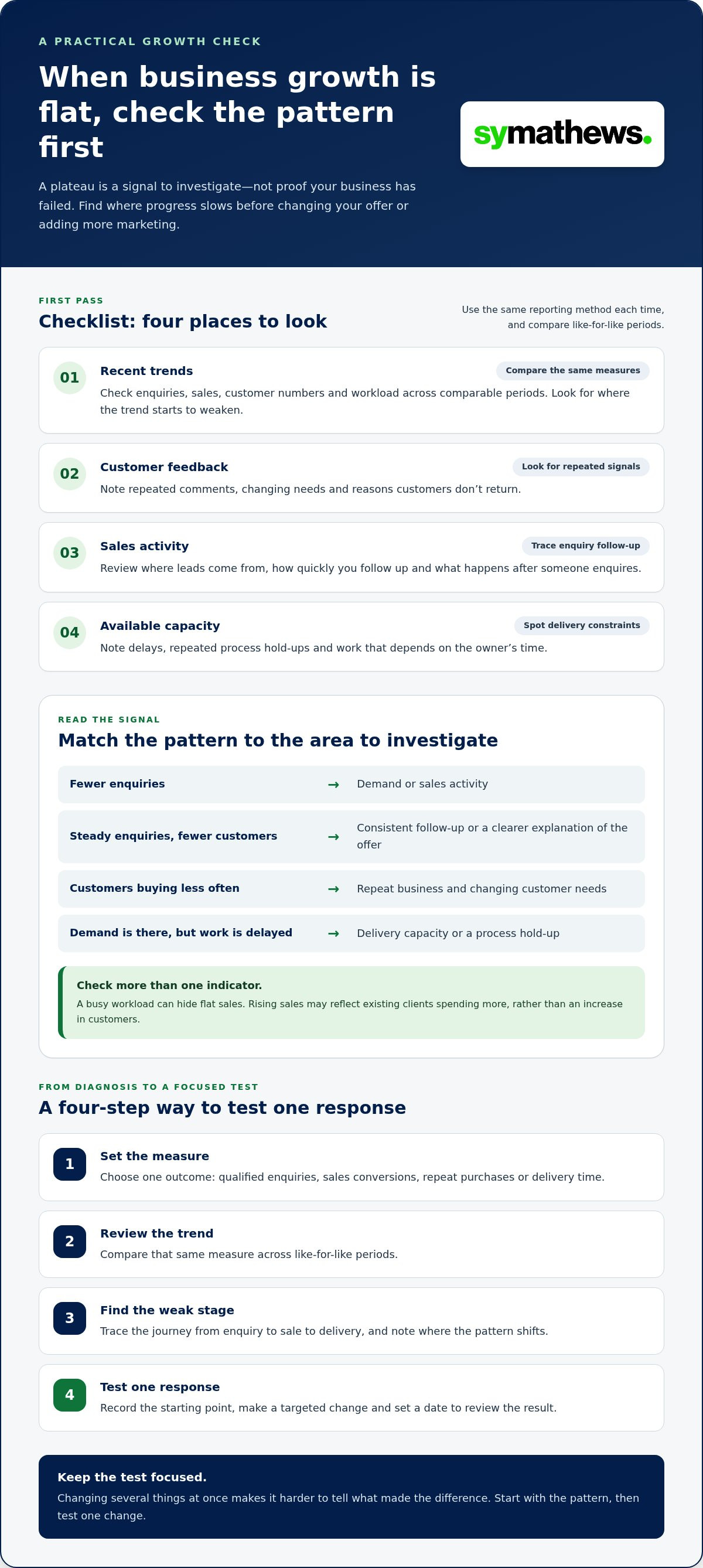
A plateau is a signal to investigate, not proof your business has failed. Before changing your offer or adding more marketing, work out where progress has slowed. Are fewer people enquiring? Are fewer enquiries becoming customers? Are existing customers buying less often? Or is demand there, but your team can’t deliver more without stretching capacity?
Each pattern points to a different area to examine. Fewer enquiries may relate to demand or sales activity. A weaker conversion rate may mean leads need more consistent follow-up or a clearer explanation of the offer. Repeat business may have softened, or delivery delays may be limiting the work you can take on. Start with the pattern rather than guessing at the cause.
For a first pass, compare:
- Recent trends: Check enquiries, sales, customer numbers and workload across comparable periods. Use the same reporting method each time.
- Customer feedback: Look for repeated comments, changing needs or reasons customers don’t return.
- Sales activity: Review where leads come from, how quickly you follow up and what happens after someone enquires.
- Available capacity: Note delays, repeated process hold-ups and work that depends on the owner’s time.
How can you tell whether growth has genuinely stalled?
Don’t let one quiet week make the call. Compare like-for-like periods, such as the same season or equivalent trading months, and check more than one indicator. A busy workload can hide flat sales, while rising sales may reflect existing clients spending more rather than an increase in customers. Choose the measure that matches your goal, whether that’s sales, customer numbers, repeat work or sustainable capacity.
This gives you a clearer starting point for deciding what to do when business growth is flat. You don’t need a perfect report. You need a useful signal about where to investigate next.
How to find the growth bottleneck and choose a practical response
Once you’ve spotted a pattern, resist changing several things at once. Define the growth measure that matters, review its trend, find the stage where it weakens, then test one change. This keeps the work focused and makes it easier to judge whether your response helped.
- Set the measure: Choose one outcome, such as qualified enquiries, sales conversions, repeat purchases or delivery time.
- Review the trend: Compare the same measure across like-for-like periods.
- Find the weak stage: Trace the journey from enquiry to sale to delivery, and note where the pattern shifts.
- Test one response: Make a targeted change, record the starting point and set a date to review the result.
How do you choose between a sales, margin or operations response?
Let the evidence point the way. If enquiries are steady but fewer become customers, review sales follow-up and whether the offer is being explained clearly. If sales hold but margins are tightening, examine what is affecting the return from each sale before trying to increase volume. If work is repeatedly delayed, identify the process or capacity issue creating the hold-up.
Keep the test small enough to learn from. For example, if follow-up appears inconsistent, track how many enquiries receive a timely response before and after introducing a simple routine. Compare the same measure at your chosen review point. If you also change pricing, promotion and delivery at once, it will be harder to tell what made the difference.
Testing one constraint at a time won’t solve every growth challenge overnight, but it can stop you piling on activity without knowing what’s working. For more practical business improvement ideas, browse the business advice articles and choose an approach that fits the pattern you’ve found.
When to get business growth support, and what a useful next step looks like
You may be able to work through the next step yourself if the constraint is clear, you have time to test a change and someone can keep the plan moving. Structured support can help when you’re circling the same questions, struggling to make time for follow-through or finding that the owner has become the decision-making bottleneck.
Compare the options by what the business needs right now:
- Act independently: Set the priority, track the measure and make time to review what happened. This suits a focused test with a clear owner.
- Get structured support: Get help diagnosing the issue, setting priorities and staying accountable as changes are put into practice. This is useful when the cause is unclear or the plan keeps slipping.
What should a small-business growth adviser help you do?
Useful advice should make the issue clearer and turn priorities into practical actions, not add a pile of new tasks. SY Mathews provides dedicated on-site support for small businesses through a structured 13-week programme. It focuses on improving sales and margins, finding hidden profits, creating usable systems and reducing owner dependency. These areas can help you connect the issue you’ve identified with a focused improvement plan.
If you’re still weighing up what to do when business growth is flat, write down the pattern you’ve noticed, the measure you want to shift and one question you need answered. That gives you a manageable starting point, whether you test a change on your own or work through the diagnosis with support.
Explore business advisory support if guidance and accountability would help you move from diagnosis to action.
Make your next move a focused one
Knowing what to do when business growth is flat starts with choosing a next move you can follow through on. Give yourself room to test one sensible change, learn from what happens and adjust without turning the whole business upside down. Progress can begin with a clearer decision, not a bigger to-do list.
SY Mathews provides dedicated on-site support for small businesses through a structured 13-week programme focused on practical business improvement. It offers guidance and accountability to help you work through priorities and keep attention on what matters to your business.
You don’t need to solve everything at once. Choose one useful next step and build from there.
Frequently Asked Questions
Why has my business growth suddenly slowed?
A sudden slowdown can follow a change in customer behaviour, a lost referral source, stronger competition or a shift in how people buy. Internal changes can matter too, such as a key staff member leaving or a popular service becoming harder to deliver. Look back at what changed before the slowdown began, then check whether the timing lines up with a shift in enquiries, sales or customer activity.
What should I do first when business growth is flat?
Start by asking what changed just before the numbers shifted. Note changes to pricing, staffing, opening hours, marketing channels, suppliers or the offer itself. If you’re weighing up what to do when business growth is flat, this timeline can help narrow the investigation. It won’t prove cause and effect, but it gives you specific leads to check instead of a long list of guesses.
Can a small business grow without getting more customers?
Yes. Growth can come from serving existing customers more often, encouraging repeat business or offering a relevant additional service. For example, a customer who books a one-off service might have an ongoing need your business can meet. Check whether customers know about that option and whether it suits their needs. Keep an eye on delivery workload too, so added sales remain manageable.
When should I get help with a business growth plateau?
Consider business advisory support if you’ve tried a focused change but can’t tell what’s holding progress back, or if day-to-day demands leave no time to follow through. SY Mathews works with small businesses around Campbelltown, Ingleburn, Minto, Liverpool, Parramatta, Milperra, Padstow, Revesby, Chullora, Smithfield, Wetherill Park, Fairfield, Regents Park, Lidcombe and Silverwater. An outside perspective can help turn a stuck question into a practical priority.

Article by
Sy Mathews
Sy Mathews is practical, down-to-earth and hands-on. He has owned and run businesses in Sydney and Melbourne at various times over the last fifty years, created, operated and sold them to larger companies in tourism, logistics, aviation, he understand the 'hands-on' of business ownership and the challenges it presents. He is motivated to assist owners to get out from under the burden of running and owning, into the freedom that independent business owners deserve to enjoy.
General information
Our articles are intended as general information. I personally work on-site with clients to provide tailored solutions specifically for the business.
I do not offer financial, investment or legal advice. If required, I can assist in recommending professionals in those areas. I take no fees or commissions from third parties, my recommendations are authentic and carry no hidden costs.


