

What if the task slowing your business down doesn’t need another app, just a clearer routine? Learning how to systemise a small business starts with the work that keeps landing back on your desk. When a routine depends on your memory, or each team member handles it differently, small snags can lead to rework, missed follow-ups and uneven customer experiences. With so many processes competing for attention, though, it’s not always obvious where to begin.
You don’t need a hefty manual or a perfect process map to make work more consistent. Start with one recurring bottleneck, make the steps clear enough for someone else to follow, then refine them as your team uses them. This guide shows you how to choose a process, shape a practical system and keep it useful without adding unnecessary admin. The aim is to reduce reliance on you for every routine decision and give the business a steadier way to get work done.
Key Takeaways
- See how simple, repeatable routines can support consistent daily work and clearer handovers.
- Learn how to systemise a small business by choosing one process and recording the essentials your team needs to follow it.
- Test and refine a system with team feedback so it works in practice, including when common exceptions arise.
- Explore how SY Mathews’ structured 13-week on-site advisory program can help improve business systems alongside sales, margins and hidden profits.
How systemising a small business makes daily work more consistent
Systemisation makes a recurring task clear enough for someone else to handle in a similar way, without relying on one person’s memory. It doesn’t require a lengthy manual or new software. A usable system is a short, practical guide to completing a task, including what to do when the usual steps don’t fit.
This idea sits within the broader discipline of Business Process Management (BPM), which focuses on improving business processes. For a small business, the starting point can be much simpler than a formal framework: write down the essentials of a routine and make them easy to find and follow.
Clear steps can help staff provide a more consistent customer experience, avoid repeated mistakes and make handovers smoother. If the person who usually responds to enquiries is away, for example, a colleague can see what details to gather, where to record them and what should happen next. The routine may still require judgement, but fewer important details have to stay in someone’s head.
What makes a business process worth systemising first?
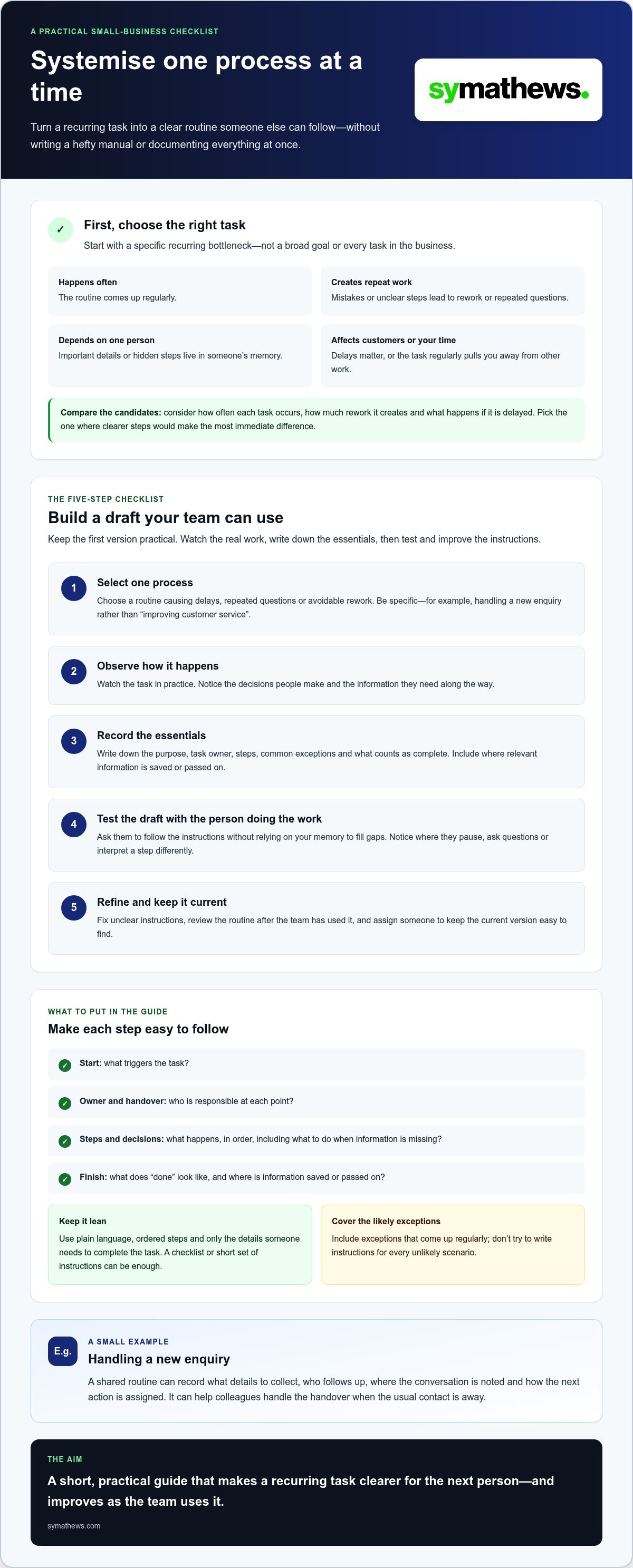
Look for tasks that happen often, create repeat work or depend on one person knowing the hidden steps. Prioritise a process that affects customers or regularly pulls your attention away from other work. To compare candidates, consider how often each task occurs, how much rework it creates and what happens if it is delayed. Choose the one where clearer steps would make the most immediate difference, rather than documenting tasks for their own sake.
Responding to an enquiry is a useful small example. Record what details to collect, who follows up, where the conversation is noted and how the next action is assigned. If staff ask different questions or leave follow-ups unclear, a shared routine can make the process easier to hand over. That’s a practical first move when working out how to systemise a small business.
How to systemise a small business one process at a time
Keep the first system small. To work out how to systemise a small business, choose one recurring process and build a draft your team can try, rather than documenting every task at once. A useful draft explains what starts the task, who owns it, what steps to follow and what “done” looks like.
- Select one process. Pick a routine that causes delays, repeated questions or avoidable rework. Be specific, such as handling a new enquiry rather than “improving customer service”.
- Observe it. Watch how the task is done in practice, including the decisions people make and the information they need along the way.
- Record the essentials. Note the purpose, who owns the task, the steps, common exceptions and what counts as complete. Include where to save relevant information or pass it on.
- Test the draft. Ask someone who does the work to follow the instructions without relying on your memory to fill gaps. Notice where they pause, ask questions or interpret a step differently.
- Refine it. Fix unclear instructions and review the routine after the team has used it. Give someone responsibility for keeping the current version easy to find.
Improvement is practical work, not paperwork for its own sake. IBM’s overview of Business Process Improvement (BPI) also frames improvement around making processes work better. Keep your own first version light: a checklist or short set of instructions is often enough to get started.
How do you document a process without creating extra admin?
Use plain language and include only what someone needs to complete the task. Write steps in the order they happen, name who is responsible at each handover and capture decision points, such as what to do if a job is missing information. Include exceptions that come up regularly, but don’t try to write instructions for every unlikely scenario.
A draft becomes useful when the person doing the work tests it, because they can spot missing steps and awkward handovers that are easy to miss from a desk. Invite their feedback, then update the instructions so they reflect the real routine. If a step is repeatedly misunderstood, rewrite it or show an example instead of adding more explanation around it.
If choosing a first process feels tricky, explore practical business systems advice from SY Mathews.
When hands-on business advice can help systemise your operations
Sometimes the hard part isn’t writing down a routine. It’s deciding which problem deserves attention first, or making time to put a good idea into practice. Business advice can help when priorities feel muddled, improvements keep stalling or everyday tasks still depend on you being there to explain each step.
SY Mathews provides a structured 13-week on-site advisory program for small businesses. The program focuses on improving sales and margins, finding hidden profits, creating usable systems and relieving owner dependency. This connects day-to-day process improvements with the wider needs of the business.
Working through changes on site can help turn broad goals into practical actions. For example, if customer follow-up relies on the owner remembering who to call, advisory support can help clarify the routine, agree who handles each step and shape a system the team can use. The aim is to make progress part of the day-to-day work, not just a list of ideas to revisit later.
What can local on-site support look like in practice?
It starts with understanding how work currently gets done and where it tends to snag. From there, you can set priorities, work through practical changes and adjust a routine as it’s put into use. That might mean clarifying handovers, making a recurring task easier to follow or reducing the number of everyday decisions that need to come back to you.
SY Mathews supports small businesses in Campbelltown, Ingleburn, Minto, Liverpool, Parramatta, Milperra, Padstow, Revesby, Chullora, Smithfield, Wetherill Park, Fairfield, Regents Park, Lidcombe and Silverwater. To explore how on-site business advisory support can help you put practical changes into action, visit SY Mathews.
Give your next improvement room to grow
Your first system doesn’t need to solve everything. Let it create a little more space for your team to take ownership, then use what you learn to decide what deserves attention next. Review whether the routine is easier to follow, whether handovers are clearer and whether fewer questions are coming back to you. That’s a steady way to build a business that relies less on you for every routine decision.
SY Mathews’ structured 13-week program provides dedicated on-site business advisory support, with a focus on usable systems, improving sales and margins, finding hidden profits and reducing owner dependency. If you’re ready to turn the question of how to systemise a small business into practical next steps for your operation, explore the program below.
Start with one useful change. You can build from there.
Frequently Asked Questions
How long does it take to systemise a small business?
There’s no set timeframe. It depends on how often the task happens, how many people handle it and how clear the current steps are. A simple routine may be documented and trialled quickly, while a process with several handovers or exceptions can take longer to understand. Start with one process and let day-to-day use show what still needs attention.
Do I need special software to systemise a small business?
No. You can begin with a shared document or another format your team already uses. The key is that people can find the latest instructions and know who maintains them. Consider software only if the process needs features such as tracking task progress or connecting repeated actions. A new tool isn’t useful if it adds more steps than it removes.
How often should small business systems be reviewed?
Review a system after the team has used it enough to spot unclear instructions or missed steps. Then revisit it if customer feedback, staff responsibilities, equipment or the way you deliver a service changes. For regular tasks, a recurring calendar reminder can prompt a check. For less frequent work, review the instructions before the next time the task is due.
Can I systemise a small business while still serving customers?
Yes. Work on one routine at a time and set aside a short block for observing or updating it, rather than pausing normal operations. You can trial a draft with a teammate during a quieter period and adjust it around customer needs. This approach can suit small businesses in Campbelltown, Ingleburn, Minto, Liverpool, Parramatta, Milperra, Padstow, Revesby, Chullora, Smithfield, Wetherill Park, Fairfield, Regents Park, Lidcombe and Silverwater.

Article by
Sy Mathews
Sy Mathews is practical, down-to-earth and hands-on. He has owned and run businesses in Sydney and Melbourne at various times over the last fifty years, created, operated and sold them to larger companies in tourism, logistics, aviation, he understand the 'hands-on' of business ownership and the challenges it presents. He is motivated to assist owners to get out from under the burden of running and owning, into the freedom that independent business owners deserve to enjoy.
General information
Our articles are intended as general information. I personally work on-site with clients to provide tailored solutions specifically for the business.
I do not offer financial, investment or legal advice. If required, I can assist in recommending professionals in those areas. I take no fees or commissions from third parties, my recommendations are authentic and carry no hidden costs.


