

A procedure nobody uses is just another file to ignore. Creating standard operating procedures from scratch works best when you start with the real task, not a polished template. If different people handle the same job in different ways, or one experienced person holds all the know-how, a clear guide can make work easier to repeat and hand over. It’s also reasonable to worry that writing one will take ages or add red tape.
You can keep the process practical. Choose work worth documenting, write steps another person can follow, then test the procedure against the job as it happens. Review and update it when the business changes, so it stays useful rather than gathering digital dust. The aim isn’t to document every tiny task. It’s to make important work more consistent and less dependent on memory.
Key Takeaways
- Start creating standard operating procedures from scratch with a task that’s frequent, error-prone or too dependent on one person.
- Give each SOP a clear purpose, scope, responsible role and completion check before you write the steps.
- Use plain language and one action per step, then test the procedure with someone who didn’t write it.
- Keep approved SOPs easy to find, invite team feedback and assign someone to maintain them.
Creating standard operating procedures from scratch starts with the right process
An SOP is a clear, repeatable set of instructions for completing a specific task. It helps people do the work consistently without relying on memory or waiting for the owner to explain each step. A broader overview of the Standard operating procedure explains how these instructions are used across different fields. For a small business, begin with one task where a shared approach would make everyday work easier.
Which business process should you document first?
Look for work that happens often and leads to rework, delays or the same questions on repeat. Tasks that are prone to mistakes or depend on one person’s know-how are also strong candidates. Rather than starting with the process that looks most impressive on paper, choose one where a clear guide would help another team member complete the work confidently.
For example, a small business in Campbelltown might document how staff prepare an order for customer collection. Ask the person who does the task to talk through what happens, including checks, hand-offs and workarounds. Record the current process first. That gives you a reliable starting point before deciding whether to change anything.
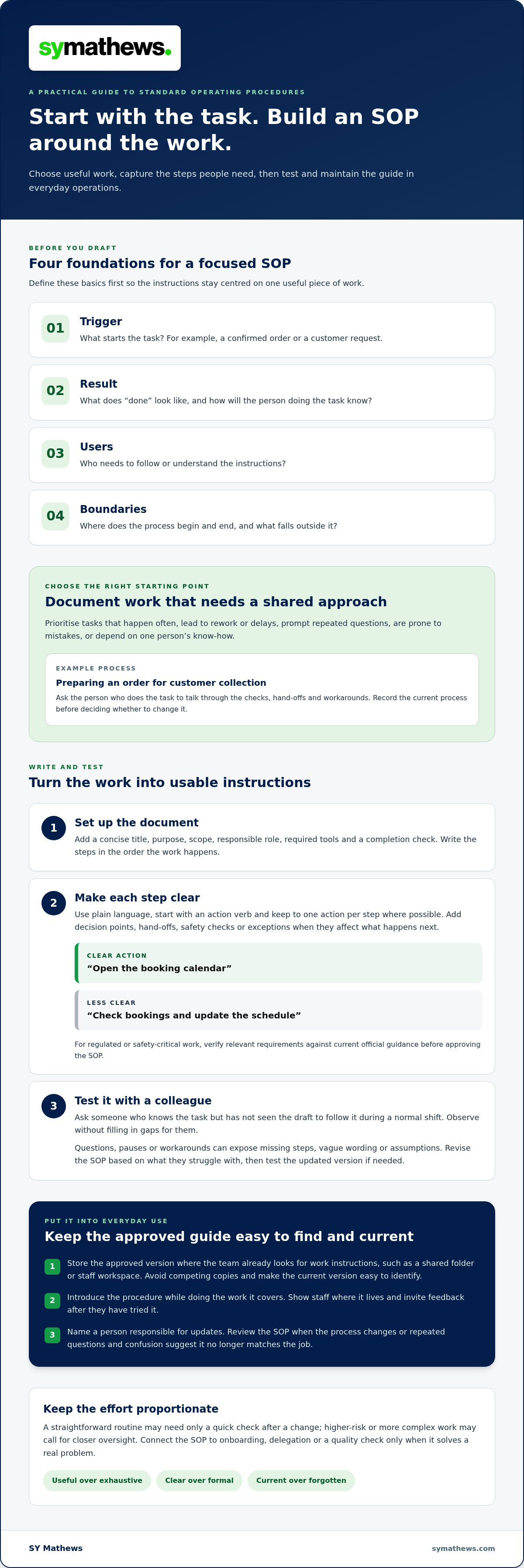
Before drafting, jot down four basics:
- Trigger: What starts the task, such as a confirmed order or a request from a customer?
- Result: What does “done” look like, and how will the person doing the task know?
- Users: Who needs to follow or understand the instructions?
- Boundaries: Where does the process begin and end, and what falls outside it?
These details keep the SOP focused. They also make creating standard operating procedures from scratch less daunting: you’re mapping one useful piece of work, not writing a rulebook for the whole business. A well-chosen first process can support clearer delegation and reduce how often the owner needs to step in.
How to write and test an SOP your team can follow
Keep the document focused on helping someone complete the task, not on sounding formal. Start with a concise title, then note the purpose, scope, responsible role, required tools and completion check. These details help readers decide whether the procedure applies and what they need before they begin.
Write the steps in the order the work happens. Start each one with a plain action verb and keep it to one action where possible. For example, “Open the booking calendar” is clearer than “Check bookings and update the schedule.” Add a decision point, hand-off, safety check or exception when it changes what the person should do. If a step depends on a particular result, spell out what to do next. For regulated or safety-critical work, verify relevant requirements against current official guidance before approving the SOP.
Test the draft with someone who performs the task
Ask a colleague who knows the work but hasn’t seen the draft to follow it during a normal shift. Observe without filling in gaps for them. Their questions can reveal a missing step, vague wording or an assumption that usually lives in the owner’s memory. For instance, if they pause to ask which booking to select or where to record a completed task, the instructions may need a clearer direction. Revise the SOP based on what they struggle with, then test the updated version if needed.
Once the process reads clearly, add a version date and name the person responsible for updates. That simple ownership step helps prevent an SOP from quietly falling out of date.
Good procedures are built alongside daily operations, not in a vacuum. SY Mathews provides business systems advisory support to help small businesses connect written steps to the way their team works.
Put new SOPs into everyday use and keep them current
An SOP only helps if people can find it when they need it. Store the approved version where the team already looks for work instructions, such as a shared folder or staff workspace. Avoid competing copies in different places, and make the current version easy to identify.
Introduce the procedure while doing the work it covers. Show staff where it lives and how to use it, then invite feedback after they’ve tried it. Questions or workarounds may point to a step that needs clarifying. Give one person responsibility for updates so changes don’t get lost between team members.
Review the SOP when the process changes, or when repeated questions and confusion suggest it no longer matches the job. Keep the review effort proportionate. A straightforward routine may need only a quick check after a change, while higher-risk or more complex work may call for closer oversight. The aim is a useful guide, not paperwork for its own sake.
Make SOPs part of a usable business system
Connect a procedure to onboarding, delegation or a quality check only when it solves a real problem. For example, a new team member could use it to learn a recurring task, while a manager refers to it when checking that work is complete. Start with a simple document or shared workspace. Choose more involved tools only if your team’s size or workflow calls for them.
Creating standard operating procedures from scratch can help build systems that reduce reliance on the owner, especially when the instructions support real work. For related ideas, explore these business systems and advisory articles.
Make your next process easier to hand over
Creating standard operating procedures from scratch doesn’t mean documenting everything at once. Pick a task that needs more consistency, write steps people can follow, then see how they work in practice. Keep the approved version easy to find and update it when the process changes or confusion crops up.
A useful SOP can do more than keep a task on track. It can help your team share responsibility and make the business less dependent on the owner. SY Mathews supports small businesses with a structured 13-week advisory programme and dedicated on-site support focused on improving sales and margins, finding hidden profits and building usable systems.
Start with one process and build from there. Small, practical improvements can make everyday work clearer for everyone.
Frequently Asked Questions
How do you create a standard operating procedure from scratch?
Creating standard operating procedures from scratch starts with choosing a repeatable task that needs more consistency. Observe how someone does it now, then define the intended result. Write the actions in order and ask a user to test the draft during normal work. Use their questions to improve the instructions, then assign an owner and set a sensible review reminder.
What should be included in an SOP?
Include a clear title, purpose, scope, responsible role, required tools or prerequisites, ordered actions, relevant decision points, a completion check and version details. This gives readers enough context to follow the procedure and know when the task is done. Match the format to the work. A simple task may need a checklist, while a process with choices may need clearer branching steps.
How detailed should a standard operating procedure be?
Include enough detail for the intended reader to complete the task consistently. The right level depends on the task’s complexity and the reader’s experience. Explain decisions and steps that prevent predictable mistakes. For an experienced team member, some context may be obvious; for someone new to the task, it may need spelling out. Cut repeated background and commentary that don’t help them act.
How often should an SOP be reviewed?
Review an SOP when the process, tools, responsibilities or relevant requirements change, and when staff feedback points to confusion. Assign one person to keep it current and set a reminder that suits the task’s risk and pace of change. For businesses in Campbelltown, Ingleburn, Minto, Liverpool, Parramatta, Milperra, Padstow, Revesby, Chullora, Smithfield, Wetherill Park, Fairfield, Regents Park, Lidcombe and Silverwater, the right review rhythm depends on the work.

Article by
Sy Mathews
Sy Mathews is practical, down-to-earth and hands-on. He has owned and run businesses in Sydney and Melbourne at various times over the last fifty years, created, operated and sold them to larger companies in tourism, logistics, aviation, he understand the 'hands-on' of business ownership and the challenges it presents. He is motivated to assist owners to get out from under the burden of running and owning, into the freedom that independent business owners deserve to enjoy.
General information
Our articles are intended as general information. I personally work on-site with clients to provide tailored solutions specifically for the business.
I do not offer financial, investment or legal advice. If required, I can assist in recommending professionals in those areas. I take no fees or commissions from third parties, my recommendations are authentic and carry no hidden costs.


