

What if the safest way to step back is to make fewer daily decisions, not disappear from the business? If routine tasks keep landing back on your desk, handing them over can feel risky, especially when responsibilities and processes aren’t clear. If you’re asking how to step back from my business operations, you’re likely looking for a way to ease the pressure without leaving your team to guess.
You don’t need to hand everything over at once. Build a staged plan: identify tasks and decisions to transfer, make responsibilities clear, and agree how you’ll check progress without taking the work back. Start with repeatable work, write down the steps people need, and decide in advance which issues should come to you. This creates more room for strategy and your role as the owner while helping the business rely less on you day to day.
Key Takeaways
- Stepping back means changing where you focus, not leaving your team without leadership or support.
- To work out how to step back from my business operations, list recurring tasks and choose one clear handover to trial.
- Give each task an owner, practical instructions and clear decision boundaries.
- Monitor a few useful indicators, and revisit the handover if delays, customer issues or slipping standards appear.
How to Step Back from Business Operations Without Losing Control
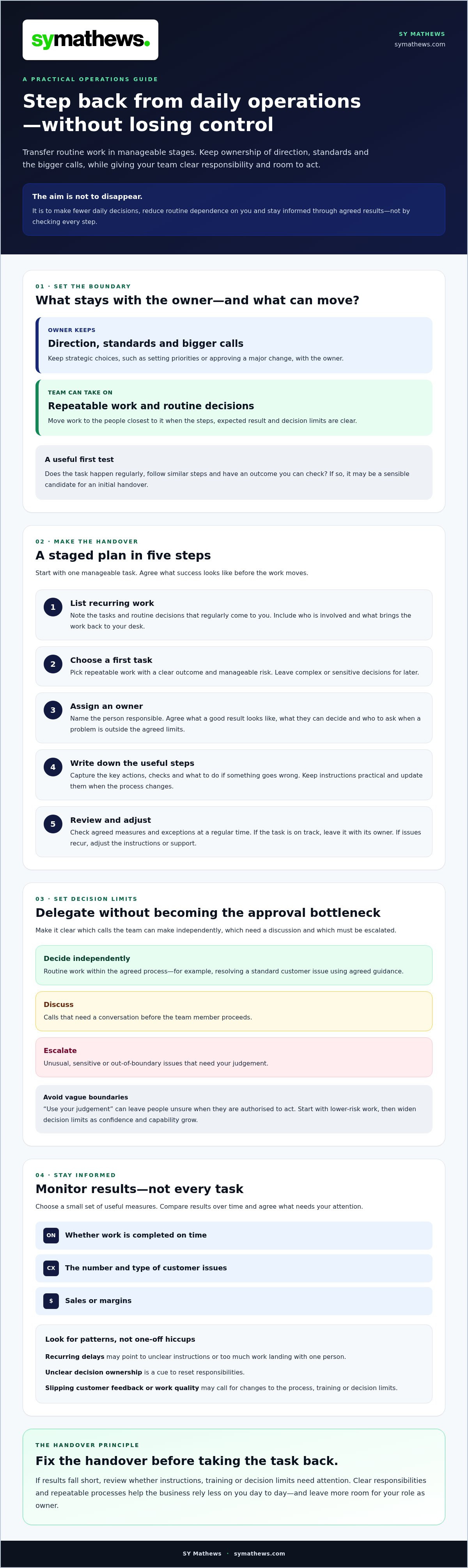
You want fewer daily tasks on your plate, but customers still need reliable service and you still need to know what’s happening across the business. The goal isn’t to vanish. It’s to transfer routine work and decisions while keeping a clear view of results and stepping in when something needs your judgement.
You remain responsible for the direction of the business, its standards and the bigger calls. Your team can take on repeatable tasks and routine operational decisions within agreed limits. Owner dependency falls when responsibilities, processes and decision limits are clear. That gives people room to act and helps you identify where support is needed, without checking every step.
What should stay with the owner, and what can move to the team?
Keep strategic choices, such as setting priorities or approving a major change, with the owner. Move repeatable work and routine decisions to the people closest to them. For example, a team member might handle a standard customer query using agreed guidance, while you decide how unusual or sensitive cases should be escalated.
List the tasks you believe only you can perform, then ask why each one needs you. Does it depend on your authority, or is the process simply undocumented? Could someone else do it with clear instructions and a boundary for when to ask for help? Tasks that happen regularly, follow similar steps and have an outcome you can check are often sensible candidates for an initial handover.
Delegation can feel risky when quality seems tied to your judgement. Transfer one task with clear expectations, then review the result together. If the outcome falls short, identify whether the instructions, training or decision limits need attention before taking the work back. Succession planning also focuses on preparing people to take on key roles. You can apply that idea to operational responsibilities without handing over ownership.
A Practical Handover Plan for Stepping Back from Daily Operations
If you’re working out how to step back from my business operations, make the change in manageable stages. A clear handover gives your team room to take responsibility and gives you a way to check progress without hovering. Before you begin, be clear about what a successful handover looks like, such as the task being completed to the agreed standard without routine approval from you.
- 1. List recurring work. Note the tasks and routine decisions that regularly come to you. Include how often they happen, who is involved and what tends to bring them back to your desk.
- 2. Choose a first task. Pick repeatable work with a clear outcome and manageable risk. Leave complex or sensitive decisions for later. A standard customer query may be easier to hand over than an unusual complaint that requires your judgement.
- 3. Assign an owner. Name the person responsible and agree what a good result looks like. Make sure they know what they can decide independently and who to ask if a problem falls outside the agreed limits.
- 4. Write down the useful steps. Capture what someone needs to repeat the task reliably: the order of key actions, any checks and what to do if something goes wrong. Keep the instructions practical, and update them when the process changes.
- 5. Review and adjust. Set a regular time to check agreed measures and exceptions. If the task is on track, leave it with its owner. If issues keep coming up, adjust the instructions or support rather than automatically taking the task back.
How do you delegate without becoming the approval bottleneck?
Agree which calls the team can make independently, which need a discussion and which must be escalated. For example, a team member might resolve a standard issue using the agreed process but bring an unusual customer concern to you. Be specific about the boundary: vague instructions such as “use your judgement” can leave people unsure when they’re authorised to act. Start with lower-risk work, then widen decision limits as their confidence and capability grow.
Clear, usable processes make those boundaries easier to follow. Explore these practical business systems articles for more ideas on making everyday work easier to repeat and hand over.
Keep the Business on Track as You Step Back from Operations
Visibility doesn’t mean checking every task. Choose a small set of measures that shows whether the handover is working. You might track whether work is completed on time, the number and type of customer issues, and sales or margins. Compare results over time and agree what needs your attention. This helps you focus on meaningful changes rather than reacting to every small wobble.
Look for patterns, not one-off hiccups. Recurring delays may point to unclear instructions or too much work landing with one person. If nobody is sure who owns a decision, reset responsibilities. If customer feedback or work quality slips, check whether the process, training or decision limits need adjusting. The aim is to fix the handover, not automatically take the task back.
When can an on-site business adviser help with the transition?
An adviser can help you spot where decisions still depend on you and prioritise realistic changes. On-site support may also help turn agreed changes into usable systems and clearer responsibilities. For small businesses, SY Mathews offers business advisory support, including a structured 13-week program aimed at improving sales and margins, finding hidden profits, building usable systems and reducing owner dependency. These are program aims, not promised results.
If you’d like help shaping a practical plan, explore business advisory support. It can be a useful next step when you’re deciding what to monitor and where to focus first.
Make Your Next Handover a Step Towards More Room
Stepping back doesn’t mean disappearing. It means moving routine work and decisions to the team with clear responsibilities, practical processes and boundaries for when to involve you. To work out how to step back from my business operations, start small, then review a few useful measures and adjust the handover when patterns show it needs attention.
If you’d like help identifying where the business still depends on you and choosing practical priorities, SY Mathews offers dedicated on-site support for small businesses and a structured 13-week advisory program. Its aims include improving sales and margins, finding hidden profits and reducing owner dependency.
Choose one handover to begin. Each clear step can make more space for you to focus on the owner’s role.
Frequently Asked Questions
How do I step back from my business operations?
To work out how to step back from my business operations, list the recurring tasks and decisions that keep coming to you. Choose one manageable task, name the person responsible and agree what they can decide. Write down the essential steps and checks, including when to ask for help. Hand over gradually, then review how it’s going before passing across more responsibility.
Can a small business run without its owner being involved every day?
Yes, a small business can rely less on its owner day to day when people know what they’re responsible for and have clear processes to follow. The owner still needs appropriate oversight. Agree what information to review, such as completed work, customer issues or sales, and which exceptions should be raised. That keeps you informed without requiring you to manage every task.
How do I delegate business tasks without losing control?
Set clear decision boundaries before handing over a task. Spell out what the team member can decide, when they should consult you and what must be escalated. Start with repeatable, lower-risk work, then expand responsibility as their confidence grows. Check agreed measures at regular intervals and discuss exceptions, rather than asking to approve every small decision along the way.
When should a business owner start stepping back from daily operations?
Start reviewing owner-held tasks when daily requests crowd out planning, team support or other leadership work. Choose a manageable handover and adjust the pace to the team’s readiness. SY Mathews provides on-site advisory support for small businesses in Campbelltown, Ingleburn, Minto, Liverpool, Parramatta, Milperra, Padstow, Revesby, Chullora, Smithfield, Wetherill Park, Fairfield, Regents Park, Lidcombe and Silverwater, including a structured 13-week program.

Article by
Sy Mathews
Sy Mathews is practical, down-to-earth and hands-on. He has owned and run businesses in Sydney and Melbourne at various times over the last fifty years, created, operated and sold them to larger companies in tourism, logistics, aviation, he understand the 'hands-on' of business ownership and the challenges it presents. He is motivated to assist owners to get out from under the burden of running and owning, into the freedom that independent business owners deserve to enjoy.
General information
Our articles are intended as general information. I personally work on-site with clients to provide tailored solutions specifically for the business.
I do not offer financial, investment or legal advice. If required, I can assist in recommending professionals in those areas. I take no fees or commissions from third parties, my recommendations are authentic and carry no hidden costs.


