

What happens when the person who knows your customers, handles difficult decisions and keeps essential work moving is suddenly unavailable? Even a routine absence can cause delays, missed details and an owner pulled back into every problem. Key person dependency risk mitigation isn’t about making everyone replaceable. It’s about making important work easier for someone else to pick up.
You may already know who the go-to people are. The harder part is identifying which tasks and knowledge only they can manage, then creating backup arrangements your team will use. This guide explains how to find the biggest gaps, document what matters and cross-train people without adding unnecessary complexity. You’ll also learn how to keep customer service and day-to-day operations moving when someone is away or moves on.
Key Takeaways
- Map essential tasks to the people who handle them, then identify what could stall if they’re unavailable.
- Use key person dependency risk mitigation to prioritise exposed work, record essential information and assign a backup.
- Keep procedures concise and practical, with clear owners, access requirements and decision limits.
- Schedule regular checks and simple handover tests to identify gaps and improve coverage.
Key person dependency risk: find the work your business cannot afford to lose
A key-person dependency exists when essential knowledge, decisions or tasks sit with one person and their absence could disrupt the business. Specialisation becomes a continuity risk when nobody else can cover the work and waiting would cause a real problem.
For example, a staff member might specialise in a technical task, while a documented process and trained backup keep it covered. But if only the owner knows which supplier to call when a delivery fails, even a short absence could delay customer orders. Key person insurance may offer financial protection, but it won’t transfer knowledge or keep daily tasks moving.
How to spot single-person bottlenecks before they disrupt work
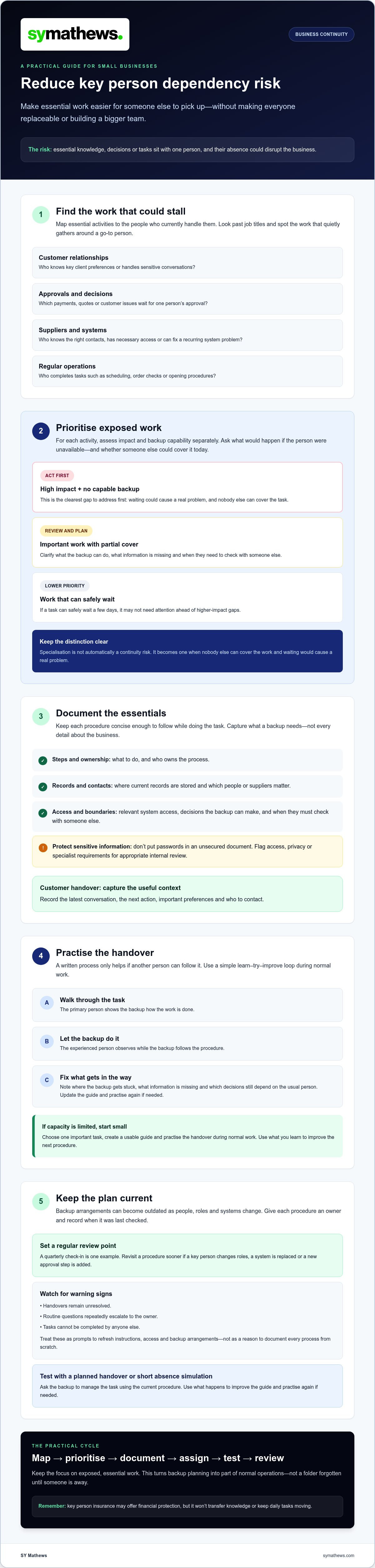
List essential activities and the person who currently handles each one. Look beyond job titles to the work that can quietly gather around a go-to person:
- Customer relationships: Who knows key client preferences or handles sensitive conversations?
- Approvals and decisions: Which payments, quotes or customer issues wait for one person’s approval?
- Suppliers and systems: Who knows the right contacts, has the necessary access or can fix a recurring system problem?
- Regular operations: Who completes tasks such as scheduling, order checks or opening procedures?
For each activity, record what would happen if the person were unavailable and whether someone else could cover it today. Assess impact and backup capability separately. A high-impact task with no capable backup deserves attention first. If a task can safely wait a few days, it may be a lower priority. This simple map shows where key person dependency risk mitigation should begin, without treating every piece of specialist knowledge as an emergency.
How to mitigate key person dependency risk without building a bigger team
You don’t need a large team or a manual for every task. Start with the highest-impact gap on your risk map, then prioritise it, document the essentials, assign a backup and test the handover. This makes key person dependency risk mitigation manageable, even when everyone is busy.
What to document, delegate and cross-train first
Make each procedure short enough to follow while doing the task. Include the steps, who owns the process, where current records are stored, key contacts, relevant system access and the decisions the backup can make. Be clear about when they need to check with someone else. Don’t put passwords in an unsecured document. Flag access, privacy or specialist requirements for appropriate internal review.
For a customer handover, record the latest conversation, the next action, important preferences and who to contact. The primary person can first walk the backup through the task. Then the backup can do it while the experienced person observes. A written process is only useful if someone else can follow it.
If spare capacity is limited, keep the first step small. Choose one important task, create a usable guide and practise the handover during normal work. Guidance on everyday business continuity also focuses on identifying essential functions and planning for disruption. Treat it as a useful framework, not Australian regulatory advice.
Use what you learn to improve the next procedure. Clarify confusing steps before documenting another task. If practical business systems are on your improvement list, explore SY Mathews’ business advisory blog for further ideas.
Make key person risk mitigation part of everyday business continuity
A backup plan can become outdated as people, roles and systems change. Give each procedure an owner and record when it was last checked. Set a regular review point, such as a quarterly check-in, and revisit the procedure sooner if a key person changes roles, a system is replaced or a new approval step is added.
How to keep backup arrangements useful as the business changes
Watch for practical signs that the business relies too heavily on one person: unresolved handovers, routine questions repeatedly escalated to the owner, or tasks nobody else can complete. Use these as prompts to refresh instructions, access and backup arrangements. They don’t mean you need to document every process from scratch.
Test the plan with a planned handover or a short absence simulation. Ask the backup to manage the task using the current procedure. Then note where they get stuck, what information is missing and which decisions still depend on the usual person. Update the guide and practise again if needed. That’s how key person dependency risk mitigation becomes part of normal operations, rather than a folder that’s forgotten until someone is away.
For small businesses in South-West Sydney, SY Mathews provides business advisory support through a structured 13-week programme with dedicated on-site support. The programme focuses on improving sales and margins, finding hidden profits, creating usable systems and reducing owner dependency. If practical systems are an improvement priority, explore SY Mathews’ business systems insights.
Build a business that keeps moving
Key-person risk rarely disappears overnight, but you can make essential work less dependent on one person. Start by identifying tasks that could stall. Record the key steps and contacts, give someone else the opportunity to practise the work, and update the process when roles or systems change.
That’s the purpose of practical key person dependency risk mitigation: make important knowledge easier to find, share and use. A simple handover test can show whether your backup arrangements work in practice or need adjustment.
For small businesses across South-West Sydney, including Campbelltown, Ingleburn, Minto, Liverpool and Parramatta, SY Mathews provides business advisory support with dedicated on-site guidance through a structured 13-week programme. Its focus includes usable business systems and reducing owner dependency.
You don’t have to fix every gap at once. Start with one task and make the next absence or change easier to manage.
Frequently Asked Questions
What is key person dependency risk?
Key person dependency risk is the chance that important work will stall or suffer because one person holds essential knowledge, relationships, system access or decision-making responsibility. It can exist even when that person is dependable. It becomes a continuity issue when no practical backup can keep critical tasks moving during an absence or transition.
How can a small business reduce reliance on one person?
To reduce reliance on one person, list essential tasks and identify where only one person can complete or approve them. For small businesses in Campbelltown, Ingleburn, Minto, Liverpool, Parramatta, Milperra, Padstow, Revesby, Chullora, Smithfield, Wetherill Park, Fairfield, Regents Park, Lidcombe and Silverwater, start with one high-impact task: document its steps, name a backup, practise the handover and review the procedure when roles or systems change.
What should a key person dependency plan include?
A useful plan names the critical tasks at risk, who usually handles each one and who can step in. Add concise instructions, required system access, key contacts, handover points and clear limits on decisions the backup can make. Assign someone to keep each procedure current, record when it was last reviewed and test whether the backup can complete the work.
Is key person dependency the same as key person insurance?
No. Key person dependency is an operational risk: essential work or knowledge rests with one person. Key person insurance is a financial product that may help address certain business losses following that person’s death or incapacity. It won’t transfer knowledge or keep tasks moving. Consider operational continuity separately, and seek advice from a qualified insurance professional about cover.

Article by
Sy Mathews
Sy Mathews is practical, down-to-earth and hands-on. He has owned and run businesses in Sydney and Melbourne at various times over the last fifty years, created, operated and sold them to larger companies in tourism, logistics, aviation, he understand the 'hands-on' of business ownership and the challenges it presents. He is motivated to assist owners to get out from under the burden of running and owning, into the freedom that independent business owners deserve to enjoy.
General information
Our articles are intended as general information. I personally work on-site with clients to provide tailored solutions specifically for the business.
I do not offer financial, investment or legal advice. If required, I can assist in recommending professionals in those areas. I take no fees or commissions from third parties, my recommendations are authentic and carry no hidden costs.


