

What if your business could keep moving when you’re not there to answer every question? If routine decisions keep landing back on your desk, handing off tasks alone won’t fix the bottleneck. Creating a self-managing business means giving your team clear boundaries and practical ways to make decisions, not just a longer to-do list.
It makes sense to feel cautious about delegating when expectations and processes aren’t clear. This guide shows you how to build that clarity, help your team act with confidence and make more time for higher-value work. You’ll find practical steps for improving systems, decision-making and accountability. SY Mathews’ structured 13-week advisory program provides dedicated on-site support for small businesses putting improvements into practice.
Key Takeaways
- Spot the decisions that keep coming back to you, then choose one owner bottleneck to tackle first.
- Creating a self-managing business takes more than handing off tasks. Give people clear decision-making authority within agreed boundaries.
- Build short, useful procedures around the outcome you need, then update them when the team finds a better way to work.
- Use a few practical measures to see whether a process needs coaching, clearer ownership or a refresh.
Creating a Self-Managing Business Starts with Finding the Owner Bottleneck
A self-managing business isn’t one where the owner disappears. It’s one where work gets done reliably and routine decisions are made without constant owner input. Start by identifying where your involvement has become the default.
Delegating a task means asking someone to complete it while you still make the decisions. Transferring authority means agreeing on the result, boundaries and when to escalate, then letting that person handle routine situations within those limits. That distinction is central to creating a self-managing business.
How can you tell whether your business relies too heavily on you?
Look for observable signs: routine approvals waiting in your inbox, the same instructions being explained repeatedly, or handovers that leave work unresolved. These patterns often point to unclear ownership or guidance, rather than a team that can’t take responsibility. For more ideas, explore our small business improvement articles.
Try a quick bottleneck audit. Over a typical week, note:
- Interruptions and repeated questions that pull you into routine work.
- Approvals your team could make within clear limits.
- Tasks that stall when you’re unavailable, including incomplete handovers.
Sort your notes into decisions that need your role and those that could be handled by someone else. Setting direction or dealing with sensitive matters may remain with you. For other decisions, define the outcome, information needed and limits that would help a team member act confidently. A short process can make the handover repeatable. This is the practical side of business process management: understanding how work flows so the next step doesn’t depend on one person remembering it.
How to Create a Self-Managing Business in Practical Steps
Keep the first change small. Choose work that happens often, follows a recognisable pattern and has a clear result. A repeatable customer enquiry or stock check may be a better starting point than a rare, high-stakes decision. Creating a self-managing business is easier when you improve one handover, learn from it, then build on what works.
What should you systemise and delegate first?
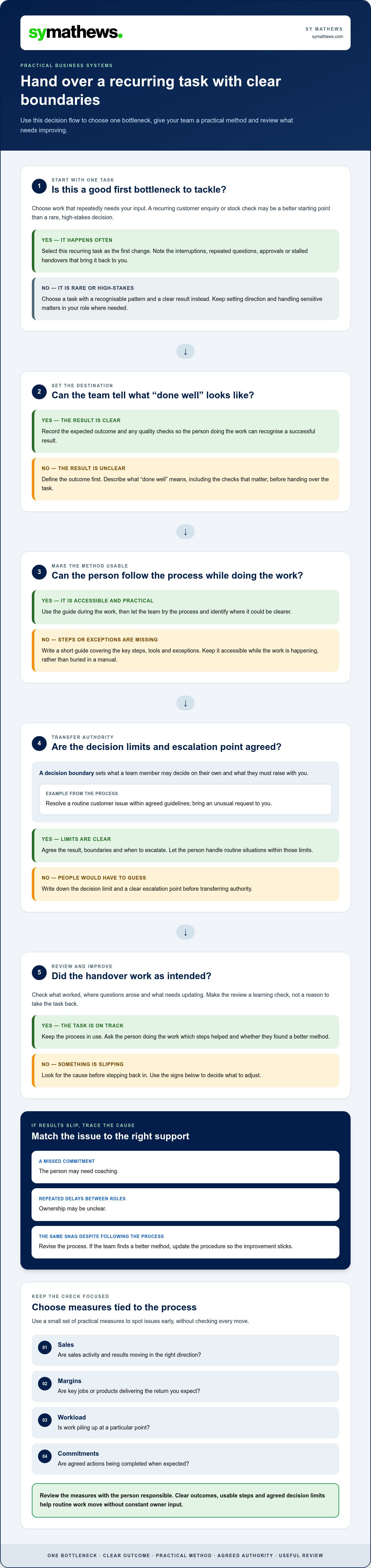
Use this five-step sequence:
- Choose one bottleneck: Select a recurring task that needs too much owner input.
- Define the outcome: Describe what “done well” looks like, including any quality checks.
- Document the method: Write a short guide with the key steps, tools and exceptions. Keep it accessible while the work is happening, not buried in a manual.
- Delegate authority: Set limits for decisions and explain when to escalate.
- Review: Check what worked, where questions arose and what needs updating.
A decision boundary is what a team member may decide on their own, and what they must raise with you. For example, someone might resolve a routine customer issue within agreed guidelines, but bring an unusual request to you. Write down the limit and a clear escalation point so people can act without guessing.
Make the review a learning check, not a reason to take the task back. Ask the person doing the work where the guide was unclear and which steps caused delay or rework. If they find a better method, update the procedure so the improvement sticks. Drucker’s Managing Oneself offers a useful prompt to reflect on where your own strengths are best used, rather than keeping every familiar task on your plate.
For practical ideas to keep improving how work gets done, explore these business systems and improvement articles.
Keep a Self-Managing Business on Track with Support and Clear Measures
Delegation works best when you can see whether the work is on track without checking every move. Choose a small set of measures that helps you spot issues early, rather than building a dashboard nobody has time to use. Pick measures that relate directly to the process you’ve handed over.
- Sales: Are sales activity and results moving in the right direction?
- Margins: Are key jobs or products delivering the return you expect?
- Workload: Is work piling up at a particular point?
- Commitments: Are agreed actions being completed when expected?
Review the measures with the person responsible. If a result slips, look for the cause before stepping back in. A missed commitment may mean the person needs coaching. Repeated delays between roles may point to unclear ownership. If people follow the process but still hit the same snag, revise the process. This keeps accountability steady without turning every problem into an owner approval.
When can an on-site business adviser help make the change stick?
A fresh perspective and structured follow-through can help turn priorities into daily practice. On-site business advisory can help identify what to tackle, clarify responsibilities and shape usable systems with the team. SY Mathews provides dedicated on-site support for small businesses in Campbelltown, Ingleburn, Minto, Liverpool, Parramatta, Milperra, Padstow, Revesby, Chullora, Smithfield, Wetherill Park, Fairfield, Regents Park, Lidcombe and Silverwater. Its structured 13-week program focuses on improving sales and margins, finding hidden profits and creating practical business systems.
Explore SY Mathews’ on-site business advisory support to put clearer measures and practical systems to work.
Make More Room for the Work Only You Can Do
Creating a self-managing business starts with noticing where work still depends on you. Find one recurring bottleneck, set a clear outcome and give your team authority to handle decisions within agreed limits. Then review a few useful measures and improve the process if it needs clearer guidance, ownership or steps.
You don’t have to turn every improvement into a system on your own. SY Mathews provides dedicated on-site support to small businesses through a structured 13-week advisory program, focused on sales, margins, hidden profits and usable business systems.
Start with one change, give your team room to build confidence and keep improving as you go. Steady progress can make more space for the work that moves your business forward.
Frequently Asked Questions
What is a self-managing business?
A self-managing business keeps suitable work moving without the owner making every routine decision. The team understands who owns each task, what a good result looks like and which decisions they can make independently. The owner still sets direction and handles responsibilities that need their input. Clear processes and accountability help the business work consistently, even when the owner is unavailable.
Can a small business run without its owner?
A small business can handle routine operations without the owner being involved in every step, but that doesn’t mean the owner has no role. The team needs clear responsibilities, workable systems and agreed limits for decisions. SY Mathews provides on-site advisory support to small businesses in Campbelltown, Ingleburn, Minto, Liverpool, Parramatta, Milperra, Padstow, Revesby, Chullora, Smithfield, Wetherill Park, Fairfield, Regents Park, Lidcombe and Silverwater.
How do I start creating a self-managing business?
Start by identifying one recurring task or decision that regularly comes back to you. Define the outcome, write down the essential steps and clarify what the team member can decide without escalation. Then review how the handover is working. Creating a self-managing business is gradual: use what you learn to improve the guidance before moving on to another bottleneck.
Does a self-managing business need automation?
No. Automation can help with suitable repetitive tasks, but it isn’t a requirement. Start by making the process clear enough for someone to follow and own. If a manual step causes repeated delays or errors, consider whether a tool could help. Keep the focus on reliable work and sensible decisions, not adding technology for its own sake.

Article by
Sy Mathews
Sy Mathews is practical, down-to-earth and hands-on. He has owned and run businesses in Sydney and Melbourne at various times over the last fifty years, created, operated and sold them to larger companies in tourism, logistics, aviation, he understand the 'hands-on' of business ownership and the challenges it presents. He is motivated to assist owners to get out from under the burden of running and owning, into the freedom that independent business owners deserve to enjoy.
General information
Our articles are intended as general information. I personally work on-site with clients to provide tailored solutions specifically for the business.
I do not offer financial, investment or legal advice. If required, I can assist in recommending professionals in those areas. I take no fees or commissions from third parties, my recommendations are authentic and carry no hidden costs.


