

What if exhaustion is a signal to pause and look closer, not proof you’ve failed? If you’ve caught yourself thinking, “I’m tired of running my business,” you’re not alone in feeling worn down by constant decisions, customer issues and staff questions. It can be hard to tell whether the real drain is the workload, business performance or the way work is organised. And when people’s jobs and your income depend on the business, changing things can feel like a gamble.
You don’t have to make a major decision before you understand what’s wearing you down. Start by identifying the pressure points, then choose a manageable change to workload, sales or operations and track whether it helps. This article walks through practical ways to diagnose the cause and decide whether hands-on business support could help turn priorities into action.
Key Takeaways
- If you’re tired of running my business, trace the strain to specific pressure points such as margins, unpredictable sales or unclear accountability.
- Record what’s weighing on you, review relevant business measures and choose one issue to address before making a major decision.
- Use KPIs and reporting to make changes visible, then review progress without expecting one adjustment to fix everything.
- SY Mathews’ on-site, 13-week Business Improvement Program moves from diagnosis and priority planning to sales and margins, operations and accountability, then execution and growth management.
Tired of Running Your Business? Find What Is Draining You
Feeling worn out by the business doesn’t mean you have to quit, sell or simply push harder. It means something deserves a closer look. If you’re thinking, “I’m tired of running my business,” separate the feeling from the decision. First, identify what’s taking the most energy and whether the strain is temporary or built into the way the business runs.
Business exhaustion is a prompt to investigate the work and conditions creating it. The cause could be a packed workload, unpredictable sales, pressure on margins, operational bottlenecks or unclear accountability. More than one factor may be contributing.
Is the problem the workload, the business model or both?
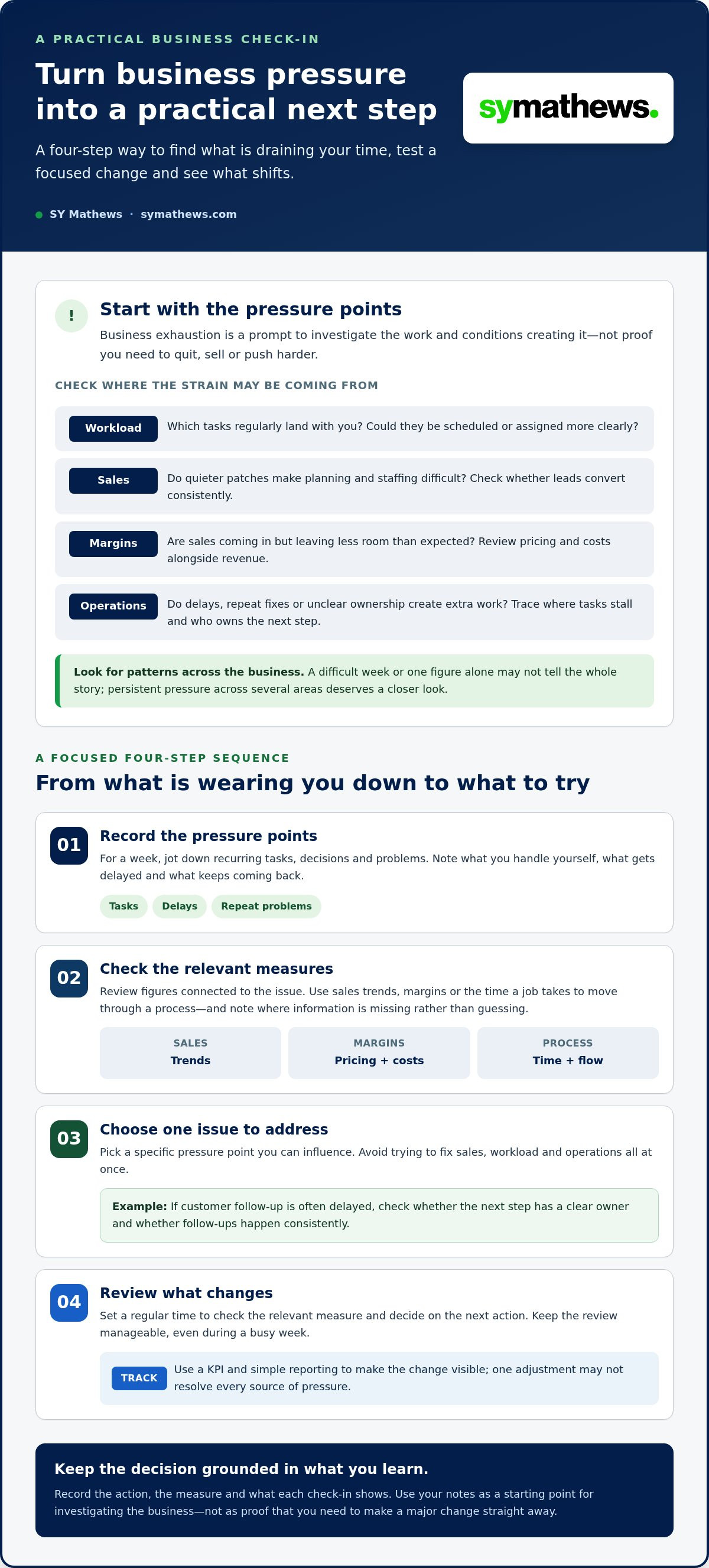
For a week, jot down recurring tasks, decisions and problems that keep pulling your attention away. Note what you handle yourself, what gets delayed and what keeps coming back. This record can help distinguish between too much work, repeated interruptions and processes that create avoidable effort.
- Workload: Which tasks regularly land with you, and could any be scheduled or assigned more clearly?
- Sales: Do quieter patches make planning and staffing difficult? Look at whether leads are converting consistently.
- Margins: Are sales coming in, but leaving less room than expected? Review pricing and costs alongside revenue.
- Operations: Do delays, repeat fixes or unclear ownership create extra work? Trace where tasks stall and who is responsible for the next step.
Review recent sales, margins and operational issues together. Look for patterns, such as the same delays appearing during busy periods, but don’t draw a firm conclusion from one difficult week or a single figure. A temporary rush may ease; persistent pressure across several areas calls for a closer look at how the business is working.
Descriptions of occupational burnout can help you understand the term, but they aren’t a diagnosis. Use your notes as a starting point for investigating the business, not as proof that you must make a major change straight away.
How to Make a Practical Change Without Rushing a Big Decision
You don’t need to overhaul the business to make progress. A small, focused change can help you test what’s causing friction before making a bigger call. If you’re thinking, “I’m tired of running my business,” use this sequence to turn that feeling into a practical next step.
- Record the pressure points. Write down recurring tasks, delays and problems that take time or create rework.
- Check the relevant measures. Review figures connected to the issue, such as sales trends, margins or the time a job takes to move through a process. Note where information is missing rather than guessing.
- Choose one issue to address. Pick a specific pressure point you can influence instead of trying to fix sales, workload and operations all at once.
- Review what changes. Set a regular time to check the relevant measure and decide on the next action. Keep the review manageable, even during a busy week.
What can you change first when you feel stretched?
Start with a task or process that repeatedly lands back on your desk. Write down who handles each part, where work stalls and what would count as a useful improvement. For example, if customer follow-up is often delayed, check whether the next step has a clear owner and whether follow-ups happen consistently. A KPI and simple reporting can show whether the change is helping, though one adjustment may not resolve every source of pressure.
Keep a brief record of the action, the measure and what you learn at each check-in. Practical small business articles can help you explore ideas that may suit your business. Use them to shape a focused test, then review your own business measures to see whether it’s helping. If you’d value hands-on help turning priorities into action, explore business improvement support.
When Western Sydney Business Support Could Help You Move Forward
If you’re thinking, “I’m tired of running my business,” an outside perspective can help turn a long list of concerns into clear priorities. SY Mathews works with privately owned Western Sydney businesses with 5-50 employees and/or contractors. Its hands-on, on-site 90-Day Business Improvement Program is a structured 13-week engagement focused on improving commercial performance, operational control and profitability.
What does hands-on support look like over 13 weeks?
The program follows four phases, each with a practical focus:
- Weeks 1-2: Review performance, identify constraints, establish KPIs and prioritise opportunities.
- Weeks 3-6: Improve the sales process, lead conversion, pricing structure and revenue consistency to focus on sales and margins.
- Weeks 7-10: Identify bottlenecks, improve workflow and put clearer accountability in place.
- Weeks 11-13: Consolidate improvements, optimise performance and prepare for the next growth stage.
Weekly working sessions, KPI tracking and reporting make performance and progress visible. Accountability, implementation support and practical business improvement guidance help keep agreed actions moving. The measures give you a clearer view of what’s changing and where further attention may be needed.
The program is designed for businesses in trades and construction, industrial and manufacturing, wholesale and distribution, retail, and professional services. It begins with a free, 50-minute on-site diagnostic session to assess the business, identify performance gaps and quantify additional profit potential. The session is an assessment that helps clarify where attention may be needed.
For business owners in Campbelltown, Ingleburn, Minto, Liverpool, Parramatta, Milperra, Padstow, Revesby, Chullora, Smithfield, Wetherill Park, Fairfield, Regents Park, Lidcombe and Silverwater, you can arrange a free 50-minute diagnostic and take a practical first step towards deciding what support could help you move forward.
Choose a Clear Next Step
The thought “I’m tired of running my business” doesn’t have to decide your future for you. Treat it as a reason to pause, get a clearer view and choose a next step that fits your situation. You can move forward without having every answer today.
SY Mathews’ founder brings over 40 years of commercial experience and has built and sold multiple businesses. The 13-week on-site program pairs practical guidance with KPI tracking, reporting, accountability and implementation support, helping you keep priorities in view as you put agreed actions into practice. The fixed fee is $14,300.00, invoiced weekly or monthly in advance to suit your cash-flow preference.
You don’t need a perfect plan to begin. A free, 50-minute on-site diagnostic can help you understand performance gaps and quantify additional profit potential.
Take it one step at a time. A clearer picture can make the next move feel more manageable.
Frequently Asked Questions
What should I do first if I am tired of running my business?
Start by capturing the work that repeatedly takes your time or energy. If you’re thinking, “I’m tired of running my business,” note the task, how often it comes up and who currently handles it. Compare your notes with relevant sales, margin or operations information. Look for a specific pressure point to investigate instead of treating one difficult day as a reason to make a major business decision.
Is it normal to feel tired of running a small business?
It can happen when the workload, business performance or daily demands feel hard to sustain. That feeling alone doesn’t tell you whether to leave the business. Consider what has changed, whether the strain is ongoing and which parts of your role contribute to it. Pressure tied to one short-term project, for example, may call for a different response from repeated problems across everyday operations.
Can business advisory support help when I feel overwhelmed?
Hands-on advisory can help eligible owners examine performance gaps and work through practical priorities. SY Mathews’ 13-week program is for privately owned Western Sydney businesses with 5-50 employees and/or contractors. It includes weekly working sessions, KPI tracking and reporting, accountability, implementation support and practical guidance. These measures help you see what is changing as you put agreed actions into practice.
What happens in the free business diagnostic session?
It’s a 50-minute on-site assessment of your business. The session explores performance gaps and quantifies additional profit potential, but it is not the full program. It is available to businesses in Campbelltown, Ingleburn, Minto, Liverpool, Parramatta, Milperra, Padstow, Revesby, Chullora, Smithfield, Wetherill Park, Fairfield, Regents Park, Lidcombe and Silverwater.

Article by
Sy Mathews
Sy Mathews is practical, down-to-earth and hands-on. He has owned and run businesses in Sydney and Melbourne at various times over the last fifty years, created, operated and sold them to larger companies in tourism, logistics, aviation, he understand the 'hands-on' of business ownership and the challenges it presents. He is motivated to assist owners to get out from under the burden of running and owning, into the freedom that independent business owners deserve to enjoy.
General information
Our articles are intended as general information. I personally work on-site with clients to provide tailored solutions specifically for the business.
I do not offer financial, investment or legal advice. If required, I can assist in recommending professionals in those areas. I take no fees or commissions from third parties, my recommendations are authentic and carry no hidden costs.


