
What if a lower advisory fee leaves you with a plan but no help putting it to work? Comparing small business advisor fees Australia can be difficult when one option is a short conversation and another is structured, hands-on support.
It’s reasonable to want to know exactly what you’re paying for and whether the work addresses a real business problem. This guide explains what can shape advisory fees and how to compare the scope, practical support and intended improvements. A higher fee doesn’t automatically mean better value.
SY Mathews provides a structured, dedicated on-site 13-week programme focused on improving sales and margins, finding hidden profits, creating usable systems and reducing owner dependency. The goal is practical progress, not advice that sits on a shelf.
Key Takeaways
- Compare small business advisor fees Australia by looking at the scope of support, not just the fee structure.
- Separate general government-funded guidance from privately engaged, hands-on advisory support to understand what each is designed to do.
- Consider how your goals, the work involved and on-site support needs around south-west Sydney shape an advisory engagement.
- Explore whether a structured 13-week programme’s focus on sales, margins, usable systems and reduced owner dependency fits your business priorities.
Small business advisor fees in Australia: what are you paying for?
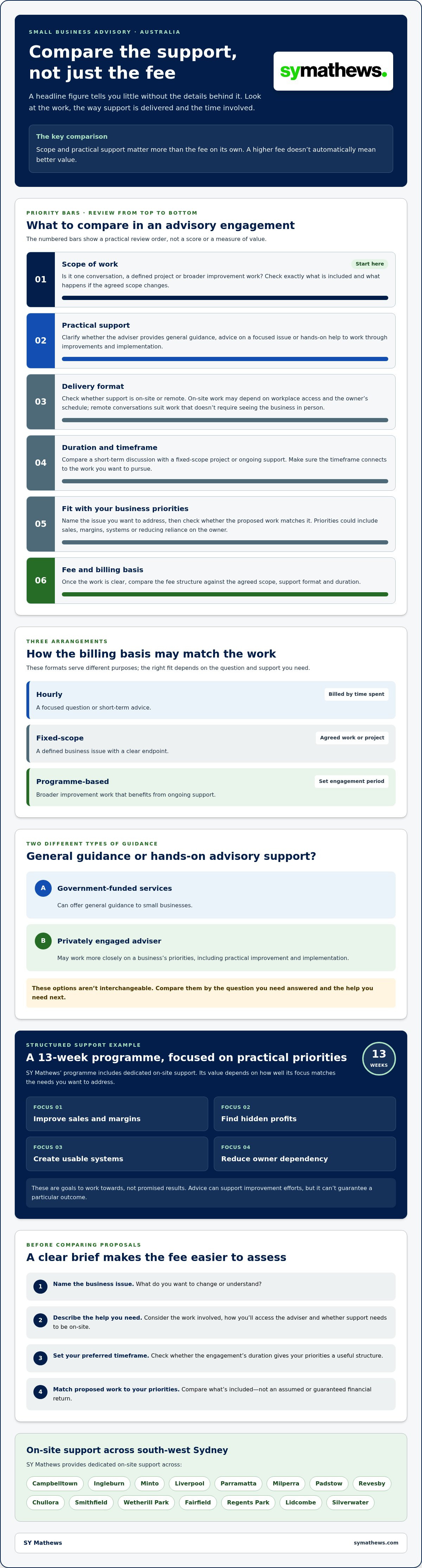
It’s understandable to feel unsure about small business advisor fees Australia. A headline figure tells you little without the details behind it. Is the work a single conversation, a defined project or ongoing help to put changes into practice? The scope and support matter more than the fee on its own.
Government-funded services can offer general guidance to small businesses. A privately engaged adviser may work more closely with a business on its priorities, including practical improvement and implementation. These options serve different purposes, so free guidance and hands-on advisory support aren’t interchangeable. The right fit depends on the question you need answered and what kind of help you need next. For context on the businesses this support is designed for, see Small and medium enterprises in Australia.
| Arrangement | Billing basis | Typical fit |
|---|---|---|
| Hourly | Time spent | A focused question or short-term advice |
| Fixed-scope | Agreed work or project | A defined business issue with a clear endpoint |
| Programme-based | Set engagement period | Broader improvement work that benefits from ongoing support |
What does a small business advisory fee usually reflect?
Advisory fees reflect the agreed scope, delivery format and duration. In practice, consider what work is included, how you’ll access the adviser and how long the engagement runs. A single strategy discussion differs from on-site guidance over a fixed period. Neither format is automatically better. The important question is whether the support matches the problem you want to solve.
Before comparing proposals, write down the business issue, the practical help you’re seeking and your preferred timeframe. Then compare what each engagement includes: the work to be completed, the format of support, and what happens if your priorities or the agreed scope change. This makes it easier to see whether you’re comparing similar kinds of support.
What shapes small business advisor fees around south-west Sydney?
Small business advisor fees Australia can vary because each business has different priorities. A business focused on improving sales may need a different scope from one that wants clearer systems or less day-to-day reliance on its owner. The work involved, delivery format and length of support can all shape an engagement.
Make the fee conversation practical. Start with the business issue, then identify the work that could help address it and the timeframe you have in mind. For example, a focused strategy discussion is different from ongoing support to work through sales, margins and business systems. Compare the proposed work with your priorities, not with a promised financial return. Advice can support improvement efforts, but it can’t guarantee a particular result.
How do location and on-site support affect the engagement?
For a business in Campbelltown, Liverpool or Parramatta, on-site guidance means the adviser works with you at your business rather than relying only on remote conversations. SY Mathews provides dedicated on-site support across Campbelltown, Ingleburn, Minto, Liverpool, Parramatta, Milperra, Padstow, Revesby, Chullora, Smithfield, Wetherill Park, Fairfield, Regents Park, Lidcombe and Silverwater. The fee discussion should make the delivery format and agreed work clear.
Location can shape how an engagement is organised. On-site sessions need to fit around access to the workplace and the owner’s schedule. Remote advice may suit conversations that don’t depend on seeing the business in person. These formats provide different kinds of input, so focus on what the work requires rather than assuming one is automatically better or cheaper.
Before weighing up a tailored scope, note the priorities you want the adviser to focus on and the practical support you’re seeking. You can also explore business advisory insights as you consider what kind of guidance fits.
Is a 13-week business advisory programme worth considering in Sydney?
A fixed-term programme can suit a business owner who wants to work on several connected priorities instead of tackling one question and stopping there. SY Mathews’ structured 13-week programme includes dedicated on-site support. It focuses on improving sales and margins, finding hidden profits, creating usable systems and reducing owner dependency.
These aims connect day-to-day improvements with how the business runs. Usable systems can help make work clearer and more consistent. Reducing owner dependency means examining how much relies on the owner’s direct involvement. These are goals to work towards, not promised results. The programme’s value depends on how well its focus matches the needs you want to address.
What should you assess before starting a fixed-term programme?
Start by naming the changes you want to pursue. Are sales or margins a priority? Do you want to look for hidden profits, create more usable systems or reduce the number of tasks that depend on you? Then consider whether a 13-week timeframe gives those priorities a useful structure. A clear programme links its timeframe to specific business objectives.
When weighing small business advisor fees Australia, consider the programme’s stated purpose and dedicated on-site format alongside the fee. Look for a clear connection between your priorities and the work the engagement is designed to address. That’s a more grounded way to judge fit than expecting a guaranteed financial return.
If you’re in Campbelltown, Ingleburn, Minto or nearby, explore business advisory support and consider whether the programme’s aims align with the improvements you want to pursue.
Choose support that moves your priorities forward
Before deciding, identify what you want to change in your business and what kind of support will help you work towards it. Small business advisor fees Australia are easier to assess when you connect the proposed engagement to priorities that matter, instead of treating the fee as a number in isolation.
For owners seeking a defined period of focused improvement, SY Mathews offers a 13-week advisory programme with dedicated on-site support across south-west Sydney. Its focus is on sales, margins, hidden profits, usable systems and reducing owner dependency. Consider how closely those aims match the changes you want to pursue, without assuming a particular result.
To take the next step, share the business goals you’re working towards and start a conversation with SY Mathews about the programme.
Frequently Asked Questions
Can I get free small business advice in Australia?
Yes, government-funded small-business services may offer general guidance at no charge, though the topics and support available depend on the programme. This can be a useful starting point for general questions. Business owners in Campbelltown, Ingleburn, Minto, Liverpool, Parramatta, Milperra, Padstow, Revesby, Chullora, Smithfield, Wetherill Park, Fairfield, Regents Park, Lidcombe and Silverwater can look into relevant NSW small-business support options.
Are small business advisor fees tax deductible in Australia?
It depends on the nature and purpose of the advice, so don’t assume every fee is deductible. The ATO’s Taxation Determination TD 2024/7 addresses financial advice fees, distinguishing initial advice about new investments from ongoing advice for existing income-producing investments. That determination isn’t a blanket answer for business advisory fees. Keep invoices and engagement details, then ask a registered tax professional how the rules apply to your circumstances.
Is a business advisor the same as an accountant?
No. Their roles can differ. An accountant commonly helps with financial records, tax returns and reporting, while a business advisor may help an owner think through strategy, sales, marketing or business systems. For example, an accountant can prepare financial statements, while an advisor can help use business priorities to shape an improvement plan. Some businesses use both, with each focused on their area of expertise.

Article by
Sy Mathews
Sy Mathews is practical, down-to-earth and hands-on. He has owned and run businesses in Sydney and Melbourne at various times over the last fifty years, created, operated and sold them to larger companies in tourism, logistics, aviation, he understand the 'hands-on' of business ownership and the challenges it presents. He is motivated to assist owners to get out from under the burden of running and owning, into the freedom that independent business owners deserve to enjoy.
General information
Our articles are intended as general information. I personally work on-site with clients to provide tailored solutions specifically for the business.
I do not offer financial, investment or legal advice. If required, I can assist in recommending professionals in those areas. I take no fees or commissions from third parties, my recommendations are authentic and carry no hidden costs.


