

It’s 8:00 PM on a Tuesday. You’re still at the desk fixing a mistake your team should’ve handled hours ago. You feel indispensable. You’re also completely exhausted. Knowing how to delegate effectively in a small business feels like a distant dream when you’re fire-fighting every small issue. It’s frustrating when your team lacks initiative, leaving you as the ultimate bottleneck.
You probably think that if you want it done right, you have to do it yourself. Delegation isn’t about dumping tasks on others. It’s about building systems that buy back your freedom. I’ll show you a simple, system-based approach to help you organise and step back. We’ll look at creating usable processes over a thirteen-week timeline that empower your team to take ownership, allowing you to focus on strategy and better margins.
Key Takeaways
- Stop trading your time for tasks that don't grow your bottom line. Learn why the "Owner Trap" is the biggest cap on your growth and profit margins.
- Master a simple 5-step framework on how to delegate effectively in a small business. You'll learn to audit your week and match the right tasks to the right people.
- Close the knowledge gap by building usable systems. These tools ensure your team performs at your level without you standing over their shoulders.
- Reclaim your freedom and start working on the business instead of in it. Discover how a thirteen-week approach turns your team into an independent powerhouse.
Escaping the Owner Trap: Why Doing It All is Costing You
Many owners think they're building an empire. In reality, they're just the most overworked employee. If you can't step away for a week without the wheels falling off, you don't have a business. You have a high-stress job. This is the "Owner Trap". It feels safe because you have total control, but it caps your growth potential and hides your true profit margins.
Doing everything yourself makes your books look better than they are. If you're performing tasks that a junior staffer could handle, you aren't accounting for the real cost of labour. Mastering Delegation is a survival strategy. It forces you to see where your systems are broken. You need to move from being the "Chief Everything Officer" to a strategic leader who focuses on growth. You can find more tips on our blog about scaling.
Spotting the "I’ll Just Do It Myself" Syndrome
It usually starts with a small mistake by a team member. You think, "It’s faster if I just fix it." This is a mistake. Every time you take a task back, you teach your team to stop thinking. They learn that you'll always provide the answer, so they stop looking for one. This cycle keeps you working 60+ hours a week while your team stays in second gear.
Your time is your most valuable asset. Spending it on low-value admin tasks is a waste of your talent. Understanding how to delegate effectively in a small business means protecting your schedule for high-value strategy. Owner dependency is the primary barrier to small business scaling.
The 5-Step Framework for Effective Delegation
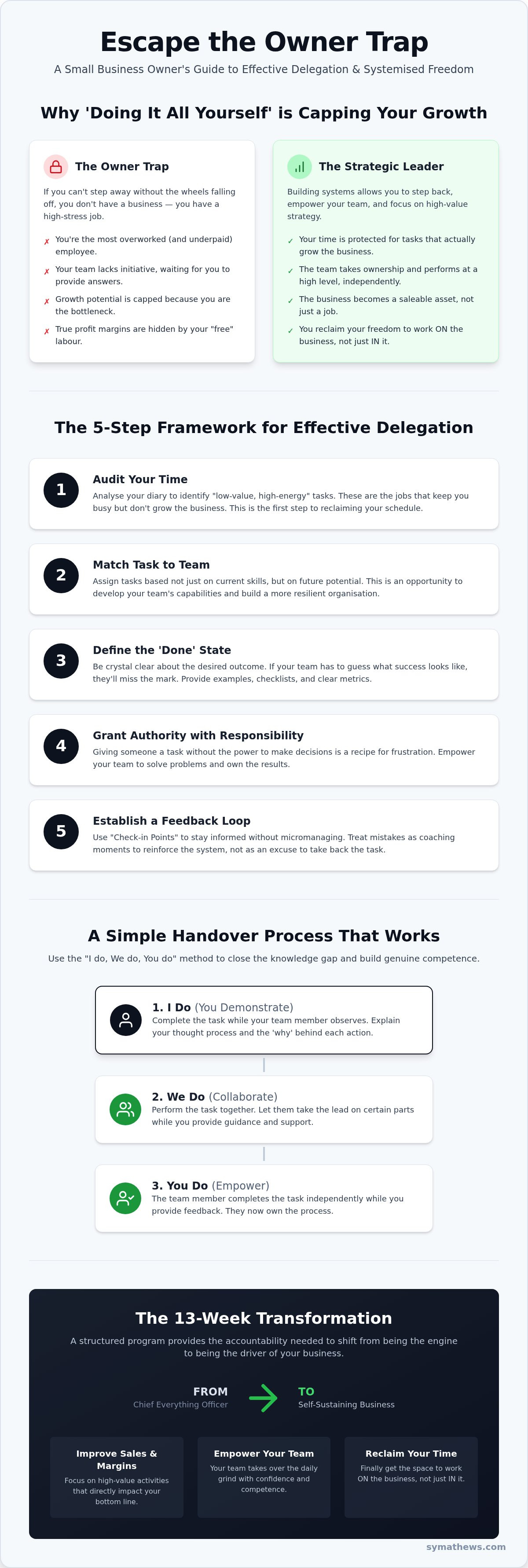
Learning how to delegate effectively in a small business starts with a hard look at your diary. You need to find the "low-value, high-energy" tasks that drain your battery. These are the jobs that keep you busy but don't actually grow the business. Once you've found them, match the job to the right person. Look for current skills but also future potential. While some academic sources offer 9 tips for managers, small owners need a more hands-on approach.
Defining the "Done" state is vital. If your team has to guess what success looks like, they'll likely miss the mark. Be crystal clear about the outcome you want. Mastering how to delegate effectively in a small business means giving them the authority to make decisions. Responsibility without authority is just a recipe for frustration. If you're struggling to let go, our blog has more on building team trust.
A Simple Handover Process That Actually Works
Try the "I do, We do, You do" method for training. First, they watch you complete the task. Next, you do it together. Finally, they take the lead while you provide feedback. This builds genuine competence. Use "Check-in Points" to stay informed without hovering over their shoulder. If they make a mistake, don't snatch the task back immediately. Use it as a coaching moment to reinforce the system. If you want a partner to help you build these habits, we offer outcome based solutions to help you reclaim your time.
Systemising Your Business for Long-Term Freedom
Delegation often falls over because of the "Knowledge Gap". You have all the answers in your head, but your team is flying blind. If you haven't documented your processes, you'll always be the bottleneck. Real freedom comes from creating usable systems. These tools let a new hire perform at your level from day one. It’s about building a business that works so you don’t have to.
Learning how to delegate effectively in a small business is simpler with a partner by your side. A structured advisory approach helps you find hidden profits while you step back from the tools. We provide on-site support across Western Sydney, including Parramatta and Campbelltown. Being there in person makes it easier to implement these systems and see real change. This hands-on help ensures your team actually uses the systems you build, rather than letting them gather dust on a shelf. It's about creating a culture of accountability that lasts.
The 13-Week Transformation to a Self-Sustaining Business
Changing old habits takes more than a weekend. A fixed-term program provides the accountability you need to stop micromanaging for good. Knowing how to delegate effectively in a small business requires a shift in focus. Over thirteen weeks, we work together on improving your sales and margins. This happens while your team takes over the daily grind. It’s a transition from being the engine to being the driver. You'll finally have the space to work on the business instead of just in it. Ready to reclaim your time? Explore our 13-week business advisory program.
Start Building a Business That Works for You
You've seen how the owner trap caps your growth. You know the framework to offload low-value tasks. Now it's time to build the systems that make it stick. Learning how to delegate effectively in a small business is the only way to find hidden profits and reclaim your weekends.
It isn't just about giving away work. It's about creating a team that takes ownership. We help you make this shift through our structured 13-week program. With on-site support across Western Sydney, we focus on building usable systems that relieve owner dependency for good. You don't have to do this alone.
We'll be your partner in turning your job back into a business. Book a business diagnostic to see how we can relieve owner dependency. You've got this.
Frequently Asked Questions
How do I know which tasks I should delegate first in my small business?
Start with tasks that are repetitive and don't require your unique expertise. These are usually admin, basic customer service, or simple scheduling. Track your time for three days to spot these energy-drainers. If a task is low-risk and easy to document, it's the perfect candidate for your first handover. This lets you reclaim your time for high-value leadership work.
What should I do if my employee makes a major mistake after I delegated a task?
Look at the system before you blame the person. Most mistakes happen because a process was vague or a resource was missing. Fix the documentation and walk through it with them again. Taking the task back is a trap that keeps you stuck in the day-to-day grind. Use the error as a coaching moment to build a more resilient team for the future.
How can I delegate effectively when my team is already flat out?
Audit their current workload to find tasks that can be automated or ditched. If the team is flat out, they might be stuck doing busy work that doesn't add value. Knowing how to delegate effectively in a small business involves clearing the path for your staff. You might need to bring in short-term help or freelancers to manage the transition while you organise your systems.
Is it better to delegate the whole project or just small pieces of it?
Delegating the whole project is better for long-term freedom. It gives your team ownership and reduces the number of handovers you have to manage. If you only delegate small pieces, you remain the project manager for everything. This is a core part of how to delegate effectively in a small business. Provide a clear "done" state and let them figure out the best path to get there.

Article by
Sy Mathews
Sy Mathews is practical, down-to-earth and hands-on. He has owned and run businesses in Sydney and Melbourne at various times over the last fifty years, created, operated and sold them to larger companies in tourism, logistics, aviation, he understand the 'hands-on' of business ownership and the challenges it presents. He is motivated to assist owners to get out from under the burden of running and owning, into the freedom that independent business owners deserve to enjoy.
General information
Our articles are intended as general information. We provide mature, on-site advisors who can tailor solutions specifically for your business. We do not offer financial or legal advice, we recommend speaking to a specialist in those areas.


