
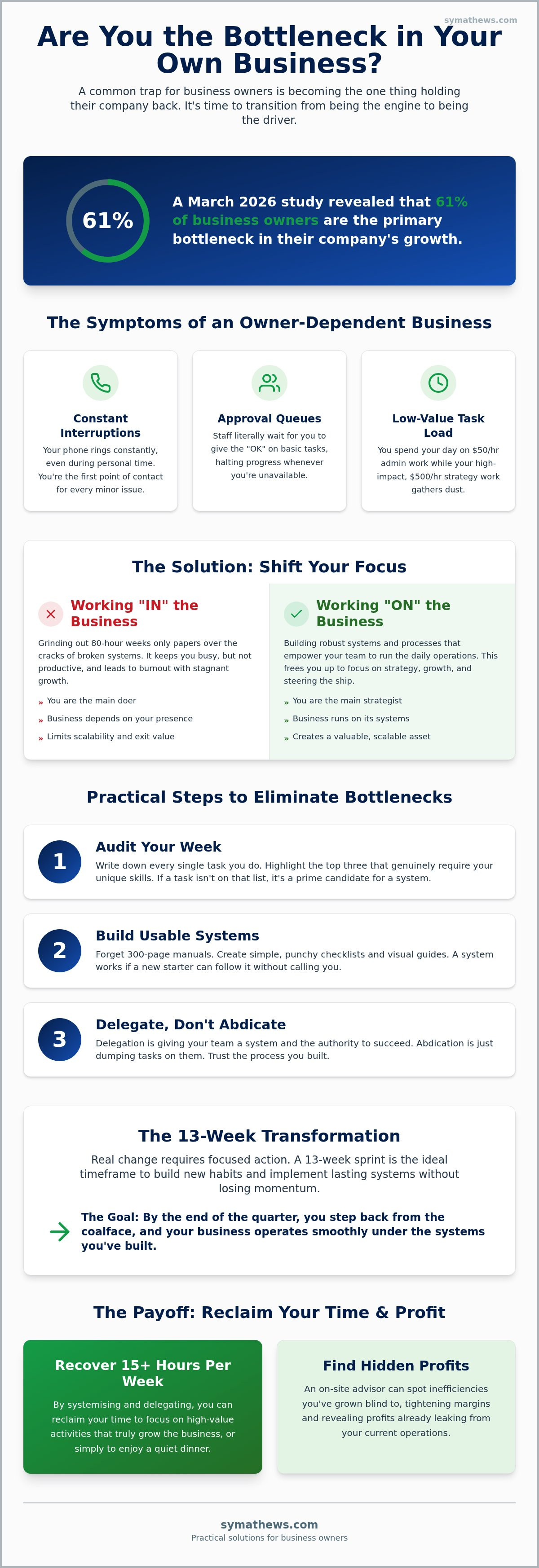
A March 2026 study revealed that 61% of business owners are the primary bottleneck in their own growth. It is a common trap. You likely feel it every time your phone buzzes while you are trying to have a quiet dinner in Parramatta. Working 60 hour weeks with no real growth isn't the dream you signed up for. It is frustrating to feel like the anchor holding your own team back.
We have some practical business owner bottleneck solutions to help you step away from the daily grind. This guide explains how to identify hidden clogs and transition from being the business to truly owning it. You will discover how to recover 15 hours of your week and find the hidden profits currently being wasted. We are looking at how to build a business that runs smoothly in Campbelltown without your constant presence. It is time to stop being the engine and start being the driver.
Key Takeaways
- Spot the signs that your business relies too much on your daily input.
- Audit your week to identify the specific tasks that only you should be doing.
- Implement business owner bottleneck solutions by creating usable systems that your team can follow without you.
- Learn how a 13-week transformation helps you step back from operations and focus on scaling.
- Find hidden profits by inviting an advisor to see your business in action on-site.
What is a Business Bottleneck and Why are You the Culprit?
A bottleneck is a simple concept. It is any point where work slows down because a specific part of the system cannot keep up. In most small businesses, that part is you. Management experts often point to the Theory of Constraints to explain this. It suggests that every process has one specific limit that dictates the speed of the whole operation. If you are the only one who can sign off on a quote or talk to a supplier, the business can only move as fast as you do.
If you are searching for business owner bottleneck solutions, you have likely realised that you are that limit. You have become the "Chief Everything Officer". Being the most skilled person in the room feels good. It makes you feel essential. However, it is actually a failure of leadership. If every decision needs your "OK" to move, nothing moves when you are gone. This creates a business with zero exit value. No one wants to buy a company that breaks the moment the owner takes a holiday. It also keeps your margins stagnant because you cannot scale your own time.
The Symptoms of an Owner-Dependent Business
You can usually tell if you are the clog in the system by looking at your daily habits. It is not just about being busy. It is about how that busyness manifests. Watch for these signs:
- Your phone rings constantly while you are trying to grab a quiet dinner in Parramatta.
- Staff members literally wait in line outside your office to ask for basic approvals.
- You spend the morning doing $50 an hour admin tasks while your $500 an hour strategy work gathers dust.
Why Traditional "Hard Work" is Not the Solution
Most Aussies are taught that working harder fixes everything. It doesn't. Grinding out 80 hour weeks only masks the fact that your systems are broken. You are simply papering over the cracks with your own exhaustion. There is a massive difference between working "in" your business and working "on" it. One keeps the lights on today. The other ensures the lights stay on while you are at the beach. Real business owner bottleneck solutions focus on building systems that don't need your constant permission to function. Hard work is a virtue, but it is a poor substitute for a scalable process.
Practical Steps to Eliminate Bottlenecks and Organise Growth
You have identified the clog. Now you need to clear it. Start with a simple audit of your week. Write down every single thing you do. Highlight the top three tasks that actually require your unique skills. If a task isn't on that list, it is a candidate for a system. Effective business owner bottleneck solutions aren't about complex software. They are about clarity and reclaimed time.
Building Systems That Actually Work
Forget the 300 page manual gathering dust. Nobody reads those. A system is simply a repeatable way to get a predictable result. Focus on simple, punchy checklists instead. If you have a warehouse in Minto or an office in Campbelltown, use visual tools. Put a whiteboard up. Use tape on the floor. If a new starter can follow the steps without calling you, the system works. This is how you move from "doing" to "leading".
Finding Hidden Profits in Your Current Operations
Scaling doesn't always mean finding new customers. Sometimes it means fixing the "Australian Margin Challenge". Look at your local supply chain. Are you overpaying for convenience? Small tweaks in your workflow can reveal hidden profits that are currently leaking out of your business. Tightening these margins allows you to grow without increasing your stress levels. If you want a fresh set of eyes on your operations, a business diagnostic can pinpoint exactly where those leaks are happening.
There is a big difference between delegation and abdication. Abdication is throwing a task at someone and hoping for the best. Delegation is giving them the system and the authority to succeed. You keep the quality control through the checklist, not through your constant presence. It's about trusting the process you built. This gives you the space to focus on the high level strategy work that actually moves the needle.
The 13-Week Transformation: Reclaiming Your Time and Profit
Real change doesn't happen overnight. It also shouldn't take years. A 13-week sprint is the sweet spot for a small business. It is long enough to build new habits but short enough to keep the fire lit. This isn't about vague motivation. It is about outcome-based solutions that fix your sales, margins, and systems. By the end of the quarter, the goal is simple. You should be stepping back from the coalface and letting your business breathe.
Many business owner bottleneck solutions fail because they are too theoretical. You don't need another PDF to read. You need someone at your Liverpool or Smithfield location who can see the real business in action. When an advisor is on-site, they spot the clogs you have become blind to. They see the messy desk, the confused staff, and the wasted minutes that you have accepted as normal.
The Value of On-Site Business Advisory
Remote coaching often falls apart when you get busy. It is too easy to cancel a Zoom call when a customer is screaming. Having a professional walk through your doors makes all the difference. SY Mathews provides this dedicated, hands-on support across Western Sydney. We are on the ground from Parramatta to Campbelltown. We don't just tell you what to do; we help you build the systems to actually do it.
Your Next Steps to Freedom
Your journey to a self-running business starts with a diagnostic. We need to find the one bottleneck that, if removed, changes everything for you. Maybe it is your quoting process. Maybe it is how you manage your warehouse team. Once we find it, we fix it. You can check out our latest insights on the SY Mathews blog for more tips on reclaiming your time. Organise a chat today to see how a structured 13-week program fits your specific industry. It is time to stop being the business and start owning it.
Start Your Move from Worker to Owner
You now know the signs of a business that relies too much on its founder. It is a common challenge for successful people, but it doesn't have to be your permanent reality. By auditing your time and building usable systems, you can finally stop being the anchor. Real growth happens when you focus on strategy and margins instead of daily fire-fighting.
Finding the right business owner bottleneck solutions often requires a fresh perspective. We provide hands-on, on-site support across Western Sydney to identify exactly where your operations are clogging up. Our structured 13-week program helps you organise your workflow to give you back your time while improving your bottom line. We work with you in your own space to ensure these changes actually stick.
Ready to see where your business is leaking profit? Book a 13-Week Business Diagnostic with SY Mathews to get started. It is time to reclaim your personal time and build a business that runs smoothly without you. You have done the hard work of starting up. Now, let's make it scale.
Frequently Asked Questions
What is the biggest bottleneck in most small businesses?
The owner is typically the biggest bottleneck in any growing company. A 2026 study showed that over 60% of owners are the main restriction in their own sales and marketing. You become the limit when every quote, invoice, or staff question has to cross your desk before it gets a green light. This creates a ceiling on your growth that no amount of extra coffee can fix.
How do I know if my business is too dependent on me?
You know there is an issue if the business stops moving the moment you step away. If you can't spend a Saturday at the footy without checking your emails, you are too dependent. Look for "quick questions" from staff that could be solved with a simple checklist. If your team cannot function for a full week without your input, you haven't built a business; you have built a high-stress job.
Can a 13-week program really change how my business operates?
Yes, because 13 weeks is the perfect window to implement business owner bottleneck solutions that actually stick. It is long enough to identify the clogs and build the systems to clear them. This timeframe provides the accountability needed to move from "working in" to "working on" the business. You get a clear roadmap to transition from being the engine to being the driver of the company.
What is the difference between a business coach and a business advisor?
A business coach often focuses on your personal motivation and "headspace" through talk-based sessions. A business advisor takes a more practical, hands-on approach to your strategy and systems. We look at your margins and sales data to find where the money is leaking. At SY Mathews, we come to your site in Western Sydney to see the problems first-hand and fix them with you.

Article by
Sy Mathews
Sy Mathews is practical, down-to-earth and hands-on. He has owned and run businesses in Sydney and Melbourne at various times over the last fifty years, created, operated and sold them to larger companies in tourism, logistics, aviation, he understand the 'hands-on' of business ownership and the challenges it presents. He is motivated to assist owners to get out from under the burden of running and owning, into the freedom that independent business owners deserve to enjoy.
General information
Our articles are intended as general information. We provide mature, on-site advisors who can tailor solutions specifically for your business. We do not offer financial or legal advice, we recommend speaking to a specialist in those areas.


