
Your business shouldn't need you there every Saturday just to keep the lights on. You've built something great, but it's likely you're feeling a bit burnt out lately. It's tough when sales look good but profit stays flat, or when things grind to a halt the moment you try to take a holiday. A structured business improvement program is the best way to fix those cracks without adding more hours to your day.
We'll show you how a deliberate 13-week framework can find hidden profits in your current setup. This guide covers how to organise your operations so they run smoothly without you. You'll discover a clear roadmap to better margins and, finally, get your weekends back. It's a calm, steady path to making your business work for you, rather than the other way around. Let's look at how to build systems your staff will actually follow.
Key Takeaways
- Learn how a structured business improvement program fixes your business engine rather than just increasing your workload.
- Discover the trick to finding hidden profits already tucked away in your current daily operations.
- See how a 13-week roadmap builds systems that give you your weekends back.
- Find out why having an advisor on-site helps you protect your margins and grow with confidence.
What is a Structured Business Improvement Program?
A structured business improvement program isn't a vague chat over coffee. It's a deliberate, time-bound framework. It targets specific operational leaks that drain your cash. Most Sydney SMEs are used to "business as usual," which focuses only on the daily output. This program looks at the engine instead. It's about fixing the machine, not just cleaning the windshield.
This approach draws on the Continual improvement process, but it's tailored for a local workshop or factory floor. Business owners in places like Smithfield or Wetherill Park are moving away from fluffy coaching. They want result-based advisory programmes that deliver actual outcomes. The goal is simple. You want to move from accidental success to a business that works by design. It's the difference between hoping for a good month and planning for one.
The Difference Between Improvement and "Just Trying Harder"
Many owners hit a ceiling because they simply try harder. They work more hours. They drink more coffee. They stay late every Friday. This leads to accidental growth, which is often messy and hard to sustain. It's exhausting; eventually, the growth stops because you can't work any harder. You've hit your personal limit.
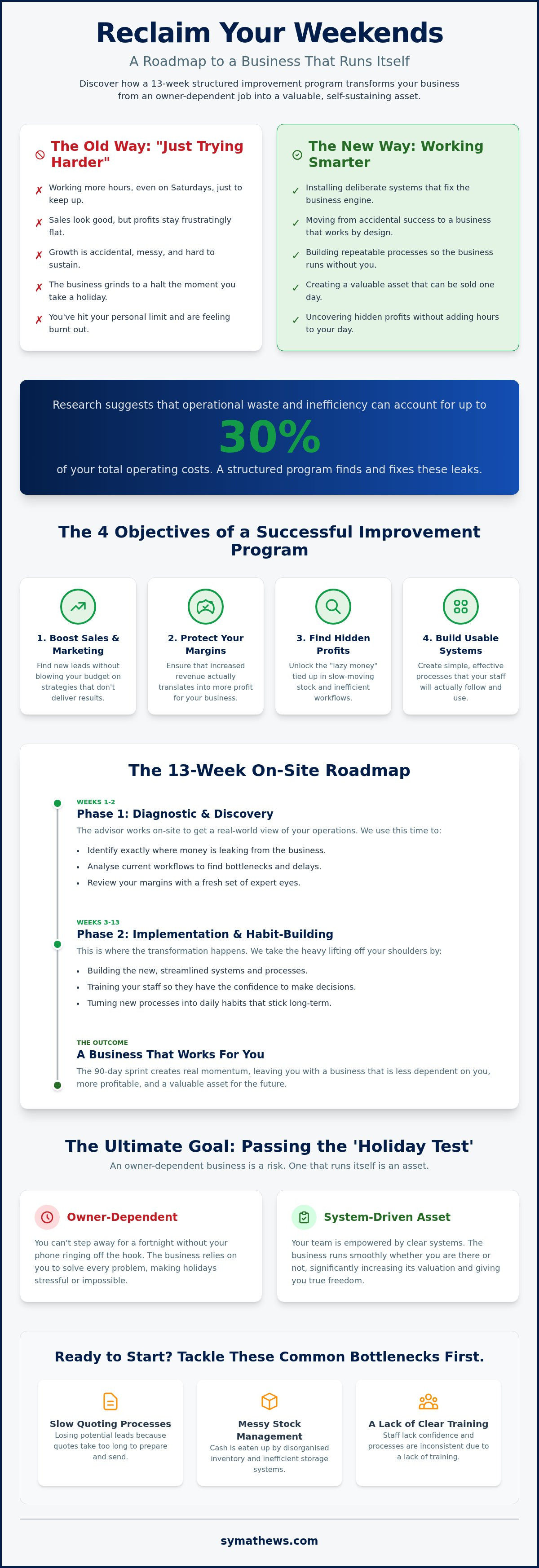
A structured business improvement program changes the game by installing deliberate systems. An external advisor sees the blind spots you're too close to notice. Research suggests waste and inefficiency can account for as much as 30% of operating costs. Finding those leaks isn't about effort; it's about perspective. You need a partner to help build repeatable conditions so the business doesn't grind to a halt the moment you take a holiday.
The 4 Objectives of a Successful Improvement Programme
A structured business improvement program focuses on four specific pillars. It's not about doing everything at once. We start by boosting your sales and marketing. This means finding new leads without blowing your marketing budget on things that don't work. Then, we look at protecting your margins. It's vital to ensure more revenue actually equals more profit, especially with the 4.75% minimum wage increase hitting your payroll.
The third objective is finding hidden profits. This is the "lazy money" sitting in your current operations. It might be tied up in slow stock or inefficient workflows. Finally, we build systems. These are usable processes that keep things running smoothly. Many leaders find this hard. As Harvard Business School points out in Why Organizations Don't Learn, cultural habits often block real progress. We break those habits together.
Relieving Owner Dependency: The Ultimate Business Asset
How do you tell if your business is owner-dependent? Try the holiday test. If you can't step away for a fortnight without your phone ringing, you have a problem. Whether you're running a workshop in Smithfield or a warehouse in Wetherill Park, owner dependency is the biggest risk to small business valuation. To sell one day, you need a business that works without you in the middle of it.
Implementing a structured business improvement program helps you build systems that staff actually use. We avoid thick manuals that sit on a shelf and gather dust. Instead, we create simple, digital signposts. This gives your team the confidence to make decisions. If you're ready to see where your business stands, a business diagnostic is a great first step.
The 13-Week Roadmap: What to Expect
Thirteen weeks is the sweet spot. It's long enough to see real change but short enough to keep your team engaged. This 90-day sprint creates a natural momentum that a perpetual project just can't match. We don't just send a PDF and hope for the best. A structured business improvement program works because of the hands-on support. Having an advisor on-site at your Smithfield or Parramatta facility beats a grainy Zoom call every time. It allows us to see how your team actually works in the real world. We spot the small habits that cause big delays.
Phase one starts with the diagnostic. In the first fortnight, we find exactly where the money is leaking. We look at your workflows and your margins with fresh eyes. Phase two is all about implementation. This structured business improvement program builds the systems and trains your staff. It's about taking the heavy lifting off your shoulders so you can finally breathe. We turn those new processes into daily habits that stick.
Taking the First Step Toward a Better Business
Before the advisor arrives, it helps to prepare your team. Let them know this isn't about finger-pointing. It's about making everyone's job easier and more profitable. Try to identify your top three bottlenecks. Common ones include:
- Slow quoting processes that lose leads.
- Messy stock management eating your cash.
- A lack of clear staff training.
Knowing these hurdles early helps us hit the ground running. See how our 13-week program works to reclaim your time and find those hidden profits.
Build a Business That Works Without You
Your business is a massive achievement. But it shouldn't be a life sentence. We've seen how a structured business improvement program can turn things around in just 13 weeks. By focusing on clear objectives and building systems your staff actually follow, you can finally reclaim your weekends. You get dedicated on-site support across Greater Sydney to help find the money already sitting in your operations.
It's about moving from owner-dependency to genuine freedom. You deserve a business that thrives whether you're at your desk or on a beach. It's time to stop the burnout and start the growth. Take that first step today and see what's possible when you have a clear roadmap. Find your hidden profits with our 13-week program. We're ready when you are.
Common Questions About Business Improvement
How long does a structured business improvement program typically take?
Our structured business improvement program runs for exactly 13 weeks. We find this timeframe is the sweet spot for a 90-day sprint. It's long enough to build new habits but short enough to keep your team motivated. You get a clear, time-bound roadmap with specific milestones. This ensures the project doesn't drag on forever without showing real results on your bottom line.
What is the difference between a business coach and a business advisor?
A business advisor is a hands-on partner who focuses on outcome-based solutions. While a coach might talk about your mindset, an advisor looks at your strategy and systems. We come to your site in places like Wetherill Park to see how things actually work. It's about providing accountability and practical tools rather than just general motivation or vague advice over a coffee.
Will I need to change my entire staff to see results from the program?
You definitely don't need to sack your team to see an improvement. In fact, a structured business improvement program is designed to make your existing staff more effective. We build usable systems that people actually follow. By removing bottlenecks and providing clear training, your team can take the load off your shoulders. This reduces owner dependency without needing a whole new roster of employees.
How do you find "hidden profits" in a business that is already profitable?
Hidden profits are often tucked away in inefficient workflows or poor margin protection. Even profitable businesses can have waste accounting for up to 30% of operating costs according to industry research. We look for "lazy money" in areas like slow stock management or outdated quoting processes. Finding these leaks means you keep more of the revenue you're already making without having to find new customers.

Article by
Sy Mathews
Sy Mathews is practical, down-to-earth and hands-on. He has owned and run businesses in Sydney and Melbourne at various times over the last fifty years, created, operated and sold them to larger companies in tourism, logistics, aviation, he understand the 'hands-on' of business ownership and the challenges it presents. He is motivated to assist owners to get out from under the burden of running and owning, into the freedom that independent business owners deserve to enjoy.
General information
Our articles are intended as general information. We provide mature, on-site advisors who can tailor solutions specifically for your business. We do not offer financial or legal advice, we recommend speaking to a specialist in those areas.


