
If you disappeared for a month today, would your Sydney business still be there when you got back? Most owners in places like Parramatta or Campbelltown feel like the glue holding every single moving part together. You're likely working 60 hours a week and missing out on family dinner because the chaos never stops. It's a common trap, but you're probably wondering how to build a business that runs itself without everything collapsing the moment you head to the coast for a break.
We agree that being the bottleneck is exhausting. You didn't start this journey to be a slave to your own desk. This guide shows you the exact structural shifts needed to transform your business from an owner-dependent grind into a self-sustaining asset in just 13 weeks. You'll learn how to find hidden profits and organise usable systems that your staff actually follow. We're going to walk through the roadmap to reclaiming 20 hours of your week while your business keeps growing without you.
Key Takeaways
- Identify the owner-dependency trap and why being the "glue" is actually stalling your growth in Sydney.
- Discover how to build a business that runs itself by replacing dusty manuals with living, usable systems.
- Shift your team from simply performing tasks to taking full ownership of your business results.
- Follow a structured 13-week roadmap to uncover hidden profits and reclaim 20+ hours of your week.
- Learn how on-site advisory support can help you implement these changes without the usual stress.
The Owner-Dependency Trap: Why Your Business Can’t Breathe Without You
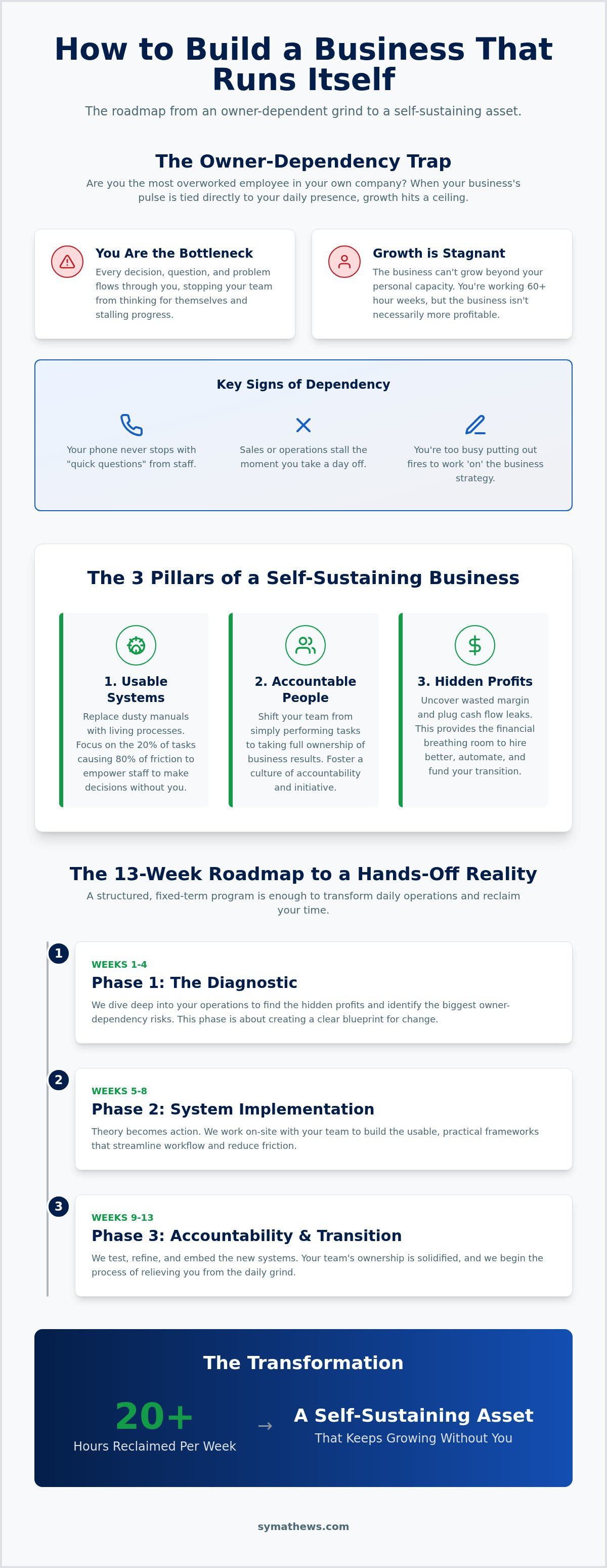
Owner dependency is a bit like a leash. Your business's pulse is tied directly to your daily presence. If you aren't there to push the buttons, the machine stops. This is the ultimate trap for many in Western Sydney. You've built something great, but it's fragile. When you start looking at how to build a business that runs itself, you have to admit that your expertise might be the very thing holding you back.
In Parramatta or Liverpool, we see this "Bottleneck Effect" everywhere. You're the expert. You know the clients. You know the "secret sauce." Because of this, every decision flows through you. Your team stops thinking for themselves because they know you'll just step in and fix things. Growth hits a ceiling because you only have so much energy. You're flat out, but you aren't necessarily profitable.
Working "on" the business feels like a luxury you can't afford. You're too busy putting out fires in the workshop or office to think about strategy. It’s a cycle that drains your bank account and your spirit. Breaking it requires a total shift in how you view your role as a leader.
Signs You Are the Bottleneck
It's easy to spot once you know where to look. Your phone likely never stops ringing with "quick questions" from staff. Sales might stall the moment you take a day off or head down the coast for a break. If you're the only one who knows how the operations actually work, you aren't really an owner; you're just the most overworked employee in the building.
The Sydney Small Business Reality
The competitive landscape in Wetherill Park and Smithfield is intense. Local owners often feel they must stay on-site to maintain their reputation for quality. However, you can protect that reputation without being there 60 hours a week. By integrating business process automation and clear accountability, you can finally step back. Learning how to build a business that runs itself isn't about doing less; it's about building a structure that does more for you.
The 3 Pillars of a Self-Sustaining Business: Systems, People, and Profit
Building a hands-off operation isn't magic. It's about three solid pillars. When these are in place, you stop being a manager and start being an owner. You're probably wondering how to build a business that runs itself while you're busy on the floor. It starts by looking at your systems, your people, and your bottom line as a single machine.
Pillar one is usable systems. Forget dusty manuals. We want living processes your team actually likes. Pillar two is about people and accountability. You need a team that takes ownership of results, not just a list of tasks. Finally, pillar three is finding hidden profits. You need to identify wasted margins to fund your eventual exit from the daily grind.
Systemising Without the Stress
You don't need to document every tiny thing. Focus on the 20% of tasks that cause 80% of the friction. These are the "functional signposts" that allow staff to make decisions without calling you every five minutes. It makes life easier for everyone. For more on this, you can check out our latest insights on business systems.
When your team has a clear path, they stop guessing. This clarity is a huge part of how to build a business that runs itself. It gives you the space to think about the big picture instead of the next invoice.
Uncovering Hidden Profits
You can't step back if the cash flow is tight. We look at your margins to find where cash is leaking in your current workflow. Often, improving sales efficiency provides the breathing room you need to hire better or automate more. A business advisory service can help spot these opportunities because you're often too close to the work to see them. It's about making the business work for you, rather than you working for it.
The 13-Week Roadmap: Moving from Theory to a Hands-Off Reality
You don't need years to fix your workflow. A structured 13-week program is enough to see a real shift in your daily operations. This isn't about starting a new side hustle from scratch. It's about fixing the machine you've already built. This is how to build a business that runs itself without losing your momentum or your mind.
The journey happens in three distinct phases. Phase 1 (Weeks 1-4) is the Diagnostic. We find the hidden profits and identify the biggest owner-dependency risks. Phase 2 (Weeks 5-8) moves into System Implementation. We build usable frameworks on-site with your team. Finally, Phase 3 (Weeks 9-13) focuses on Accountability and Transition. This is where we test the systems and start relieving you of the daily grind.
Why 13 Weeks is the Sweet Spot
Thirteen weeks is long enough to see your sales and margins actually move. It's also short enough to keep your team engaged. Setting a fixed term creates the urgency needed to stop procrastinating on your exit. It gives you a clear finish line to aim for.
The Value of On-Site Advisory in Western Sydney
Generic Zoom coaching often misses the nuances of a busy workshop or office. Having an advisor on-site at your Minto or Fairfield business makes a massive difference. We get stuck into the hard yakka with you to ensure the changes actually stick. It's about getting a fair go with professional guidance that understands the local Sydney market. If you're ready to start, explore how a structured advisory program can change your life.
Your 13-Week Path to Freedom Starts Now
You now have the blueprint for how to build a business that runs itself. We've explored how to break the owner-dependency trap and set up the three pillars. Moving from being the bottleneck to becoming a true owner is a structural shift. It's about making your business a self-sustaining asset. Your business should work for you, not the other way around.
We provide dedicated on-site support across Western Sydney. Our structured 13-week program focuses on owner freedom. We find hidden profits and improve your margins. This isn't generic advice. It's about getting real results on the ground. We help you build frameworks that your staff actually follow.
Stop working 60 hours a week. You can start enjoying the rewards of your effort. Book your 13-week business transformation with SY Mathews today. You've done the hard work of building this business. Now it's time to let it work for you. We look forward to helping you reclaim your time.
Frequently Asked Questions
How long does it really take to make a business run without the owner?
You can see significant structural shifts in just 13 weeks. While building a legacy takes time, this specific period allows you to implement usable systems and find hidden profits. It is a fixed term that creates the urgency needed to stop being the bottleneck. By the end of this roadmap, you should start reclaiming 20 or more hours of your week.
Can a small service-based business in Sydney actually be systemised?
Yes, any service business from Wetherill Park to Parramatta can be organised for freedom. It isn't about complex manuals that nobody reads. We focus on "functional signposts" that help your team make decisions on the floor. This is a key part of how to build a business that runs itself. You simply need processes that staff actually want to follow.
What is the difference between a business coach and a hands-on business advisor?
A coach often provides high-level advice over a Zoom call and leaves the implementation to you. A hands-on advisor gets on-site at your workshop or office to help with the heavy lifting. We work as a partner to build the frameworks and ensure the accountability sticks. It is a more practical approach for busy owners who don't have time for more homework.
How do I find hidden profits in my business if I am already flat out?
Finding leaked cash requires a professional business diagnostic from someone outside your daily grind. When you are flat out, you often miss small inefficiencies in your margins or sales process. We look at your current workflow to see where the money is actually going. Understanding your numbers is essential to how to build a business that runs itself while staying profitable.

Article by
Sy Mathews
Sy Mathews is practical, down-to-earth and hands-on. He has owned and run businesses in Sydney and Melbourne at various times over the last fifty years, created, operated and sold them to larger companies in tourism, logistics, aviation, he understand the 'hands-on' of business ownership and the challenges it presents. He is motivated to assist owners to get out from under the burden of running and owning, into the freedom that independent business owners deserve to enjoy.
General information
Our articles are intended as general information. We provide mature, on-site advisors who can tailor solutions specifically for your business. We do not offer financial or legal advice, we recommend speaking to a specialist in those areas.


