
Why does work grind to a halt the moment you step away from your desk? If you find yourself asking how to stop being the bottleneck in my business, here is the honest truth. Operational bottlenecks stem from centralised decisions, not a lack of hardworking staff.
It's exhausting when every routine task requires your personal tick of approval. You want to take time off without delivery stalling, but your day gets swallowed by constant questions. Watching staff struggle to complete work to your standard only adds to the daily frustration.
You'll discover how to identify operational choke points, delegate real decision-making authority, and build simple systems that run smoothly without you. Here is a clear look at how to establish a self-sufficient team and reclaim your week for strategic growth.
Key Takeaways
- Recognise the warning signs early, from delayed client quotes to pending invoices that only move when you step in.
- Discover how to stop being the bottleneck in my business by swapping open-ended check-ins for clear spending limits and explicit decision boundaries.
- Audit your weekly hours to strip out low-value admin and focus your time on high-impact strategic growth.
- Build simple business systems and fixed operational rhythms that keep quality high without constant daily supervision.
Spotting the Signs You Are the Bottleneck in Your Business
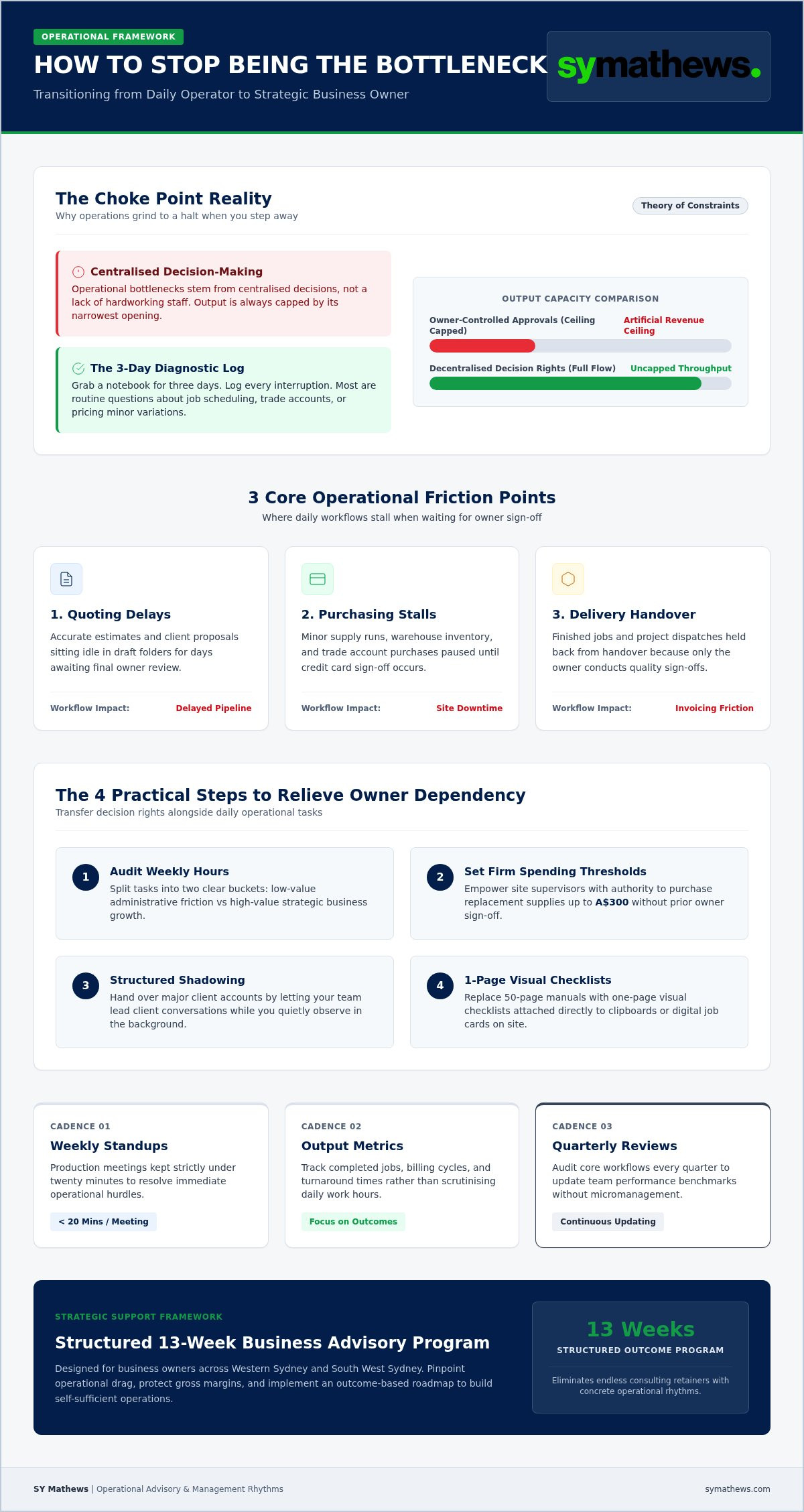
Owner bottlenecking happens when critical work grinds to a halt waiting for your personal say-so. If client quotes sit in your drafts, invoices wait for review, and projects stall on site, you are the choke point. In operations, the Theory of Constraints shows that a system's output is always capped by its narrowest opening. When you control every small choice, your revenue hits an artificial ceiling. Figuring out how to stop being the bottleneck in my business starts with recognising that your daily involvement is slowing down trade.
Diagnosing Choke Points Across Daily Workflows
Grab a notebook for three days. Log every single time a staff member asks for your input. Most of these interruptions are not complex dilemmas. They are routine questions about job scheduling, trade accounts, or pricing minor variations.
Map where approvals create unnecessary friction across your core operations:
- Quoting: Accurate estimates sitting idle for days awaiting your final review.
- Purchasing: Minor supply runs paused until you hand over a credit card.
- Delivery: Finished work held back from handover because only you do quality sign-offs.
Separate genuine risk from everyday operational tasks. High-level strategic commitments need owner oversight. Handling a minor supply delay or approving a standard job sheet does not. Learning how to stop being the bottleneck in my business means handing those low-risk calls back to your team so work keeps moving.
How to Stop Being the Bottleneck in Four Practical Steps
Delegation fails when staff lack clear authority. If you want to know how to stop being the bottleneck in my business, you need clear rules rather than vague handoffs. Research highlights that effective delegation strategies hinge on transferring decision rights alongside daily tasks.
Start by auditing your weekly hours. Split tasks into two clear buckets: low-value administrative friction and high-value strategic growth. Next, set firm spending thresholds. Give your site supervisor authority to purchase replacement supplies up to A$300 without prior sign-off. That single boundary removes dozens of weekly interruptions. When handing over top client accounts, use structured shadowing. Let your team lead client conversations while you quietly observe in the background.
Building Simple Systems Your Team Actually Uses
Skip the fifty-page operations binder. Nobody reads heavy manuals on a busy job site. It's much smarter to build one-page visual checklists. Put them right where daily work happens, attached directly to digital job cards or physical clipboards.
Keep your instructions brief and practical. You can find more practical walkthroughs on the SY Mathews business blog to help tighten operational habits across your team. Learning how to stop being the bottleneck in my business takes time, but clear systems quickly give you your week back.
Transitioning from Operator to Strategic Owner with Structured Support
Putting out fires every morning feels productive, but it keeps you trapped. True operational freedom happens when you replace reactive firefighting with steady rhythms and a clean weekly dashboard. It comes down to transferring initiative to your team so problems get resolved before reaching your desk.
Running an objective business diagnostic helps pinpoint exactly where operational drag eats your profit margins. For business owners across Western Sydney and South West Sydney, breaking that cycle often requires dedicated, on-site business advisory support. Rather than signing up for endless consulting retainers, working through a structured 13-week business advisory program provides a clear, outcome-based roadmap to relieve owner dependency and protect your gross margins.
Embedding Accountability Rhythms into Your Operations
Maintaining momentum without falling back into micromanagement requires practical operating habits:
- Weekly standups: Keep production meetings strictly under twenty minutes to address project milestones and immediate hurdles.
- Output metrics: Track completed jobs, billing cycles, and turnaround times rather than scrutinising daily work hours.
- Quarterly reviews: Audit workflows every quarter to update team benchmarks without hovering over your staff.
Knowing how to stop being the bottleneck in my business comes down to clear accountability. With simple scorecards and fixed meeting cadences, your workshop or office runs predictably whether you are on site or taking a well-earned break.
Take Your Next Step Toward Operational Freedom
Stepping back from daily firefighting doesn't happen by accident. It starts when you replace constant approvals with clear spending limits, simple visual checklists, and steady weekly check-ins. Solving how to stop being the bottleneck in my business is simply about giving your team the tools and trust they need to execute.
Practical business systems unearth hidden profits, protect margins, and let you step away without work stalling. When you're ready for dedicated on-site business advisory support across Greater Western Sydney, a structured plan turns operational independence into reality.
Discover how our 13-week business advisory program helps you build systems that work without you. Your business should give you freedom, not tie you down.
Frequently Asked Questions
How can I tell if I am truly the bottleneck in my business?
You are the bottleneck if operational progress stalls the moment you step out of the room. Look at your team's workflow across your Campbelltown or Liverpool workshop. If basic supplier purchases, customer quotes, or delivery schedules wait for your personal nod, you are holding the business back.
Can my business run smoothly if I do not document every single process?
Yes, your operations can run smoothly without writing massive operational handbooks. Trying to record every tiny detail creates clutter that staff ignore. Instead, build simple one-page checklists for your core repeating workflows. Placing these visual aids directly on site in your Ingleburn or Minto facility delivers consistency without overwhelming your team.
What tasks should a business owner hand over first?
Hand over low-risk operational approvals and routine supplier transactions first. Figuring out how to stop being the bottleneck in my business starts with delegating purchases under set dollar limits and basic client scheduling. Relieving yourself of these repetitive tasks instantly frees up mental capacity for commercial growth and strategic sales.
How long does it take to eliminate owner dependency in an established business?
Eliminating owner dependency takes about three months when you follow a structured plan. Working through a focused 13-week business advisory program gives local business owners across Western Sydney dedicated on-site support to install usable systems, establish clear team accountability, and learn practical steps for how to stop being the bottleneck in my business.

Article by
Sy Mathews
Sy Mathews is practical, down-to-earth and hands-on. He has owned and run businesses in Sydney and Melbourne at various times over the last fifty years, created, operated and sold them to larger companies in tourism, logistics, aviation, he understand the 'hands-on' of business ownership and the challenges it presents. He is motivated to assist owners to get out from under the burden of running and owning, into the freedom that independent business owners deserve to enjoy.
General information
Our articles are intended as general information. We provide mature, on-site advisors who can tailor solutions specifically for your business. We do not offer financial or legal advice, we recommend speaking to a specialist in those areas.


