

If you stepped away from your business for a month right now, would it still be standing when you got back? Most Aussie business owners feel like the only ones who know how things actually get done. You might be wondering how to document business processes without drowning in paperwork. It's a common struggle. Feeling trapped by the daily grind is a choice you don't have to keep making.
This guide shows you how to capture your knowledge. Your team can deliver results without you needing to be on-site every single day. We'll explore how to turn your expertise into a system that runs like clockwork. You will learn to boost profit margins through efficiency and finally get your free time back. Let's build a business that works for you, not the other way around.
Key Takeaways
- Stop being the bottleneck. Get the "secret sauce" out of your head so your team can handle things without you.
- We show you how to document business processes using a simple five-step framework. It all starts with a quick audit of your week.
- Don't overthink the tech. Use voice memos and basic photos to capture your "ugly first draft" and keep the momentum going.
- Systems find hidden profits by cutting out errors. Use your new manuals to train staff in Liverpool or Fairfield with way less stress.
Why Documentation is Your Ticket to Reducing Owner Dependency
Process documentation is just a fancy way of saying you're capturing your "secret sauce". It's the specific magic that makes your Campbelltown business actually work. Right now, that magic probably lives entirely in your head. That's a massive problem. When your knowledge is trapped, you become the ultimate bottleneck. It kills your growth and eats your profit margins because nothing moves forward without your personal say-so. You end up working for your business instead of the business working for you.
Learning how to document business processes isn't about creating corporate red tape. It's about buying back your time. You might feel burnt out or like you're missing too many weekend games or family dinners in Macarthur. It's a heavy weight to carry every single day. Documenting your processes is the only way to transform from a business "doer" into a business "leader". It gives your team the confidence to step up while you finally take a breather. Knowing how to document business processes is the difference between owning a stressful job and owning a valuable asset.
Identifying Your "Secret Sauce" in Local Operations
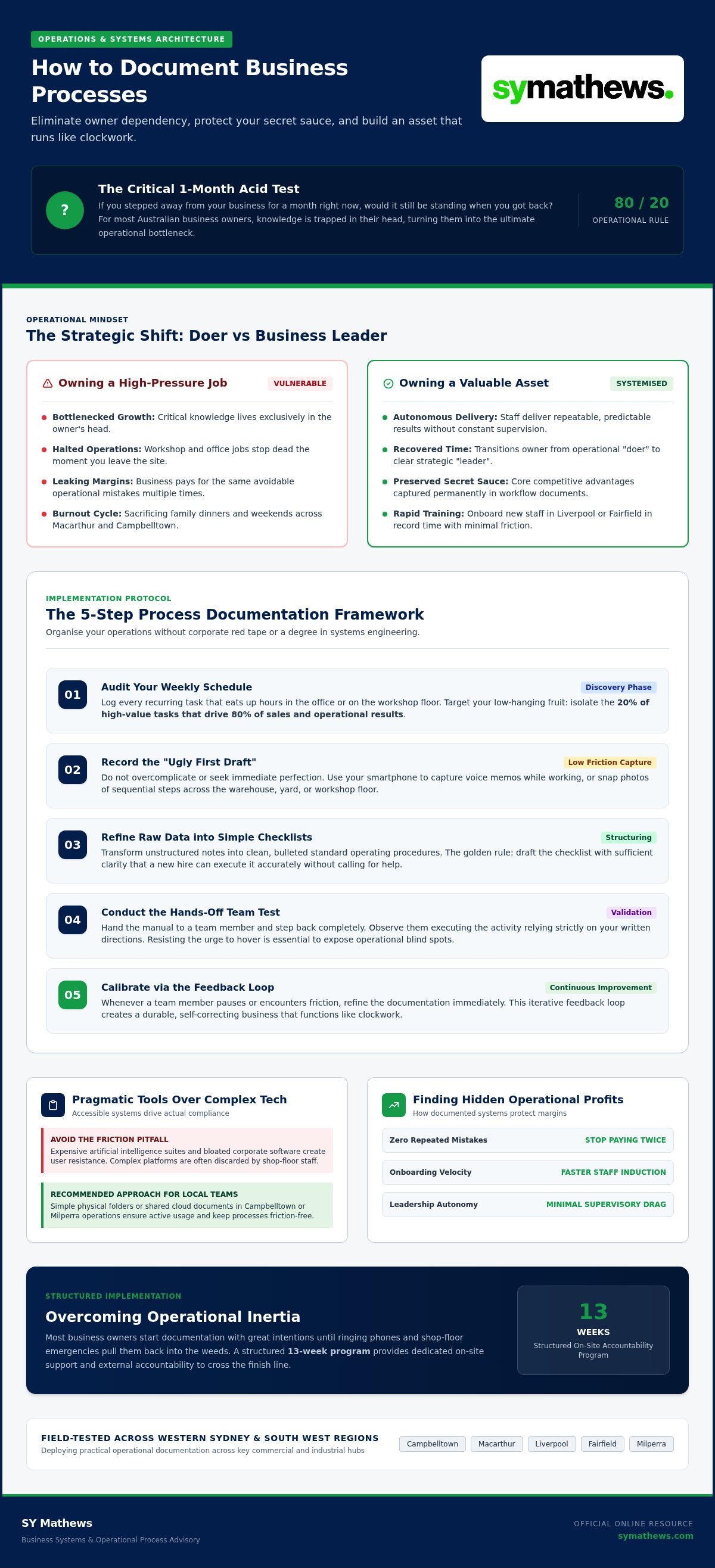
Start by spotting the critical tasks that currently require your personal "magic touch". Think about the jobs in the workshop or the office that grind to a halt when you aren't there. These are your high-value activities. They directly impact your sales and your bottom line. You don't need to write a novel. Just identify the 20% of tasks that deliver 80% of your results. If a task makes the phone ring or keeps the profit coming in, it belongs in your new system. You can find more tips on our blog to help you get started.
A Simple 5-Step Framework to Organise Your Operations
Organising your business doesn't need to be a massive headache. You can learn how to document business processes without a degree in systems engineering. Start by auditing your week. Note down every recurring task that eats your time. These are your low-hanging fruit. Next, record an "ugly first draft". Don't worry about being perfect. Just grab your phone. Use voice memos while you work or snap photos of the steps in the workshop.
Once you have the raw info, refine it into a simple checklist. Write it so a new hire could follow it without calling you for help. The final step is the true test. Hand that checklist to a team member and watch them perform the task using only your notes. If they get stuck, your documentation needs a tweak. This feedback loop is vital for creating a business that runs like clockwork.
Choosing the Right Tools (Beyond Fancy Software)
You don't need expensive AI tools or complex software to get results. For a small team in Milperra or Campbelltown, a simple physical folder or a shared cloud document often works best. It's about accessibility. If the system is too complex, nobody will use it. You can find more tips on how to document business processes and build robust systems on the SY Mathews blog. Keeping things basic ensures your team actually follows the plan while you focus on strategy. If you're feeling stuck on where to start, a business diagnostic can help pinpoint exactly which systems need work first to free up your schedule.
Turning Your Systems into a Profit-Making Machine
Systemised businesses are simply more profitable. They don't leak cash through avoidable mistakes or redundant steps. When you master how to document business processes, you stop paying for the same error twice. It's about finding those hidden profits tucked away in your daily operations. You can finally train a new team member in Liverpool or Fairfield in record time. They get up to speed faster, and you spend less time hovering over their shoulder. It's less stress for everyone involved.
There is a massive psychological shift that happens here. You stop seeing your business as a high-pressure job you have to show up to every single day. Instead, it becomes a valuable asset that you own. It functions smoothly whether you are on-site or taking a well-earned break. This is the goal. You want a business that delivers consistent results and healthy margins without needing your constant supervision.
Moving from "Doing" to "Leading" with a Structured Program
Most owners start the documentation journey with great intentions. Then, the phone rings or a project goes sideways, and the manual gets pushed to the back burner. It's hard to do this alone while running the show. This is why on-site support is a game changer. A structured 13-week program provides the external accountability you need to actually cross the finish line. It turns the idea of how to document business processes into a tangible, working system. It is the logical next step for owners ready to reclaim their time. You can explore more about system building on our blog. Having a dedicated partner ensures your "secret sauce" is finally safe and usable.
Build a Business That Actually Works for You
Capturing your "secret sauce" is the only way to stop being the bottleneck. We have looked at the framework you need to start today. Understanding how to document business processes is the first step toward a business that runs like clockwork. It is about moving from a daily grind to true leadership. You deserve a business that serves you.
If you're ready to reclaim your time, you don't have to do it alone. We provide dedicated on-site support across Western Sydney through a structured 13-week framework. Our focus stays on your sales, your margins, and your personal freedom. Ready to reclaim your time? Explore our 13-Week Business Advisory Program. It is time to build a business that supports your life rather than consuming it. We're excited to see what you build next.
Frequently Asked Questions
How do I find time to document processes when I am already flat out?
Start by recording tasks while you are actually doing them. You don't need a dedicated day off to learn how to document business processes. Just use voice memos or snap photos on your phone as you work through a job. Our on-site support in Campbelltown helps you fit these small habits into your existing routine without feeling overwhelmed or adding to your burnout.
What is the best format for business process documentation?
The most effective format is the one your team finds easiest to follow. For a busy team in Ingleburn or Minto, a simple checklist or a quick video usually beats a 50-page manual. Keep your instructions short and punchy. Focus on clear inputs and outputs. A shared cloud folder or a physical binder in the workshop is often all you need.
Should I document every single thing that happens in my business?
Definitely not. Focus only on the 20% of core tasks that generate 80% of your profit. You don't want to create unnecessary bureaucracy for your team in Wetherill Park. Focus on the high-value workflows that currently rely on your personal "magic touch". Learning how to document business processes effectively means knowing what to leave out so the important stuff stays clear.
How do I get my staff in Western Sydney to actually use the systems I create?
Get your team involved in the system building process. When your staff in Liverpool or Smithfield help write the checklists, they are far more likely to follow them. Explain how these systems reduce their stress and prevent annoying errors. Our 13-week program builds the accountability needed to make these systems a natural part of your daily Western Sydney operations.

Article by
Sy Mathews
Sy Mathews is practical, down-to-earth and hands-on. He has owned and run businesses in Sydney and Melbourne at various times over the last fifty years, created, operated and sold them to larger companies in tourism, logistics, aviation, he understand the 'hands-on' of business ownership and the challenges it presents. He is motivated to assist owners to get out from under the burden of running and owning, into the freedom that independent business owners deserve to enjoy.
General information
Our articles are intended as general information. We provide mature, on-site advisors who can tailor solutions specifically for your business. We do not offer financial or legal advice, we recommend speaking to a specialist in those areas.


