

Your business shouldn't stop because you decided to take a Sunday off. If everything breaks the moment you step away, you don't actually own a business. You own a very demanding job. It's a common trap. You're the only one who knows how things work. You're burnt out. There are never enough hours to work on the big picture. Creating standard operating procedures for small business often feels like a dry, corporate chore. It doesn't have to be that way.
This guide will show you how to build simple, usable systems that stop your business from relying entirely on you. You'll learn how to document your processes without the headache. We'll explore how to ensure consistent quality and find hidden profit margins. It's a fair dinkum look at making operations more efficient. Let's build a roadmap to scale so your business runs smoothly even when you're not on-site.
Key Takeaways
- Turn your daily tasks into simple recipes. Stop being the bottleneck and get your Sundays back.
- Focus on the "cock-ups" first. Start creating standard operating procedures for small business by fixing the tasks that cause the most stress.
- Use the 'Record, Refine, Repeat' method. It's a low-stress way to build systems that your team will actually use.
- Find hidden profits in your current setup. Better systems reduce waste and help your business run smoothly without you on-site.
Why Your Small Business is Flat Out Without Standard Operating Procedures
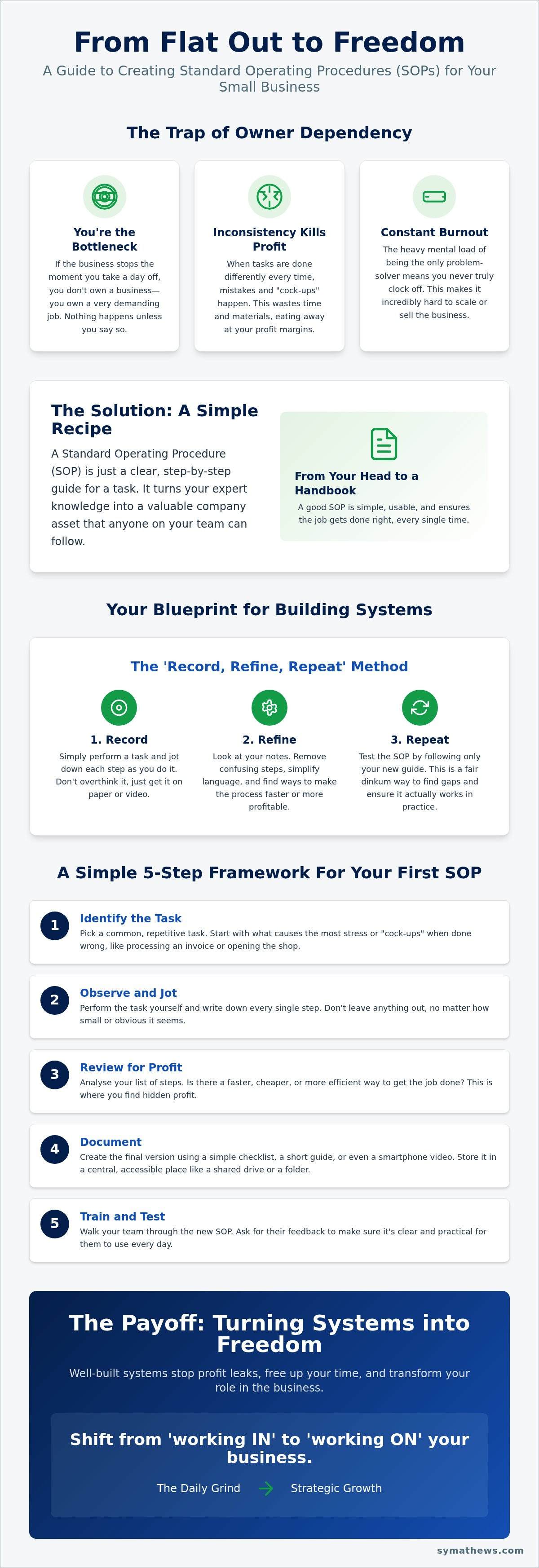
Think of a Standard Operating Procedure as a simple, step-by-step recipe for your business. It is just a clear guide on how a task is done in your shop or office. Creating standard operating procedures for small business doesn't need to be fancy. It just needs to be usable. If your team can't follow it, it's just a stack of paper.
Without these recipes, you become the bottleneck. This is called owner dependency. It means nothing happens unless you say so. You spend your day answering the same questions. It’s exhausting. You end up flat out just keeping the lights on. It stops you from actually growing. You're too busy doing the work to improve the work.
Inconsistency also hides your profits. When tasks are done differently every time, mistakes happen. You waste materials. You waste time. These are hidden costs that eat your margins. Good systems stop the leak. They ensure the job is done right every single time, whether you are on-site or at the beach.
The Real Cost of Keeping it All in Your Head
The mental load of being the only problem solver is heavy. You never truly clock off. If your business relies on your brain alone, it is incredibly hard to sell or scale. A buyer wants a machine that works, not a job they have to learn from your memory. Creating standard operating procedures for small business turns your knowledge into an asset. It makes your company more valuable and less stressful. SOPs create a stable home environment for business growth.
How to Organise Your SOPs Without the Headache
Organising your business doesn't have to be a headache. Start small. Look for the tasks that happen most often. Focus on the ones that cause the most "cock-ups" when done wrong. This is the smartest way to begin creating standard operating procedures for small business without feeling overwhelmed.
Use the 'Record, Refine, Repeat' method. First, record the task as you do it. Don't overthink the details yet. Next, refine the steps to remove waste or confusion. Finally, repeat the task using only your notes to test for gaps. Keep your language informal. If a guide is too wordy, your team won't use it. You can explore more about business systems to see how these fit into a wider strategy.
Choose a format that suits your style. A simple checklist or a quick video shot on a smartphone works wonders. For more structured help, this Writing Guide for SOPs offers a solid foundation for your documentation.
A Simple 5-Step Framework for Your First SOP
Creating standard operating procedures for small business is easier with a clear plan. Follow these five steps to get your first one done today:
- Identify the task: Pick something common, like opening the shop or processing an invoice.
- Observe and jot: Perform the task yourself. Write down every single step, no matter how small.
- Review for profit: Look at your list. Is there a faster or more profitable way to get it done?
- Document: Save the final version in a central spot, like a shared drive or a physical folder.
- Train and test: Walk your team through it. Ask for their feedback to make sure the guide is fair dinkum and actually works.
Turning Your Systems into Hidden Profits
Better systems do more than just tidy up your office. They directly improve your margins. Every time a mistake is made, it costs you money. Every hour spent fixing a "cock-up" is an hour you can't bill. By creating standard operating procedures for small business, you stop these leaks. You turn wasted time into billable time.
SOPs are the foundation for a business that eventually runs itself. When the team knows exactly how to handle the daily grind, you can step back. You move away from the tools and start focusing on strategy. This is how you grow. It's about building a machine that works while you're not there. You deserve a business that doesn't rely entirely on your physical presence.
Sometimes, you need a bit of a nudge to get started. A structured 13-week program can help you get these systems in place fast. Having an on-site advisor helps find the profits you didn't even realise were missing. They see the gaps you might have missed because you're too close to the action. It's a fresh set of eyes on your operations.
Getting the Right Support in Western Sydney
Local support makes a huge difference. Having someone on-site in Campbelltown, Liverpool, or Parramatta means they understand your specific market. SY Mathews helps you make the shift from 'working in' your business to 'working on' it. It's about taking control of your time and your future. We focus on measurable results that actually move the needle.
Don't let another month slip by in a blur of burnout. Take the first step toward a more organised and profitable future today. You can check out our latest blog posts for more tips on business systems and strategy. It's time to build a business that serves you, not the other way around.
Take the Next Step Toward Freedom
Your business should serve you, not the other way around. You now have a clear path to stop being the bottleneck. By creating standard operating procedures for small business, you build a foundation that works while you're off-site. It starts with recording the daily tasks and refining them for better margins. This is how you move from the tools to the strategy.
We offer dedicated on-site support across Western Sydney to help you find those hidden profits. Our 13-week program provides outcome-based solutions to improve your sales and relieve owner dependency. It's about making your hard work count. Ready to reclaim your time? Discover our 13-week advisory program. You've done the hard yards. Now it's time to let your systems do the heavy lifting.
Frequently Asked Questions
What is a Standard Operating Procedure (SOP) in simple terms?
An SOP is essentially a step-by-step recipe for how a specific task is done in your business. It takes the "how-to" out of your head and puts it on paper. This ensures that whether you’re there or not, the work meets your standards. It covers everything from opening the shop to handling a customer complaint.
How long does it take to create SOPs for a small business?
The time required for creating standard operating procedures for small business varies depending on your complexity. You don't need to do everything at once. Start with one core task a week. Most owners find that documenting a single process takes about thirty to sixty minutes. It is a small investment for a massive long-term gain in your daily free time.
Do I really need SOPs if I only have a small team?
Yes, especially if you have a small team. When only one or two people know how a critical task works, your business is at risk. If someone gets sick or leaves, everything stops. SOPs ensure consistency and make training new staff much faster. They allow your small team to punch above their weight by working with a high level of professional efficiency.
What happens if my staff don't follow the new procedures?
If staff aren't following the steps, it usually means the procedure is too complicated or not fair dinkum. Ask them for feedback. They are the ones doing the work, so they often know a better way. When you involve your team in creating standard operating procedures for small business, they are much more likely to take ownership and follow the rules.

Article by
Sy Mathews
Sy Mathews is practical, down-to-earth and hands-on. He has owned and run businesses in Sydney and Melbourne at various times over the last fifty years, created, operated and sold them to larger companies in tourism, logistics, aviation, he understand the 'hands-on' of business ownership and the challenges it presents. He is motivated to assist owners to get out from under the burden of running and owning, into the freedom that independent business owners deserve to enjoy.
General information
Our articles are intended as general information. I personally work on-site with clients to provide tailored solutions specifically for the business.
I do not offer financial, investment or legal advice. If required, I can assist in recommending professionals in those areas. I take no fees or commissions from third parties, my recommendations are authentic and carry no hidden costs.


