

What if your business was worth significantly more just because you stopped showing up? It sounds backwards, but getting your business ready to sell actually starts with making yourself redundant. If everything relies on you being in the office or on the tools, you haven't built an asset; you've built a very demanding job. Most Aussie owners find that buyers aren't looking for a person. They're looking for a machine that prints money without the original inventor at the controls.
It's frustrating when your hard work is hidden behind messy margins or undocumented systems that only live in your head. We know it's a lot to juggle, especially with the 2027 CGT changes on the horizon and the booming market in Western Sydney. This guide shows you how to polish those operations, clarify your financial records, and pass the "bus test" with flying colours. You'll learn exactly how to boost your margins and document your processes so a new owner can step in with confidence. We'll walk through the specific steps to turn your daily grind into a high-value exit.
Key Takeaways
- Pass the 'bus test' by proving your business can thrive without you at the wheel.
- Discover how documented systems turn your daily grind into a repeatable machine that buyers actually want to own.
- Tidy up your financial records and separate personal expenses to uncover hidden profit margins.
- Start getting your business ready to sell by creating operational 'curb appeal' that stands out in the market.
- Navigate the Western Sydney landscape and learn what local buyers in industrial hubs are looking for right now.
Why Curb Appeal and the 'Bus Test' Determine Your Sale Price
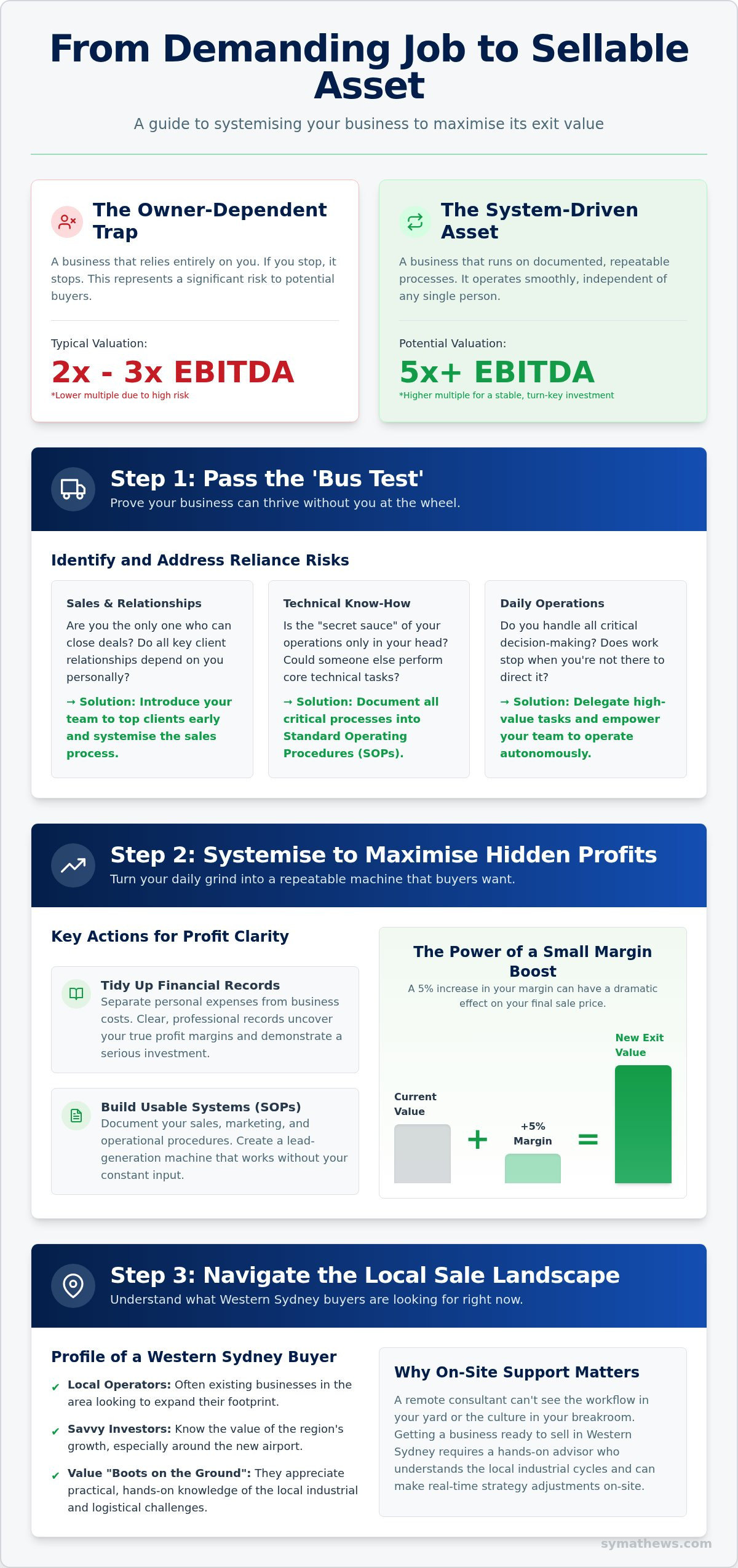
Selling a business is often compared to selling a house. You wouldn't list your home with long grass and a peeling front door. In the business world, curb appeal isn't about your logo or the paint in the foyer. It's about how your operations look to a total stranger. A buyer wants to see a machine that's already running smoothly, not a project that needs a massive overhaul. They're looking for a turn-key asset they can trust from day one.
One of the quickest ways to check your appeal is the "bus test." Ask yourself: if you were hit by a bus tomorrow, would the business still thrive? If the answer is no, your value just plummeted. Buyers pay a premium for stability. When they look at understanding business valuation, they're looking at risk. A business that stops when you stop is a massive risk. Owner dependency is the biggest risk to a successful exit.
This is why getting your business ready to sell often means making yourself less important. Businesses that rely heavily on the owner usually sell for much lower multiples. You might see a price tag of 2x or 3x EBITDA for a personality-led business, whereas a systemised company might fetch 5x or higher. You want to be the architect, not the engine. If you're looking for more tips on staying focused during this shift, check out our latest posts on the SY Mathews blog.
Identifying Your Reliance Risks
Start by looking at where the bottlenecks are. Are you the only person who can close a deal? If all the key client relationships live in your pocket, a buyer will worry those clients will leave when you do. You need to introduce your team to your top accounts early. It's about building trust in the brand, not just in you personally.
Technical "know-how" is another common trap. If the secret sauce is only in your head, the business has no value without you. Documenting these steps is a core part of getting your business ready to sell. Create a plan to delegate your high-value tasks at least six months before you list. This proves to a buyer that the wheels keep turning, regardless of who is in the driver's seat.
Systemising Operations to Maximise Hidden Profits
Buyers don't just buy your past performance. They buy your future cash flow. To get a top-tier price, you need to prove your profits aren't a fluke. This starts with your books. It's time to tidy up the ledger and separate your personal life from the business. If the family car or your weekend fuel is still on the company card, it's blurring your true margins. Clear, professional records make your business look like a serious investment rather than a hobby.
Finding hidden profit is the next step in getting your business ready to sell. Look for high-margin services that can be scaled without you. Many owners overlook these goldmines because they're stuck doing low-margin "busy work." We recommend a 13-week sprint to untangle these knots. A fixed timeframe creates real accountability and momentum. It's much more effective than a vague "one day" plan that usually stays in the too-hard basket.
Building Usable Systems
Move from "that's just how we do it" to written Standard Operating Procedures (SOPs). Focus on your sales and marketing systems first. You want a lead-generation machine that works while you're off the clock. You can use on-site advisory services to build these systems while you keep running the shop. This ensures the documentation is practical and actually used by your team every day.
Boosting Your Margins for Valuation
Review your supplier contracts and update your pricing models. Many Aussie businesses haven't adjusted their rates to match inflation or rising costs. A small, 5% increase in your margin can skyrocket your exit multiple. According to the official government guide to selling your business, sustainable margins are a cornerstone of a solid valuation. It's about showing the buyer there's still plenty of juice left in the lemon.
If you want to see where your business stands, our business diagnostic can help identify those easy wins before you list.
Navigating the Local Sale Landscape in Western Sydney
Western Sydney is a different beast compared to the CBD. If you're running a workshop in Wetherill Park or a logistics hub in Minto, your buyer isn't usually some suit from a glass tower. They're often local operators looking to expand or savvy investors who know the value of the Western Sydney Airport growth. Getting your business ready to sell in this region requires a boots-on-the-ground approach. You need an advisor who understands the traffic on the M5 and the local industrial lease cycles in Campbelltown or Liverpool.
A remote consultant in a different time zone won't cut it here. They can't see the workflow in your yard or the culture in your breakroom. Local, on-site support is vital because it allows for real-time strategy adjustments. This hands-on method helps you tick off every item on a preparing your business for sale checklist while you stay focused on the daily grind. You want a team that knows the Parramatta market as well as you do.
Don't try to fly solo when you're at the finish line. You need a local exit squad. This includes a business advisor for strategy, an accountant for the numbers, and a lawyer for the contracts. Together, they ensure your transition is as smooth as a fresh coat of bitumen. This team approach protects your legacy and your bank account. It's about having people in your corner who know the local landscape inside out.
Tailoring Prep for Your Specific Location
Western Sydney is a competitive employment hub. If you're based in Milperra or Revesby, your staff are your biggest asset. Buyers will look at your retention rates before they sign any paperwork. They want to know the team will stay after you leave. Make sure your physical premises look as sharp as your digital records. A tidy shop floor in a high-demand industrial area shows you take pride in the asset you've built.
Buyers in the Liverpool and Parramatta regions are looking for stability and growth. They want to see that getting your business ready to sell wasn't a last-minute rush. If you want to dive deeper into local market trends, our SY Mathews blog has more insights on the Western Sydney landscape.
Your Exit Starts Today
You've put in the hard yards. Now it's time to turn that effort into a valuable asset. A business that doesn't need you is a business that's easy to buy. Focus on your systems. Tidy up those margins. This is how you secure a price that reflects your years of work. It's about making yourself redundant so the machine keeps humming while you're away.
Getting your business ready to sell is a journey, not a sprint. It's about building curb appeal through repeatable operations and clear financial records. Whether you're in Wetherill Park or Minto, local support makes all the difference. You deserve an exit that feels like a win. A structured plan helps you find those hidden profits before you ever list.
Ready to pass the 'bus test'? Discover our 13-week business advisory program. We provide dedicated on-site support across Western Sydney. Our structured program focuses on finding hidden profits and reducing owner dependency. It's the pre-sale polish your business needs. You've got this. The next chapter is almost here.
Frequently Asked Questions
How long does it take to get a business ready to sell?
It typically takes six to twelve months to get everything in top shape. You want to show at least two solid quarters of improved performance under your new systems. This lead time gives you the space to fix any leaky buckets in your cash flow before a buyer starts poking around.
While you can list a business faster, you'll likely leave money on the table if you rush. Taking the time to standardise your operations ensures you get the highest possible multiple at the finish line.
Can I sell a business that is completely dependent on me?
Yes, but you'll pay for it with a lower valuation. Most buyers will shy away from a business that can't run without the owner's constant input. They're looking for an investment, not a new job where they have to do everything themselves.
Getting your business ready to sell is mostly about proving the team and systems can handle the daily grind. If the business relies on your personal "secret sauce," you need to bottle that sauce into written procedures before you list.
What are the most important documents I need for due diligence?
Buyers will ask for three years of tax returns and clean profit and loss statements. You also need your current lease agreements, employee contracts, and a full list of your documented systems. If these are messy, it signals to the buyer that the business itself might be a bit of a gamble.
Organising these documents in a digital folder early on saves a lot of stress. It shows you're a professional operator who has nothing to hide.
How do I find hidden profits before I talk to a broker?
Look at your individual product margins and cut the dead wood that costs more than it's worth. You can also identify "add-backs" like personal phone plans or vehicle costs that won't be part of the business post-sale. These small changes can significantly boost your bottom line.
Identifying these wins is a key part of getting your business ready to sell. It allows you to present a much healthier financial picture that justifies a higher asking price.

Article by
Sy Mathews
Sy Mathews is practical, down-to-earth and hands-on. He has owned and run businesses in Sydney and Melbourne at various times over the last fifty years, created, operated and sold them to larger companies in tourism, logistics, aviation, he understand the 'hands-on' of business ownership and the challenges it presents. He is motivated to assist owners to get out from under the burden of running and owning, into the freedom that independent business owners deserve to enjoy.
General information
Our articles are intended as general information. We provide mature, on-site advisors who can tailor solutions specifically for your business. We do not offer financial or legal advice, we recommend speaking to a specialist in those areas.


