

What if the most valuable thing you could do for your business was to stop showing up? Most Aussie owners are stuck in the daily grind. You're likely feeling the burnout. Messy systems and inconsistent margins make every day a struggle. It's exhausting to feel like you've built a job rather than a high-value asset.
If you're asking how to increase the value of my small business to secure a clean exit, you're in the right place. We'll show you how to swap the chaos for a maximum sale price. This guide covers the A$2 million CGT concession thresholds and the systems buyers actually want to pay for. We're looking at how to turn your hard work into a payday that reflects your effort.
Key Takeaways
- Focus on operational value. A business that runs without you is worth much more to a buyer.
- Learn how to increase the value of my small business by finding hidden profits. Small margin tweaks lead to a much bigger sale price.
- Document your systems. A clear operations manual makes your business a "plug and play" asset for any new owner.
- Use a structured 13-week program. It is the easiest way to polish your business before you head to market.
Beyond the Books: Why Operational Value Beats a Good P&L
A healthy profit and loss statement is great. It shows you've had a good run. But if you're asking how to increase the value of my small business, you need to look at operational value. This is the ability of your business to generate cash without you being there. It's the difference between selling a machine and selling a hobby.
Buyers pay a premium for certainty. They want documented, usable systems. Any new owner should be able to pick them up on day one. If the "secret sauce" is only in your head, the business is a risk. Investors look for a "plug and play" asset. They want to see that the wheels keep turning while you're at the beach. Systems make your business predictable.
Many founders fall into the owner trap. You might be the best salesperson. Or maybe you're the lead technician. While that feels good for the ego, it's bad for the final valuation. A business that relies on one person's talent is hard to scale. It is even harder to sell. You want to be the architect, not the engine.
The Red Flags Buyers Look for in Western Sydney SMEs
Investors in hubs like Parramatta or Liverpool look for stability. They often spot red flags that owners ignore. Informal supplier deals are a big one. A "mate's rate" handshake doesn't help a buyer who needs a legal contract. It creates uncertainty. Lack of staff accountability is another warning sign. If your team only moves when you're watching, it creates a massive risk post-settlement. Buyers want to see clear KPIs and independent teams. This reduces their fear. It pushes your price up. Fixing these issues is how to increase the value of my small business before the first meeting.
The Pre-Sale Cleanup: 5 Steps to Maximise Your Valuation
Detailing a business is like detailing a car. You want every corner to shine before you list it. If you're looking for how to increase the value of my small business, you have to start with the low-hanging fruit. A clean exit requires a clean operation.
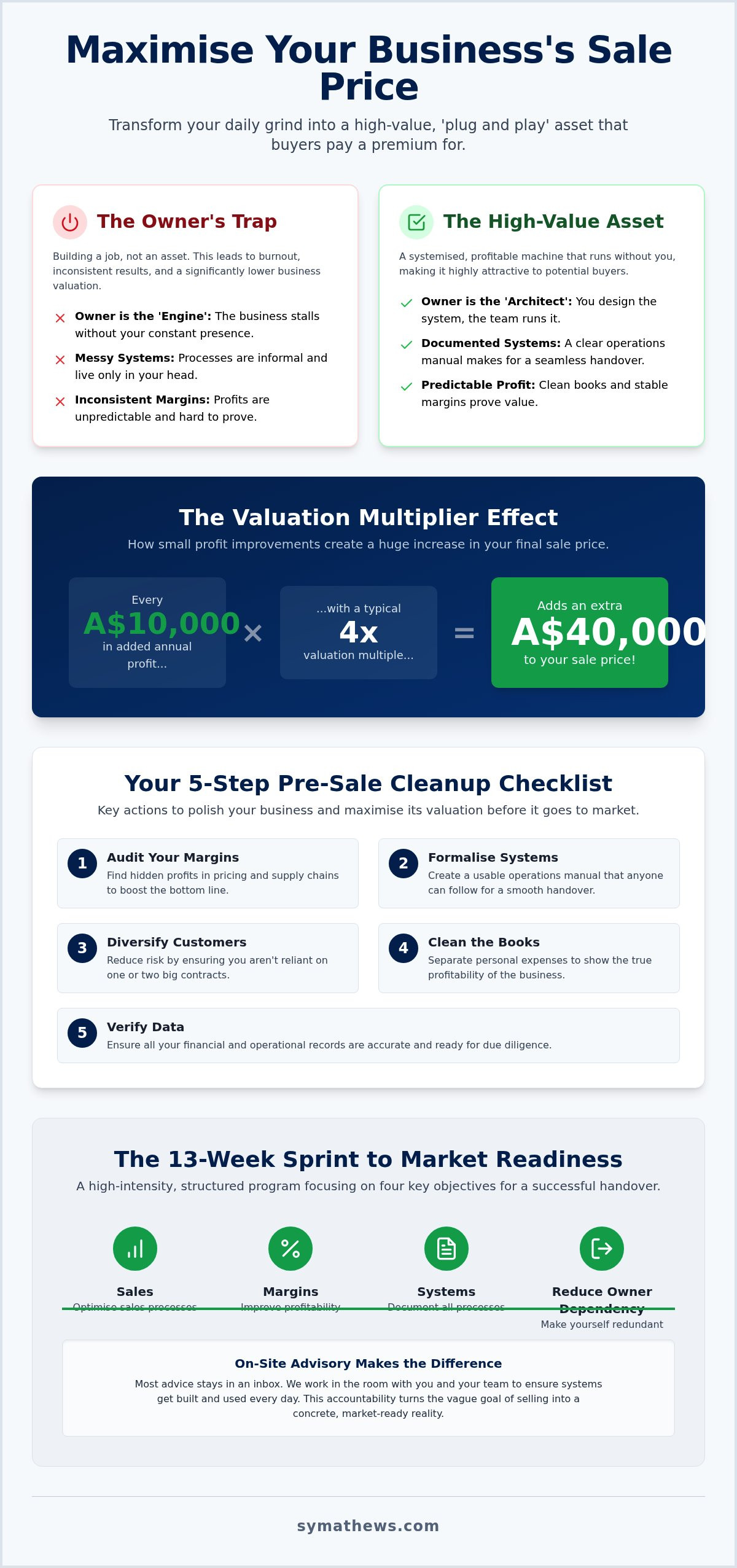
- Audit your margins: Find hidden profits that boost the bottom line immediately.
- Formalise systems: Create a usable manual that anyone can follow.
- Diversify customers: Ensure you aren't reliant on one big contract.
- Clean the books: Separate personal expenses from business costs.
- Verify data: Ensure your records are accurate and ready for review.
Most owners focus on turnover, but buyers only care about profit. Small savings in your supply chain or pricing can add thousands to your final price. Spreading the load across many clients makes your income stream much more attractive to an investor.
Finding Hidden Profits Before the Valuer Arrives
Small tweaks in margins have a massive impact because of how valuations work. Business valuations often use a multiple of earnings. If your business sells for four times its profit, every A$10,000 you save adds A$40,000 to the sale price. It's a high-impact way to boost your result.
Clean up your discretionary spending too. Owners often run personal expenses through the business. While this saves tax now, it lowers your valuation later. You need to "add back" these costs to show the real profit. You can find more tips on margin improvement and profit growth on the SY Mathews blog. Taking a moment for a business diagnostic is a core part of how to increase the value of my small business before the valuer walks through the door.
The 13-Week Sprint: Rapidly Preparing for a Successful Handover
Speed matters when you're ready to move on. A long, drawn-out exit is draining for any owner. We use a high-intensity 13-week sprint to get your operation sorted. This program focuses on four big objectives. We look at sales, margins, systems, and reducing owner dependency. It is the ultimate pre-sale polish for your hard work.
Running a shop is already a full-time job. Adding "exit prep" to your daily list is usually too much to handle. This is where on-site support in Western Sydney hubs like Liverpool or Campbelltown makes a difference. We come to your place of business. We keep you accountable. It removes the pressure of doing it all alone while you're still serving customers. This structured approach is exactly how to increase the value of my small business without burning out before the finish line.
A sprint isn't just about moving fast. It's about moving with purpose. We help you find those hidden profits and turn messy processes into clean, documented manuals. Learning how to increase the value of my small business doesn't have to be a solo mission. By the end of the 13 weeks, you have a business that looks great to any investor. You're not just selling a name. You're selling a functional, profitable machine.
Why On-Site Advisory Makes the Difference
Most business advice stays stuck in an inbox. On-site advisory means we're in the room with you and your team. We make sure systems actually get built and used every day. A fixed-term program gives you a clear deadline. You'll know your business is market-ready by a specific date. It turns a vague dream of selling into a concrete reality. You can find more tips on preparing for a handover on the SY Mathews blog. It's about getting the job done right the first time.
Your Path to a Clean Exit
You've worked hard to build something real. Now it's time to ensure you get the reward you deserve. Moving from a demanding job to a high-value asset requires clean margins. It needs systems that run without your daily input. When you focus on how to increase the value of my small business through operational independence, you change the game for potential buyers.
Our proven 13-week methodology is built for this exact transition. We provide specialist on-site support for Western Sydney owners. This keeps you accountable. It reduces owner dependency. This ensures your business is market-ready by the time the valuer arrives. Book a chat with SY Mathews to start your 13-week pre-sale transformation. You've already done the heavy lifting. Let's finish the job together.
Frequently Asked Questions
How long does it typically take to get a business ready to sell in Australia?
It usually takes 6 to 12 months to prepare properly. This gives you time to show consistent profit growth on your books. For owners in Parramatta and Liverpool, our 13-week sprint accelerates the process. We focus on fixing systems and margins quickly. Starting early ensures you don't rush the financial details. A well-prepared business always gets a better result.
What is the number one thing that devalues a small business during a sale?
Owner dependency is the biggest value killer. If the shop stops working when you're on holiday, it's a risky buy. Investors in Campbelltown or Wetherill Park want an asset that runs itself. Documenting your systems is the fix. Moving from doer to manager is the fastest way to learn how to increase the value of my small business before a sale.
Do I need to tell my employees I am planning to sell my business?
You don't have to tell them right away. Most owners wait until a deal is nearly done. Telling staff too early can cause stress and turnover. This creates a risk for the buyer. It's better to focus on a smooth handover plan first. When the time is right, explain how the new owner will support the team's future in Western Sydney.
Can I improve my business profit margins without increasing my prices?
Absolutely. You can find hidden profits by auditing your supply chain and reducing waste. Owners in Smithfield and Fairfield often find thousands in unneeded overheads. Efficiency is a powerful tool. It allows you to boost your bottom line without scaring off customers with price hikes. This strategy is a core part of how to increase the value of my small business.

Article by
Sy Mathews
Sy Mathews is practical, down-to-earth and hands-on. He has owned and run businesses in Sydney and Melbourne at various times over the last fifty years, created, operated and sold them to larger companies in tourism, logistics, aviation, he understand the 'hands-on' of business ownership and the challenges it presents. He is motivated to assist owners to get out from under the burden of running and owning, into the freedom that independent business owners deserve to enjoy.
General information
Our articles are intended as general information. I personally work on-site with clients to provide tailored solutions specifically for the business.
I do not offer financial, investment or legal advice. If required, I can assist in recommending professionals in those areas. I take no fees or commissions from third parties, my recommendations are authentic and carry no hidden costs.


